For the edition and the establishment shown above. No payment is taken at this stage.
VARIOME PATHWAYS · VOLUME I
The Gospel of Johnphrase by phrase, as eleven Old Latin manuscripts most nearly agree
Proof in preparation
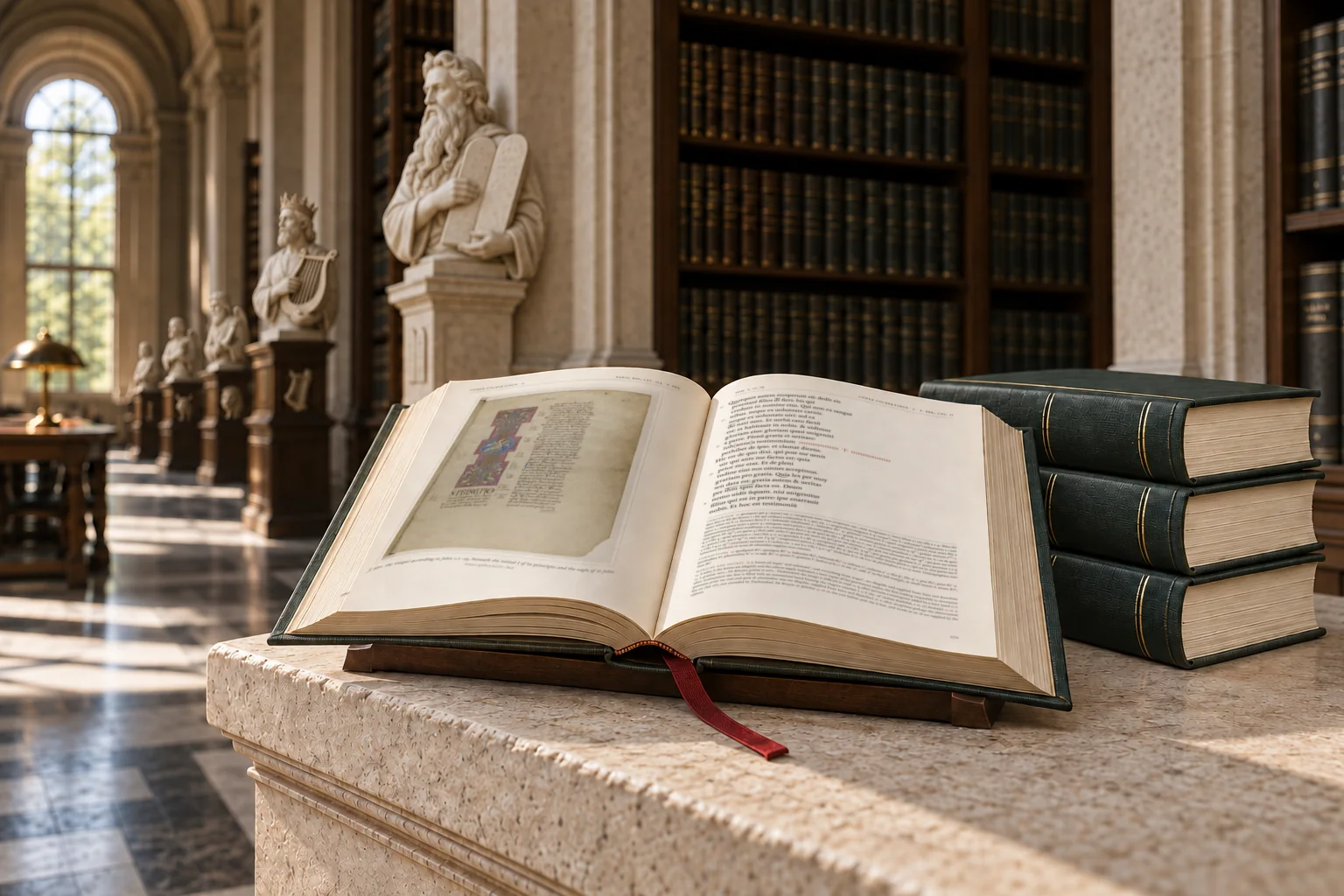
The cover of Volume I.
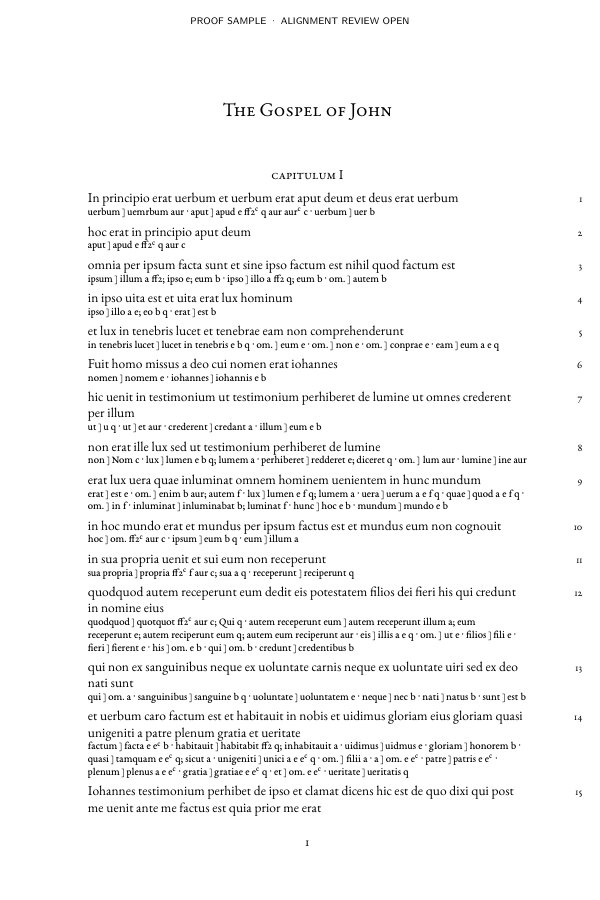
The Gospel of John, along one pathway through eleven Old Latin manuscripts. Every phrase is one that a manuscript reads; no single manuscript reads the whole.
From the published counts to the totals, in one line. Every step behind it is set out below, each marked as a count or an estimate from a source, one of our assumptions, a setting you can change, or a result of the lines above it.
Exact arithmetic from the stated counts, estimates and settings; how certain each input is appears beside it in every step.
Quantity
Value
How it is obtained
Status
A value without ≈ is exact arithmetic, given in full; counts are written out up to a thousand billion. A value marked ≈ is rounded for display, and a very large count is followed by the number of digits it would take written out. “Exact” describes the arithmetic: the status says how certain each input is. Volumes are whole: the printed text is rounded up to the next volume. Each row takes a readable unit (light-years, solar masses); the download uses metres, square metres, kilograms and years, and millimetres for thickness. It gives each value exactly where the page computes it exactly (the Pleromic counts as powers of 25) and otherwise to six significant figures, with the base-10 logarithm of the unrounded value, rounded separately.
Each volume 65 mm thick and 2.3 kg; 640 volumes to a reading gallery; a complete Bible in one volume.
Sources and assumptions
Every surviving copy.
✳
Every difference recorded.
✳
Every reading sourced.
WHY A COMPLETE EDITION
Some things are too important to leave in the footnotes.
Before printing, every Bible was copied by hand, and the copies differ from one another. Scholars call the surviving copies witnesses, and each difference between them a variant. For the New Testament alone, the Institute for New Testament Textual Research in Münster catalogued about 5,700 Greek manuscripts in 2023; in 2015 it counted some 2.1 million catalogued pages.
Printed editions have to choose. In the Letter of Jude, the United Bible Societies’ Greek New Testament (4th edition), made for translators, records 47 variants. The Nestle–Aland edition (28th edition) records 145. The Editio Critica Maior, the largest critical edition — an edition that sets out the evidence for each reading — records 789. When the 560 Greek manuscripts of Jude collated for Tommy Wasserman’s study (2006) were compared word by word, they held 1,694. (The comparison is Peter Gurry’s, 2016.) The figures show how selective each edition is, but the editions draw on different evidence and do not define a variant in the same way: they are not four sizes of one list.
Variome records every one. In genetics, a variome is the complete catalogue of variation within a population. Ours is the Bible’s.
Greek manuscripts of the New Testament, 2023
5,700
Catalogued pages, 2015
2.1 million
Variants in the Letter of Jude: UBS4, the Editio Critica Maior, 560 manuscripts collated
47 → 789 → 1,694
03 / A SPECIMEN OPENING
Half a verse. Three differences. Eight combinations.
The first half of John 1:14 in the Latin Bible before Jerome’s revision, with the Vulgate for comparison: “And the Word was made flesh, and dwelt among us, and we beheld his glory.”
Two of the oldest Latin gospel books differ from each other at three places in the first half of this verse. Each difference is small, and each is attested. The Variorum Edition reproduces every witness as it stands: five here, with four different texts among them. The Plenitude Edition binds every combination of their readings: eight volumes, four of which no witness compared here contains. Both mark every reading with its source.
THE WITNESSES
a
Codex VercellensisVercelli, Archivio Capitolare Eusebiano · p. 182 · second half of the fourth century
et uerbum caro factum est et inhabitauit in nobis et uidimus gloriam eius
b
Codex VeronensisVerona, Biblioteca Capitolare VI · fol. 123r · second half of the fifth century
et uerbum caro facta est et habitauit in nobis et uidimus honorem eius
The three places
factum / facta — “made”, agreeing with the Word or with the flesh
inhabitauit / habitauit — “dwelt within” or “dwelt among”
gloriam / honorem — “glory” or “honour”
VARIOME · THE VARIORUM EDITIONCODEX VERCELLENSIS · a
EVANGELIUM SECUNDUM IOHANNEM · I · 14
et uerbum caro factum est et inhabitauit in nobis et uidimus gloriam eius
and the Word was made flesh, and dwelt within us, and we saw his glory
factum — Codex Vercellensis; also Codex Colbertinus and the Vulgate
inhabitauit — Codex Vercellensis; of these witnesses, only Vercellensis
gloriam — Codex Vercellensis; also Palatinus, Colbertinus and the Vulgate
Codex Vercellensis, as the manuscript gives it.
5 witnesses reproduced4 different texts among them0 constructed
8 volumes bound4 found in a witness compared here4 constructed from attested readings
Letters as transcribed, with u for v; capitals, punctuation and word division normalised, and abbreviations expanded. Transcriptions: Vetus Latina Iohannes, ed. P. H. Burton, J. Balserak, H. A. G. Houghton and D. C. Parker (International Greek New Testament Project, CC BY 4.0).
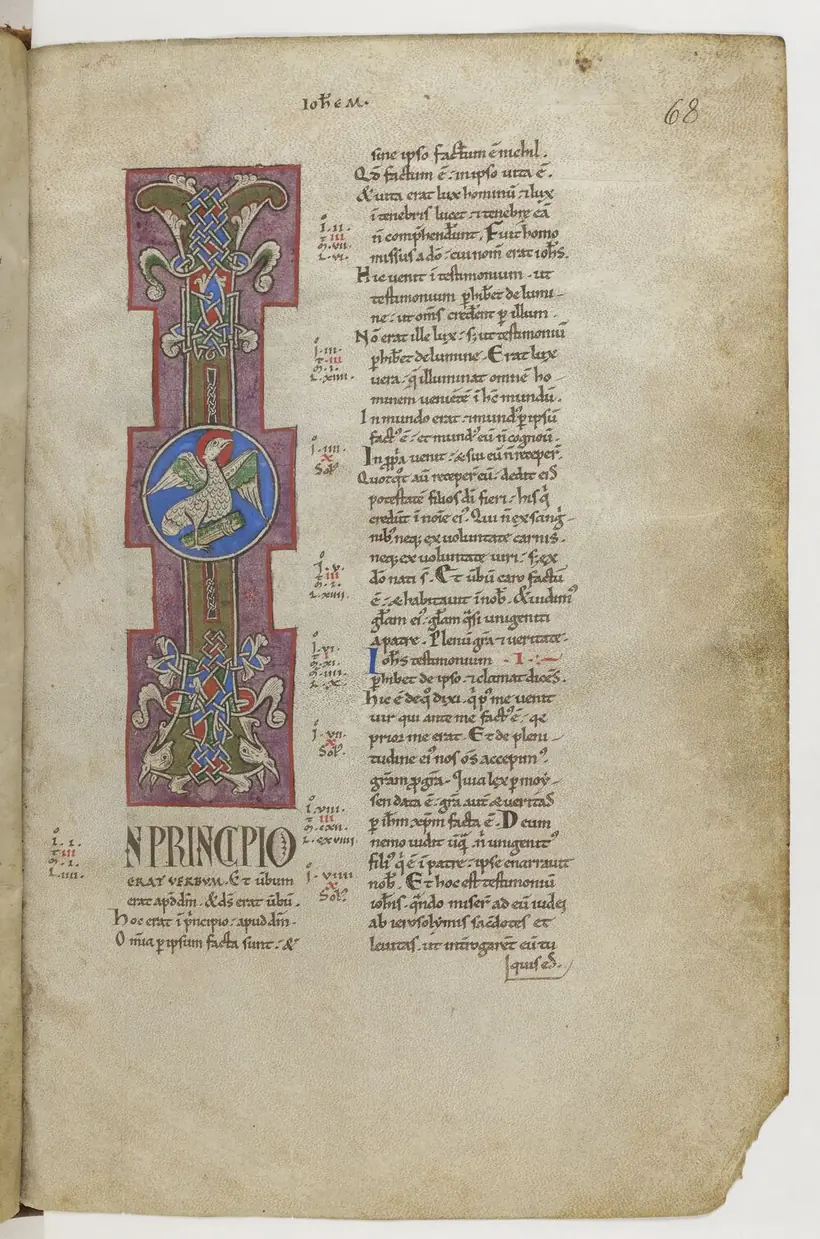
MORE WITNESSESPalatinus, Colbertinus and the Vulgate
Codex Colbertinus, the opening of John. Source gallica.bnf.fr / BnF, lat. 254, f. 68r.
Three more witnesses give the passage. Codex Palatinus, of the fifth century, has the text of Plenitude Volume VII. Codex Colbertinus, copied in the twelfth century and shown here, and the Vulgate, Jerome’s revision (here Codex Amiatinus, as edited by Tischendorf in 1854), have the text of Plenitude Volume III. Among the witnesses compared here, the other four combinations do not occur; every reading in them does.
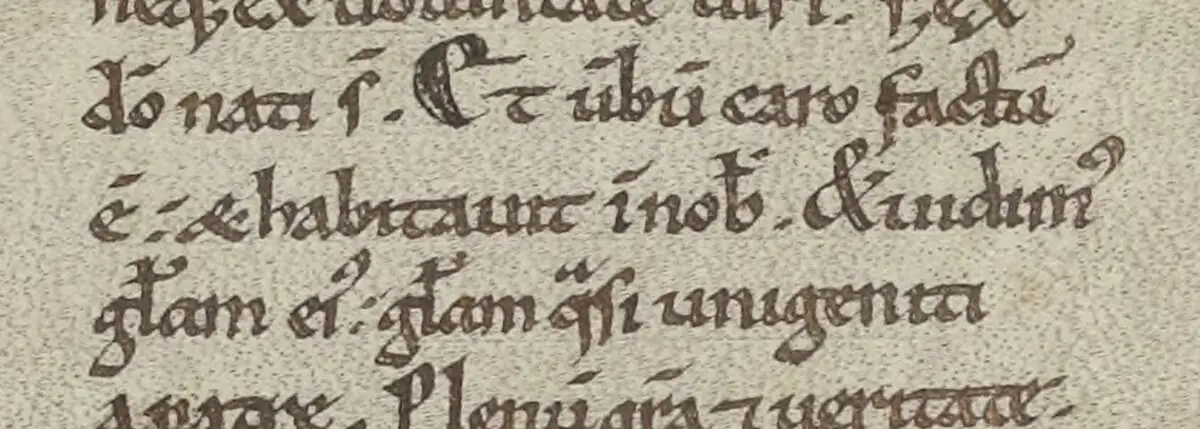
John 1:14 in Codex Colbertinus: Et u[er]bu[m] caro factu[m] e[st]. & habitauit i[n] nob[is]. & uidim[us] gl[ori]am ei[us]. Source gallica.bnf.fr / BnF, lat. 254, f. 68r (detail).
THE COMPACT EDITIONAll eight combinations in one drawing
For clients with limited shelving: the same half-verse drawn once. Every combination is a route through it, and every reading keeps its witnesses. Nothing is bound. Our architects do not recommend it.
The half-verse drawn once. It splits at each of the three places and joins again. Every route through it is one of the eight volumes of the Plenitude Edition. Four routes occur among the witnesses compared here; four do not.
Each feature of the edition answers something that can be seen on a real page. Every manuscript below can be examined online.
Photograph of 1908, Lake facsimile (1911)
CORRECTIONS & SECOND THOUGHTS
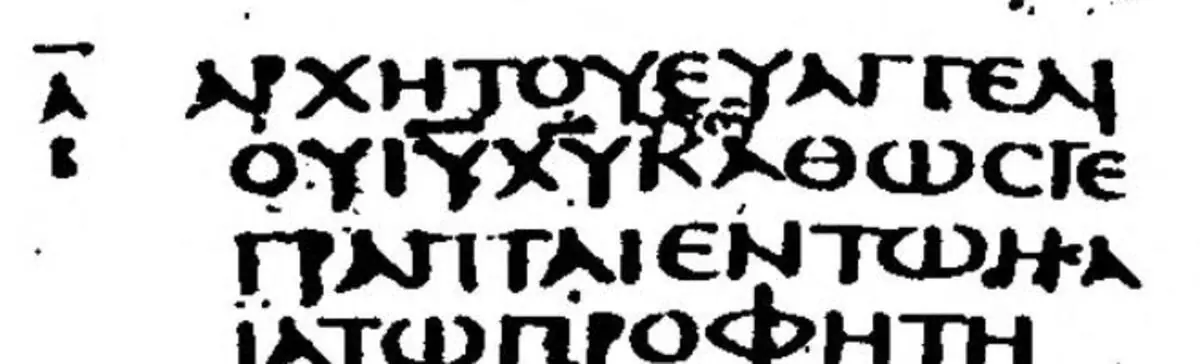
Mark 1:1 — “Son of God”, above the line
Codex Sinaiticus · fourth century
The first scribe wrote “The beginning of the gospel of Jesus Christ”. A corrector working while the book was still being made added four small letters above the second line: ΥΥ ΘΥ, the abbreviation for “Son of God”. Codex Sinaiticus carries more than 26,000 corrections.
IN THE EDITIONMark 1:1 “Son of God”: absent in the first hand; added above the line by a corrector during production.
British Library, Add MS 43725, f. 217v. Corrections: Codex Sinaiticus Project (S1, a correction made during production).
Six more pages, each behind one of the edition’s features. Open any of them.
LIFE IN THE MARGINS
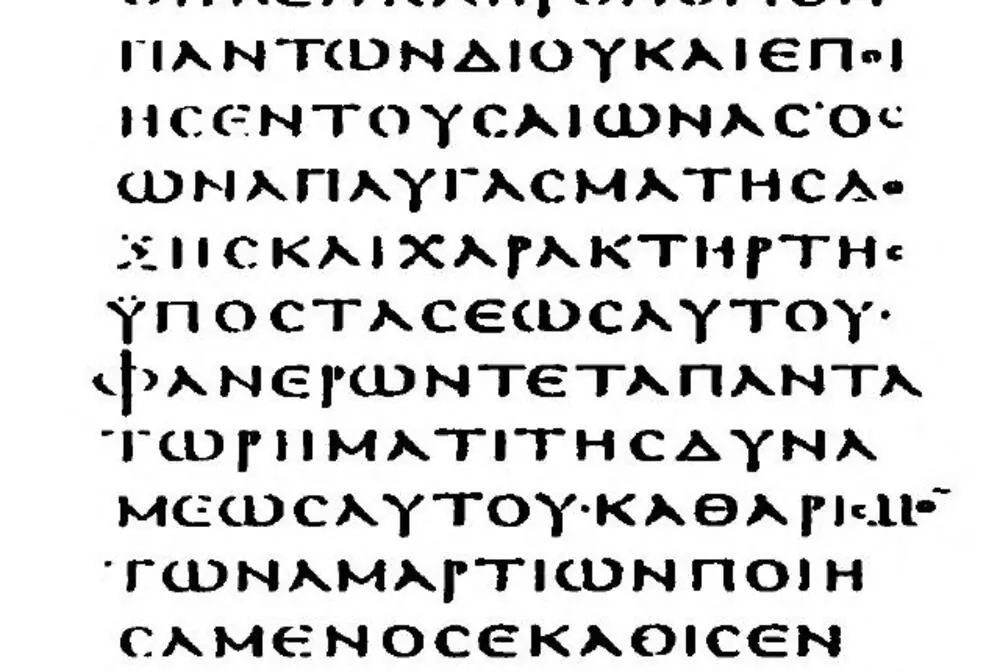
Hebrews 1:3 — “Fool and knave”
Codex Vaticanus · fourth century
Vatican type facsimile (1868), p. 1512
Every other manuscript says the Son is “upholding” all things, φέρων. The scribe of Vaticanus wrote “revealing”, φανερῶν. A corrector changed it. A later reader changed it back, and wrote in the margin: ἀμαθέστατε καὶ κακέ, ἄφες τὸν παλαιόν, μὴ μεταποίει — “Fool and knave, leave the old reading, don’t change it!”
IN THE EDITIONThree hands at one word, and the note transcribed in full. (The Vatican’s printed facsimile of 1868, shown here, gives the first reading but not the note.)
Vatican Library, Vat. gr. 1209, p. 1512. Translation: B. M. Metzger and B. D. Ehrman, The Text of the New Testament, 4th edn (2005). Hands: INTF transcription (CC BY 4.0).
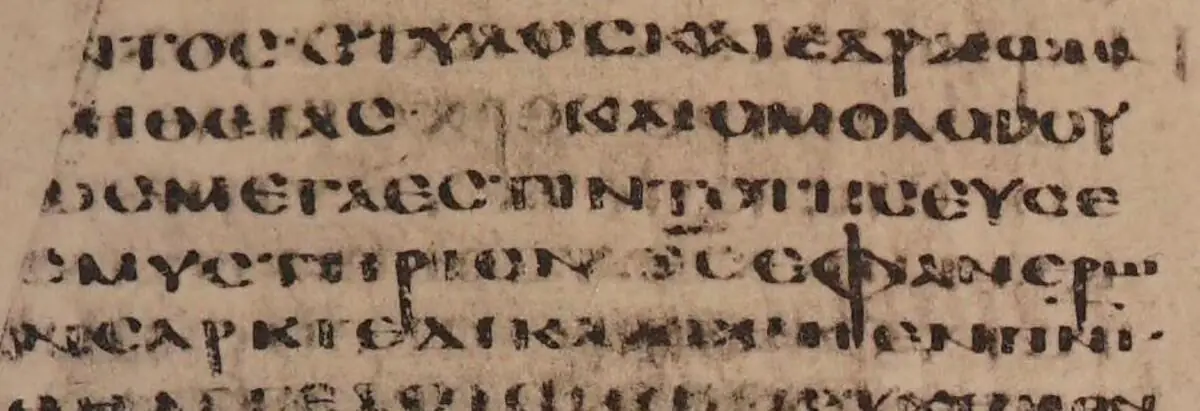
“Great is the mystery of godliness: [who / God] was manifested in the flesh.” In capitals, ΟϹ means “who”. Add a stroke inside the O and a line above, and ΘϹ stands for “God”. For three centuries readers argued over that stroke: one party inspected it with a glass in bright sunshine in the 1730s; Wettstein held it was a letter on the other side of the leaf showing through; others judged it a later retouching.
IN THE EDITIONBoth readings printed, ὅς and θεός, with the history of the dispute.
British Library, Royal MS 1 D VIII, f. 120r (fol. 145 in the older numbering). History of the dispute: F. H. A. Scrivener, A Plain Introduction, 4th edn (1894), vol. 2, p. 392.
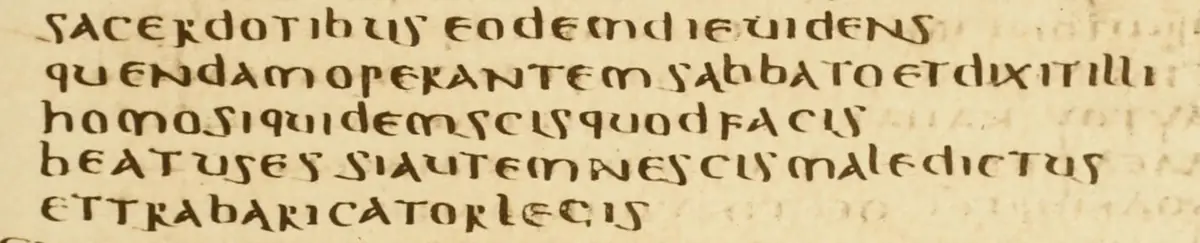
Cambridge University Library, MS Nn.2.41, ff. 205v–206r
Bezae sets a Greek text on the left-hand page and a Latin text on the right. After Luke 6:4, both add a story found in no other manuscript: “On the same day, seeing someone working on the Sabbath, he said to him: Man, if you know what you are doing, you are blessed; but if you do not know, you are cursed and a transgressor of the law.”
IN THE EDITIONBoth pages transcribed, and the Greek and Latin compared word by word.
Cambridge University Library, MS Nn.2.41, ff. 205v–206r, lines 16–20 of each page, shown from the University’s photographic facsimile of 1899. Translation ours.
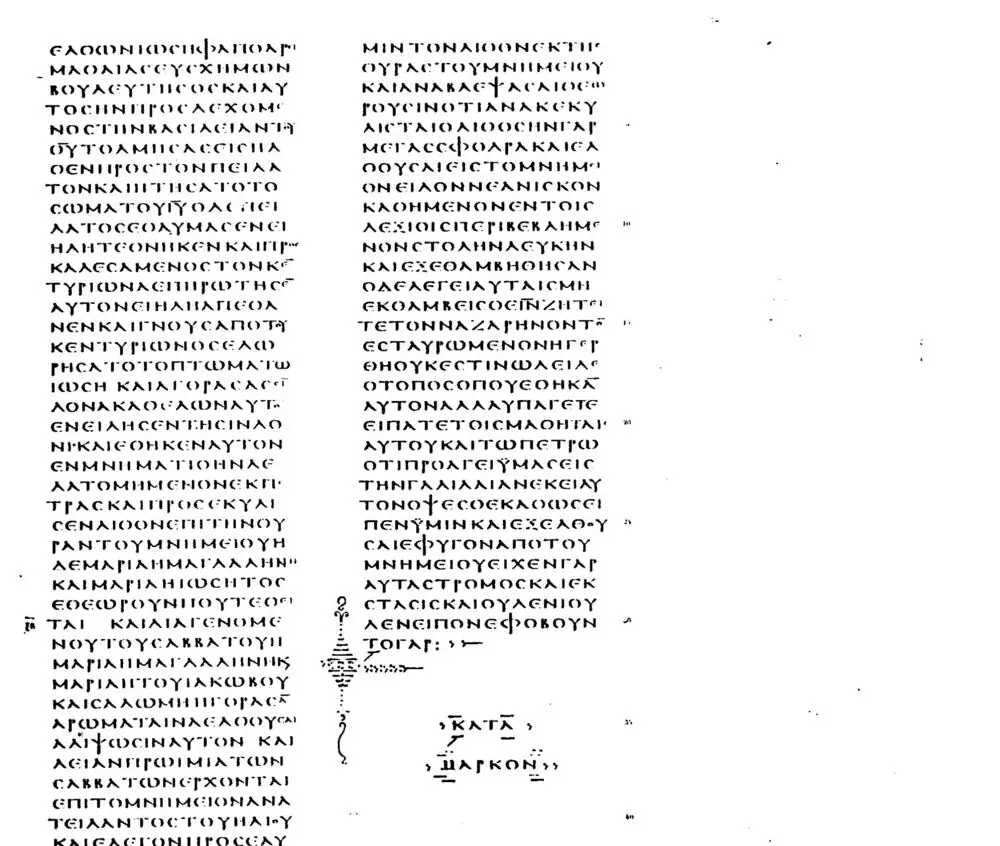
Mark ends here, at 16:8, “for they were afraid”, followed by a flourish and the title “According to Mark”. The scribe then left the next column empty: the only blank column in the New Testament of Vaticanus. Whether he knew of a longer ending is still debated.
IN THE EDITIONThe blank column, reproduced at full size.
Vatican Library, Vat. gr. 1209, p. 1303, shown in the Vatican’s type facsimile of 1868, which prints the text in a typeface cut to imitate the script.
Acts 1 — the first English Bible, with words put back
Wycliffite Bible, Earlier Version · late fourteenth century
British Museum facsimile (1900), plate XXIV
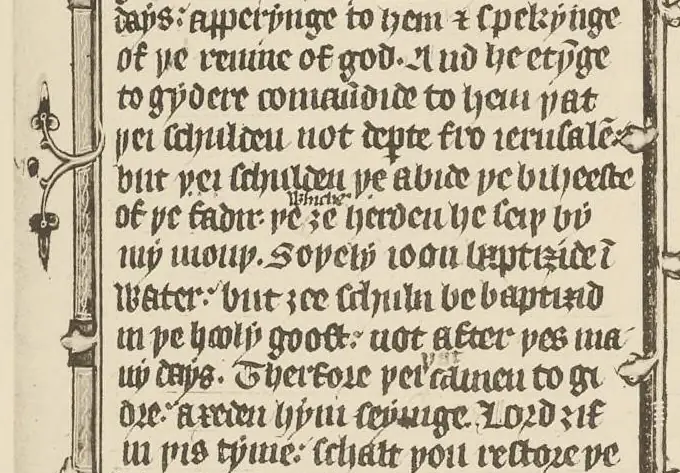
The Wycliffite Bible was the first complete translation of the Bible into English. This copy belonged to Thomas of Woodstock, Duke of Gloucester, the youngest son of Edward III; his arms are in the border of its first page. In these lines from the opening of Acts, a word left out has twice been written in small above the line: “þe whiche ȝe herden”, which you heard (1:4), and “þei þat camen”, they that came (1:6).
IN THE EDITIONEvery erasure, insertion and caret, and the hand that made it.
London, British Library, Egerton MS 618, f. 74 (Acts 1:1–22), shown from the British Museum’s Facsimiles of Biblical Manuscripts (1900), plate XXIV, whose description gives the owner and the date.
The Leningrad Codex (1008) · Codex Vaticanus · a Samuel scroll from Qumran
גָּבְהוֹ שֵׁשׁ אַמּוֹת וָזָרֶת
ὕψος αὐτοῦ τεσσάρων πήχεων καὶ σπιθαμῆς
The Masoretic text — the traditional Hebrew text underlying many Old Testament translations — makes Goliath six cubits and a span tall: about 2.9 metres, taking a cubit as 44.5 cm. The Greek of Codex Vaticanus makes him four cubits and a span: about 2 metres. So do the oldest Hebrew manuscript of the passage, the Samuel scroll 4QSama (4Q51) from the Dead Sea caves, and the historian Josephus (Antiquities 6.171).
IN THE EDITIONBoth heights. Our architects have set every doorway at three metres.
Leningrad Codex, fol. 159r; J. D. Hays, “Reconsidering the Height of Goliath”, Journal of the Evangelical Theological Society 48 (2005).
Our structural engineers work alongside our textual critics.
07 / AFTERCARE
Scholarship moves on. Your walls can follow.
A newly identified manuscript need not disrupt your collection. Our accessions service keeps your library in step with the state of scholarship.
What if a new manuscript is discovered?
Our accessions team prepares the supplement, and our architects assess the adjoining land.
What happens when a reading is corrected?
We issue the corrected page, the revised comparisons and an updated index. Earlier states remain available in the History of Corrections Gallery.
Is there room for disagreement?
Yes. Every reading keeps its source, so disagreement is recorded rather than resolved.
Can the edition be supplied in a smaller format?
Certainly. The type will be smaller. The number of volumes will be the same.
In residence
Where a community looks after the collection, it lives with it.
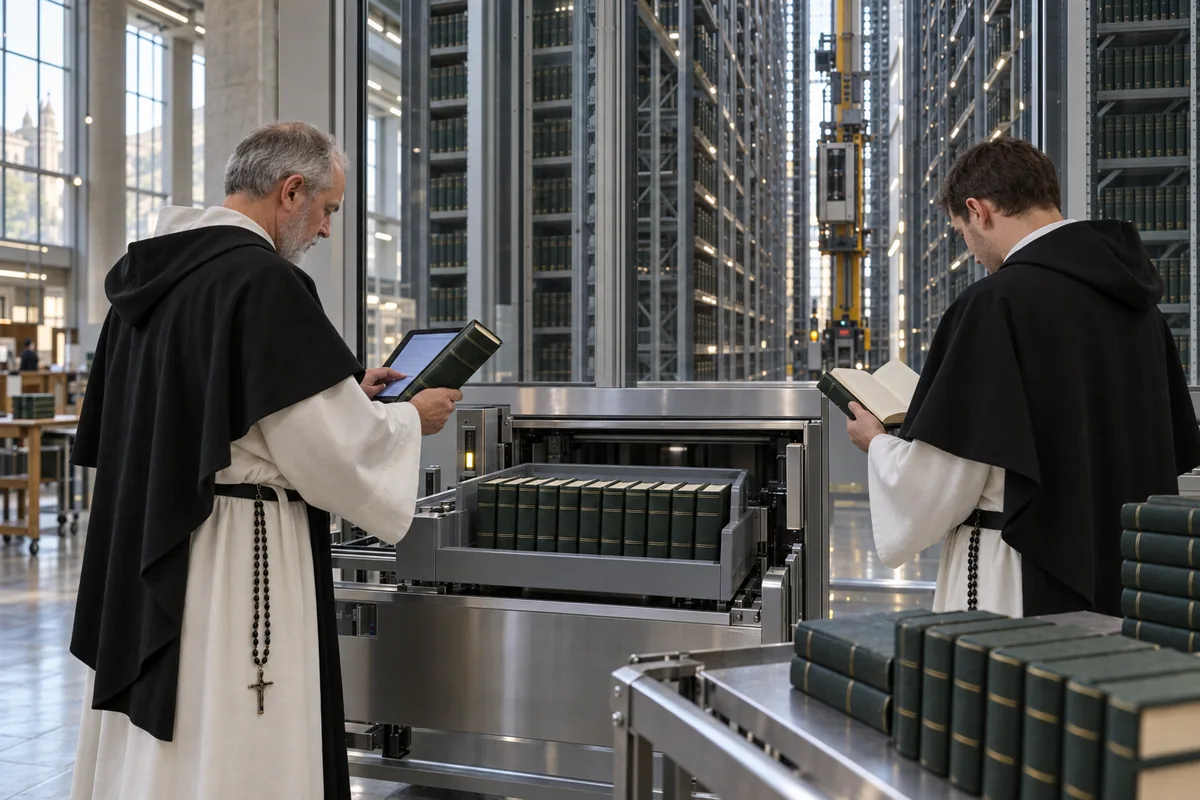
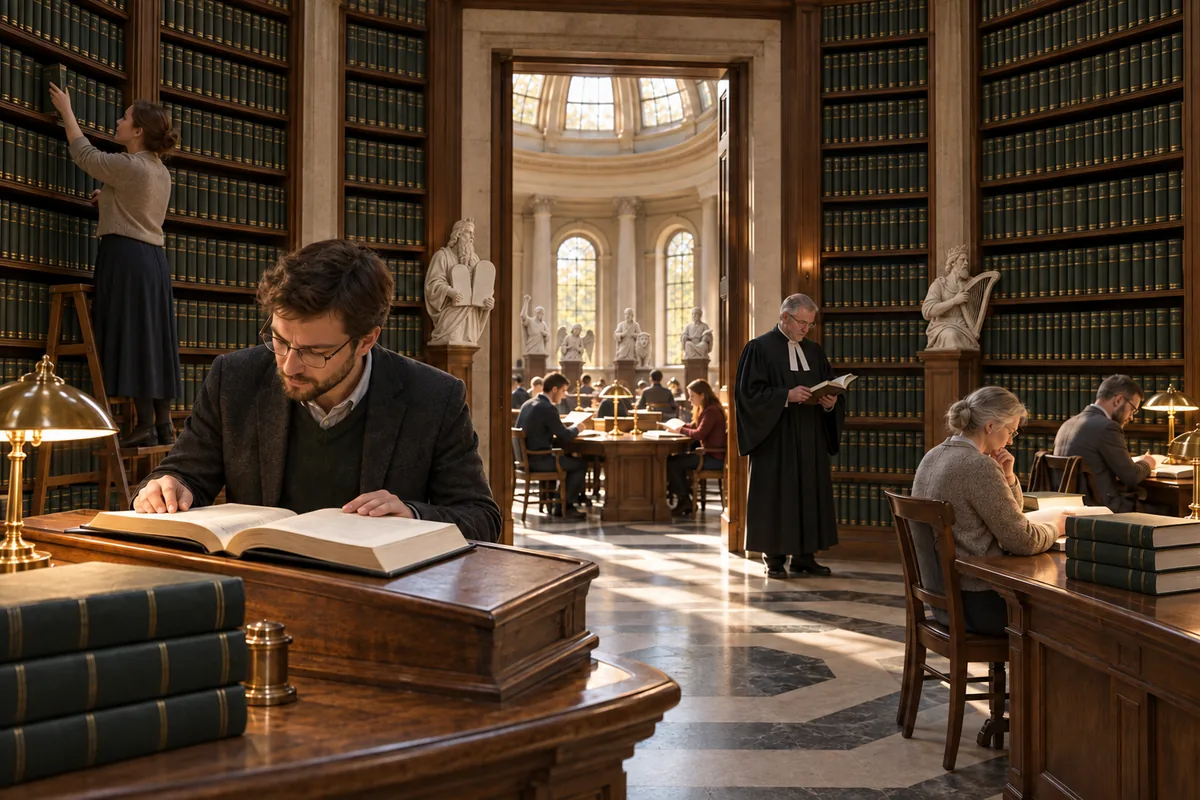
Artist’s impressions, AI-generated; the people shown are illustrative.
Select a photograph to enlarge.
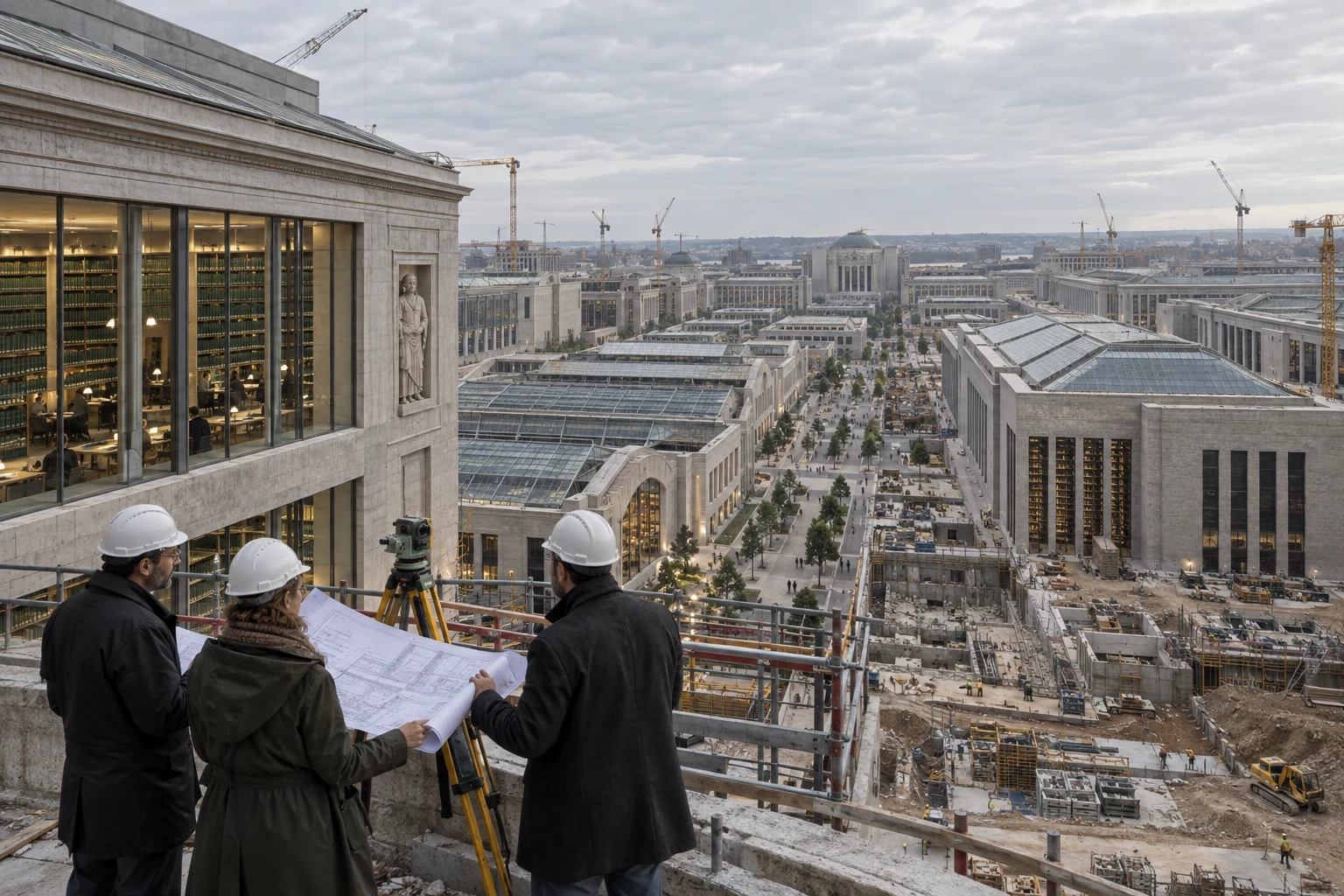
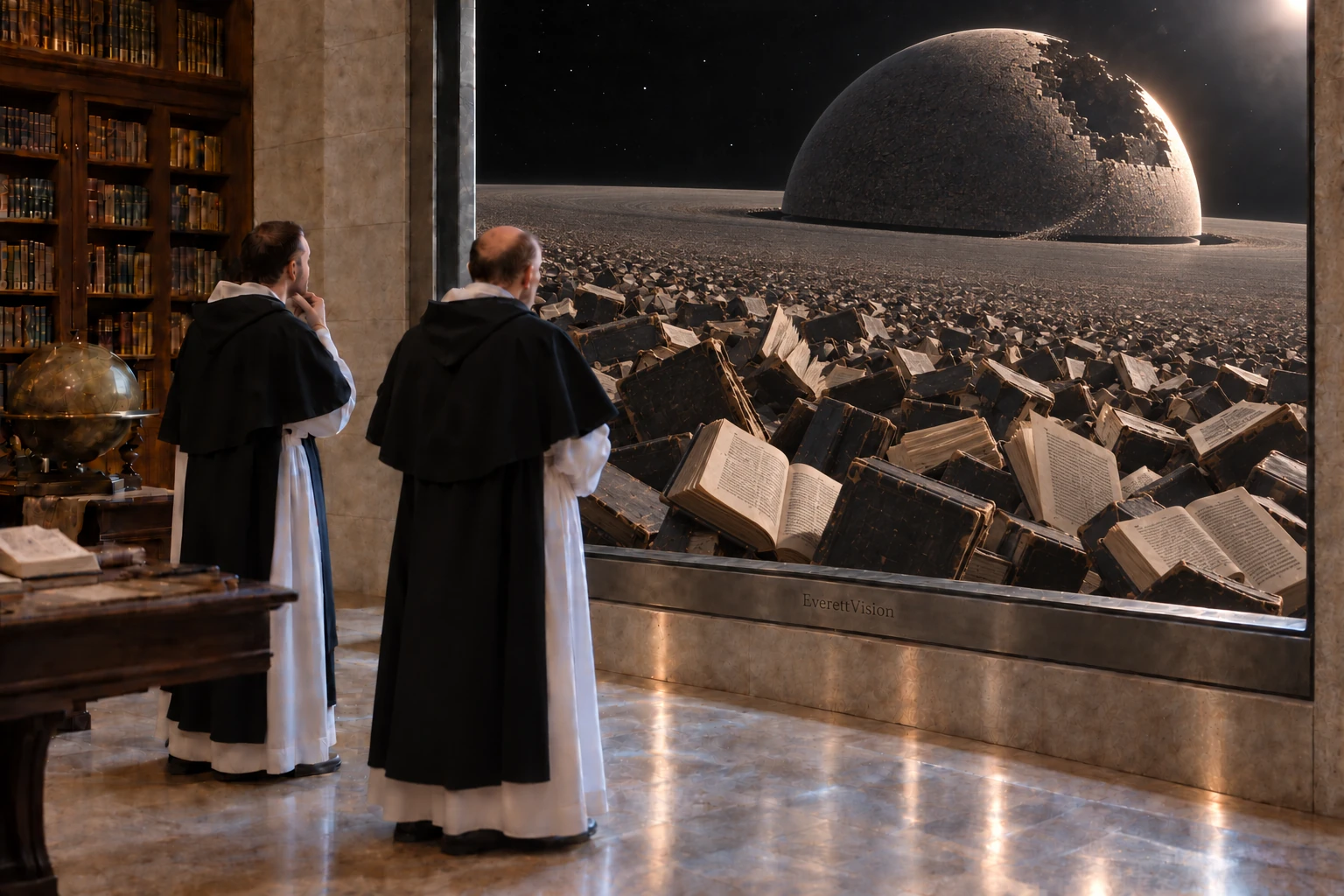
A Dominican community at the retrieval station of an automated store.A Reformed theological faculty in a reading gallery.Shared premises under a status quo, modelled on the historical arrangements at the Church of the Holy Sepulchre. Changes to the premises require the agreement of both resident communities.Our architects survey the next district of the library.Remotely inspecting the build-out of an Everett Space extension