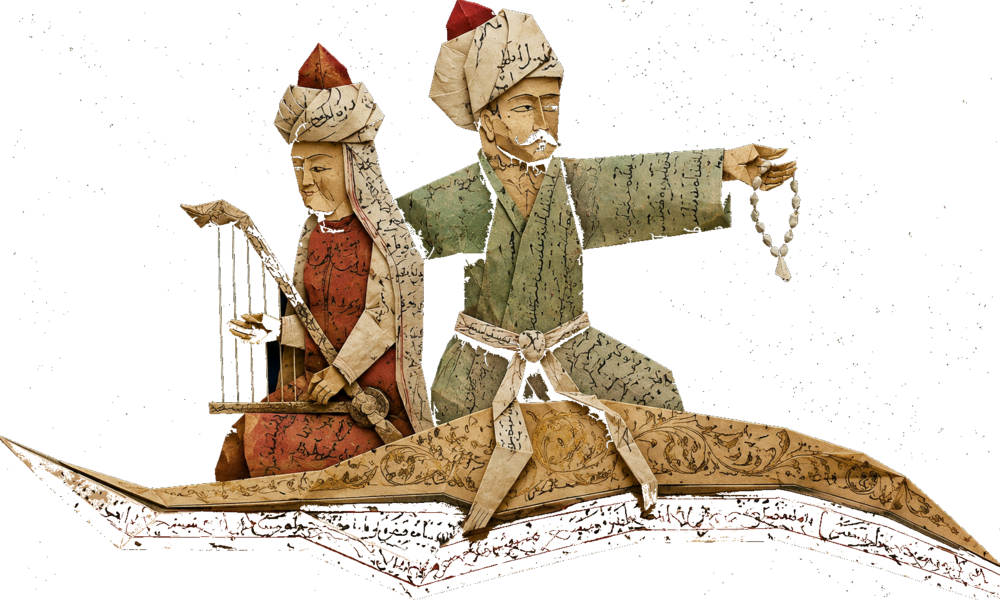
When binders needed stiffening material they cannibalised old manuscripts, cutting them into the waste fragments now recovered from bindings. The naive model treats this as physical wear-out — books used until they fell apart — which would produce a smooth aging hazard.…
One Thousand and One Conjectures
One thousand and one — an impossible number anyway: in the Nights it means more than can be counted. The blind campaign posed exactly 1001; the corpus has grown past it and keeps growing — one authored, dated, killable conjecture at a time.
1,107 posed — and counting · measured against the literature (1001 authoritative verdicts): 95 already answered · 843 anticipated — never tested · 50 no prior located · 15 resolved (6 supported / 4 killed)
Falsifiable conjectures about the pre-print world. The founding thousand and one were generated blind by Fable, a frontier AI, then judged, one dated literature-search each: 95 already answered by the literature, 843 anticipated but never tested, 50 with no prior located — verdicts independently audited by a second model (45-verdict sample; none overturned). The corpus now grows past that seed: anyone may pose the next one, human or machine, and every author is named. Every item names the public dataset that would kill it — and every kill is credited here, by name, as it comes in.
Essays
Why these conjectures matter: charting the noetome — its structure, limits & potential →
Filter
Clear all filtersMore ways to slice
Specialist axes — method, instrument, provenance and more.
What the tags mean
- Supported — a registered prediction held up in data
- Falsified — a registered prediction was refuted
- Inconclusive — a registered prediction resolved without a clean verdict either way
- Open to kill — untested — no decisive result yet; the site’s invitation, not a verdict
- Already answered — the specific result is already published; the citation is on the item’s page
- Anticipated — the literature anticipates the direction, but this exact test has never been run
- No prior located — a dated search found no prior formulation (in thin fields this measures the literature’s thinness, not originality)
- testable — a quantitative prediction + kill-dataset is registered
- Shepherd-triaged — an authoritative Fable-authored verdict; shown as the pills above and the only tier in the headline numbers
- provisional — model-triaged, shepherd review pending — an Opus-authored first pass, not yet shepherd-confirmed and excluded from every headline figure
- awaiting prior-art check — hunt open — no triage yet; found a prior yourself? open it and weigh in
Showing 1–12 of 12 matching conjectures.
This connects the palimpsest census with the communal boundaries of the paper economy. Once paper was cheap, scraping parchment stopped paying for anyone who bought materials on the open market, and the Muslim urban book trade lived on that market. Monastic communities…
Europe preserves discarded Hebrew books in two great accidental archives: the Cairo Genizah, where a community deposited its own worn texts, and the bindings of Christian books, where confiscated Hebrew manuscripts were cut up as wastepaper by binders. This conjecture claims the…
When a chant book became obsolete, binders cut it up to stiffen newer books, and thousands of neumed scraps survive in bindings. This conjecture turns the waste stream into a clock: in any region, the appearance of staffless-neume fragments in datable bindings…
The library of St. Catherine's on Sinai is full of palimpsests, and the erased undertexts are strikingly often in languages that died — Christian Palestinian Aramaic above all, plus rarities like Caucasian Albanian. The claim: erasure was not random parchment hunger —…
Between the radiocarbon-dated Garima Gospels (around the sixth century) and the manuscript boom of the thirteenth, Ethiopia presents a near-700-year hole in surviving books. But Ethiopian binders, like binders everywhere, reused old parchment as guards, stays, and spine linings, so the missing…
Two filters selected which medieval Hebrew books reached us: communities preserved what they kept using, and Christian authorities confiscated what they condemned — above all the Talmud — much of which went to binders as parchment scrap, now documented as thousands of…
A Hebrew manuscript reused in a binding carries two clocks: the palaeographic date of its writing, and the date of the host volume it was bound into, often printed and precisely dated. The interval between them is the time the book survived…
Binders wanted large, stiff sheets of parchment for covers, spine-linings, and pastedowns, so the recycling channel did not sample the Hebrew book population evenly: a large-format Bible or Talmud yields useful sheets, a pocket prayer book yields little worth the knife. The…
Hebrew binding fragments turn up in places with thin or no medieval Jewish settlement — Scandinavian archives are a famous case — and the instinct is to read every find-spot as a trace of Jewish presence. But binders bought waste parchment through…
Hebrew Bibles once carried competing vocalization systems — Tiberian, Babylonian, Palestinian — until the Tiberian system won so completely that intact codices with the losing systems are rarities. But the fragment channels did not run the winner's filter: the Geniza and European…
Every synagogue needed Torah scrolls, scrolls wear out fast under liturgical use, and worn scrolls were ritually retired rather than shelved — yet scrolls carry no colophons, so the best-dated manuscript population on earth contains almost none of them, and quantitative histories…