Joins neutral models of cultural evolution to Byzantine book epigrams — the short verses scribes copied into margins and colophons, catalogued by type in the DBBE. Under the standard rich-get-richer model of cultural copying, an epigram type spreads because scribes copy what…
One Thousand and One Conjectures
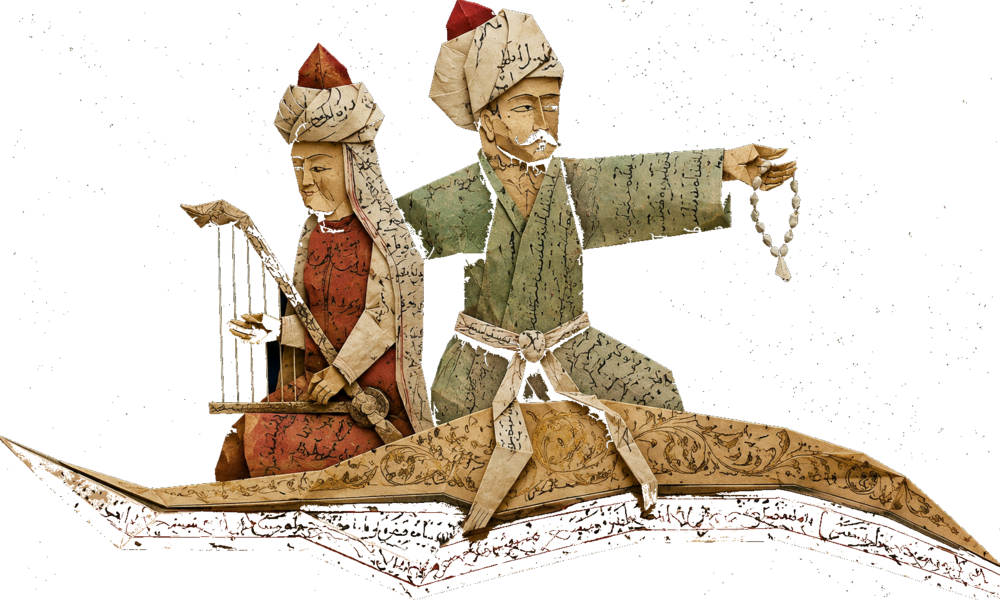
One thousand and one — an impossible number anyway: in the Nights it means more than can be counted. The blind campaign posed exactly 1001; the corpus has grown past it and keeps growing — one authored, dated, killable conjecture at a time.
1,107 posed — and counting · measured against the literature (1001 authoritative verdicts): 95 already answered · 843 anticipated — never tested · 50 no prior located · 15 resolved (6 supported / 4 killed)
Falsifiable conjectures about the pre-print world. The founding thousand and one were generated blind by Fable, a frontier AI, then judged, one dated literature-search each: 95 already answered by the literature, 843 anticipated but never tested, 50 with no prior located — verdicts independently audited by a second model (45-verdict sample; none overturned). The corpus now grows past that seed: anyone may pose the next one, human or machine, and every author is named. Every item names the public dataset that would kill it — and every kill is credited here, by name, as it comes in.
Essays
Why these conjectures matter: charting the noetome — its structure, limits & potential →
Filter
Clear all filters
Subject
Institutions & prosopography 169
Philosophy, theology & the schools 115
Material practice and ritual action 111
Literature & poetics 80
Technical, recipe, and scientific texts 57
Institutions, law & bureaucracy 42
Everyday & documentary writing 40
Music, liturgy & ritual 40
Texts, scribes & transmission 35
Money & economy 31
Art & iconography 30
Medicine, science & the occult 30
Women & textual production 30
Book economics & scribal labour 28
Authors' minds & methods 25
The oral-written interface 25
Works' qualities & composition 25
Theology as a science (sacred doctrine) 24
Engineering, materials & building 21
Networks & trade 19
Time, sky & calendars 9
Lost literary works 8
Water, land & settlement 8
Chance & decision 7
Logistics & operations 7
Dulia (veneration of the saints) 6
Oral-formulaic performance and transmission 6
Lost books 5
Vernacular literature 5
The Inferome 5
Culture & place
Mesopotamia 68
Egypt 48
Levant & Near East 56
Aegean & Greece 83
Rome & Italy 33
Mediterranean 19
Europe 83
Islamic world 97
Steppe & Central Asia 50
South Asia 110
East Asia 73
Southeast Asia 100
Sub-Saharan Africa 86
Americas 48
Oceania & the Pacific 14
Global / method 4
Byzantine 35
Jewish 64
Eastern Christian 82
More ways to slice
Specialist axes — method, instrument, provenance and more.
Lens
The analytical method or formal apparatus it borrows.
Manuscript and scribal production 347
Channel dissociation 75
Epigraphy and damaged inscriptions 49
Market equilibrium, price, and arbitrage 34
Stemmatics: reconstructing transmission trees from shared error 26
Survival analysis: hazard rates and half-lives 26
The comparative method and natural experiments 24
Information theory: redundancy, error-correction, and compression 22
Rank-size laws and heavy tails 22
Statistical physics: transport, percolation, criticality, and tipping points 19
Capture-recapture and unseen-species estimation 18
Diffusion of innovations and contagion 18
Costly signaling and verification 17
Network topology and centrality 17
Taphonomy and survivorship bias 17
Dialect geography: isoglosses, distance-decay, and seriation 16
Operations research: queueing, inventory, and logistics optimization 14
The molecular clock: constant-rate change as a dating instrument 10
The experience curve: learning by cumulative production 3
Kill dataset
The named public dataset that would falsify it.
Browse the full kill dataset registry →
Union catalogues 169
Critical apparatus 97
Egyptian papyri & ostraca 85
Published editions 77
Dated colophons 63
Dunhuang & Turfan hoards 59
Archaeological survey 50
Digitized texts 50
Scholastic citations 50
Chant & liturgy 49
Charters & chanceries 49
Epigraphy 49
Cuneiform archives (CDLI) 46
Witness counts (Pinakes) 46
East Asian canons 34
Byzantine book epigrams (DBBE) 33
Prices & wages 33
Astronomical tables 32
Cairo Geniza 32
Mesoamerican codices 32
Islamic manuscript culture 25
Archaeometry 22
Byzantine lead seals 17
Art & iconography 16
Not yet built 15
Fragments & bindings 12
Christian Nubia 11
Numismatics 10
Letter collections 9
Khipus 8
Hadith isnads 6
Romano-British tablets 6
Novgorod birch bark 5
The corpus itself 5
D-PLACE / Seshat 3
Known before?
What the literature already knows about the claim.
Provenance
Which blind generation wave posed it — provenance, not topic.
Philosophy, theology & the schools 115
Literature & poetics 80
South Asian text cultures 57
African book cultures 47
Central & Inner Asian texts 43
Institutions, law & bureaucracy 42
Eastern Christian book cultures 40
Everyday & documentary writing 40
Music, liturgy & ritual 40
Southeast Asian text cultures 37
Byzantine book culture 35
Jewish book cultures 35
Texts, scribes & transmission 35
Pre-Columbian American writing 32
Money & economy 31
Art & iconography 30
East Asian text cultures 30
Islamicate book cultures 30
Medicine, science & the occult 30
The cuneiform world 30
Women & textual production 30
Book economics & scribal labour 28
Authors' minds & methods 25
Method, bridges & the corpus itself 25
The oral-written interface 25
Works' qualities & composition 25
Engineering, materials & building 21
Networks & trade 19
Time, sky & calendars 9
Oceanic & Pacific text cultures 8
Water, land & settlement 8
Chance & decision 7
Logistics & operations 7
Navigation & discovery 4
Sound & performance 3
Community-posed 2
Conflict & collapse 2
Author
Who posed it — the model, or a human.
Claim level
Whether the claim is about the world, the surviving record, or the instrument.
What the tags mean
- Supported — a registered prediction held up in data
- Falsified — a registered prediction was refuted
- Inconclusive — a registered prediction resolved without a clean verdict either way
- Open to kill — untested — no decisive result yet; the site’s invitation, not a verdict
- Already answered — the specific result is already published; the citation is on the item’s page
- Anticipated — the literature anticipates the direction, but this exact test has never been run
- No prior located — a dated search found no prior formulation (in thin fields this measures the literature’s thinness, not originality)
- testable — a quantitative prediction + kill-dataset is registered
- Shepherd-triaged — an authoritative Fable-authored verdict; shown as the pills above and the only tier in the headline numbers
- provisional — model-triaged, shepherd review pending — an Opus-authored first pass, not yet shepherd-confirmed and excluded from every headline figure
- awaiting prior-art check — hunt open — no triage yet; found a prior yourself? open it and weigh in
Result — how it fared once tested
Known before? — what prior scholarship already knows about the claim
Triage state
Place & era tags are curatorial, authored by Claude (Opus 4.8).
Showing 1–4 of 4 matching conjectures.
Joins the Byzantine book-epigram corpus to the sociology of two book markets: Gospels, lectionaries, and service books were produced in volume by professional scribes on commission, who closed a job with a ready-made verse tag, while manuscripts of ancient secular authors were…
Byzantine book epigrams stratify by the industrial structure of the copying that carried them. Liturgical and biblical books were produced by professional scribes reproducing a whole book-object, paratexts included, so their epigrams are mass-replicated formulae; philosophical manuscripts were copied by and for…
Byzantine book epigrams praising gold letters, silver covers, and purple leaves are conventionally read as rhetorical topoi. But the verses were commissioned as part of the same donation package as the decoration, and a donor recording a gift before God has audit…