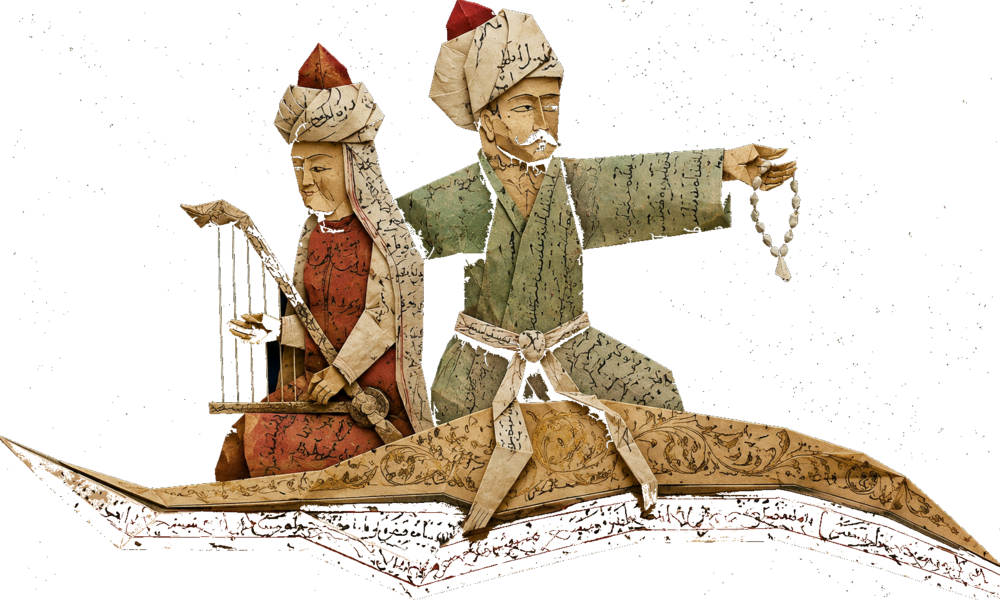
One thousand and one — an impossible number anyway: in the Nights it means more than can be counted. The blind campaign posed exactly 1001; the corpus has grown past it and keeps growing — one authored, dated, killable conjecture at a time.
Falsifiable conjectures about the pre-print world. The founding thousand and one were generated blind by
Fable, a frontier AI, then judged, one
dated literature-search each: 95 already answered by the literature, 843 anticipated but never
tested, 50 with no prior located — verdicts independently audited by a second model (45-verdict
sample; none overturned). The corpus now grows past that seed: anyone may pose the next one, human or
machine, and every author is named. Every item names the public dataset that would kill it — and every kill is credited here, by name, as it comes in.
Parchment is made from animal skins, so a sheet of vellum is effectively a livestock derivative — every codex embodies a slaughtered calf, sheep, or goat. This ties the medieval book trade to the health of the herd: when a cattle plague…
Medieval Easter tables list several parallel columns — golden number, epact, dominical letter, indiction — each computed from the same underlying calendrical cycles, so any one column can in principle be re-derived from the others. That mutual derivability is exactly the structure…
Scribes routinely closed their work with self-deprecating apologies — “forgive the faults of the unworthy scribe” — and the naive reading treats these as confessions from careless copyists. The claim inverts that: such formulae are costly quality signals, the mark of a…
When binders needed stiffening material they cannibalised old manuscripts, cutting them into the waste fragments now recovered from bindings. The naive model treats this as physical wear-out — books used until they fell apart — which would produce a smooth aging hazard.…
Monastic scribes copied in the gaps left by the agricultural year, bending to the pen most heavily in the dead of winter when the fields demanded nothing; urban professional copyists, decoupled from farm labour, worked to a flat year-round rhythm driven by…
A scribe copying from an exemplar in front of him makes errors of the eye — confusing letters that look alike — whereas a scribe taking down a text read aloud, as in dictation or the pecia system of mass university production,…
Fracture physics and Viking economics meet in the hack-silver hoard. When brittle materials are broken repeatedly and more or less at random, the resulting fragment masses follow a universal power-law distribution — a robust result from fragmentation physics that holds for shattered…
An astrolabe only works at the latitude its plate is engraved for, so every surviving instrument silently records where its maker expected it to be used. That turns the corpus of surviving astrolabes into medieval market-research data: the set of latitudes engraved…
The modern capital campaign — where a museum or university secures a headline anchor gift or star acquisition just before asking everyone else for money — is here read back into the medieval church. Relic translations, the ceremonial installation of a saint's…
The Polya urn — the classic mathematical model of path dependence, in which each ball drawn adds another of its color so that early luck compounds forever — is here applied to the medieval pilgrimage market. Pilgrims bought cheap metal badges at…
The backward-bending supply curve — the textbook anomaly in which workers with an income target respond to falling prices by working more, not less — is here joined to the fate of Norse Greenland. The colony's export staple was walrus ivory, and…
In the 13th century, English law adopted a rule for how far apart markets must be — the spacing derived in the classic legal reckoning from a day's return journey on foot, about 6.6 miles. The conjecture joins this statute to the…
Guido of Arezzo's staff notation — the 11th-century invention that fixed pitches on lines rather than leaving them to memory-jogging squiggles — is here treated as an error-correcting code, and its effect on transmission is claimed to be discontinuous rather than gradual.…
Radiocarbon dating works because decay happens at a constant rate; the conjecture is that manuscript copying does too. Scribes make errors, and within a single scriptorium — same training, same exemplars, same working conditions — the rate of new errors introduced per…
The Cistercian order expanded by filiation — mother abbeys founding daughter houses — under statutes and economic pressures that discouraged crowding, since each abbey lived off its own granges and lands. That is the setup of competitive exclusion in ecology, where territorial…
The medieval Champagne fairs ran as a fixed annual cycle of six fairs in four towns, and the merchants of Flanders and Italy worked the whole circuit. Seen with modern eyes, scheduling that cycle is a traveling-merchant optimization: fair dates and durations…
The Shapley value, cooperative game theory's canonical answer to fair division, pays each member of a coalition its average marginal contribution to the coalition's worth. The Hanseatic League was such a coalition: member cities jointly controlled Baltic and North Sea trade routes,…
As chess spread from India across Eurasia, both its objects and its rules mutated regionally: the piece carved as an elephant in the Islamic world became the bishop in Europe, and the moves themselves varied between documented regional rule sets. Linguistics maps…
Gothic churches were built in successive campaigns over decades, and masons could watch how earlier bays and earlier buildings cracked, leaned, or stood. Modern limit analysis can compute, for any buttress geometry, how far it sits from the thrust-line optimum — the…
This joins Gothic cathedral construction to the economics of competitive escalation — the same arms-race dynamics seen in armament races and advertising wars. A cathedral's height was a prestige signal aimed at specific rivals, and the relevant rivals were local: the sees…
This joins medieval craft practice to modern acoustics. An organ builder must decide how pipe diameter should vary with pipe length across a rank — too narrow and the trebles turn thin and stringy, too wide and the basses go dull —…
This joins historical linguistics to campanology. Dialectologists map isoglosses — the boundary lines where one regional speech feature gives way to another — and those lines famously follow the channels of contact: rivers, roads, trade routes. Bell founding, the conjecture claims, worked…
This joins Viking shipbuilding to modern fracture mechanics. A clinker hull is a shell of overlapping oak planks, and its worst enemy is a running split: a crack that starts at a fastening and propagates along the grain. Fracture mechanics says such…
This joins medieval pilgrimage history to tribology, the physics of wear. Every pilgrim who crossed a church threshold removed a microscopic layer of stone, and centuries of feet turned steps into shallow basins; the missing volume is a footfall counter that no…
This joins medieval fiscal instruments to information theory. An Exchequer tally was a wooden stick notched with a debt's value and then split lengthwise, creditor and debtor each keeping half; the split's matching grain already authenticated the pair. The conjecture claims the…
This joins medieval church archaeology to geomagnetism. Churches were meant to face east, yet surveyed orientations scatter by several degrees, and the scatter is usually written off as sloppy surveying. But once the magnetic compass entered the building trades — plausibly around…
This joins the mysterious accuracy of medieval portolan charts to the statistics of error averaging. Portolans appear in the late 13th century already startlingly accurate, with no known surveying campaign behind them; the conjecture's explanation is that they are averaged compass logs…
Markowitz's portfolio theory says diversification pays exactly when the assets you spread across are weakly correlated — variance falls fastest where covariance is low. The medieval open-field system's scattered strips, a puzzle ever since they were read as peasant insurance, are a…
The Bass diffusion model, the workhorse of new-technology adoption studies, splits uptake into two forces: an innovation coefficient p (adopters persuaded by external influence) and an imitation coefficient q (adopters copying their neighbours). Medieval Europe's watermill boom is a textbook diffusion process,…
RT60 — the time a sound takes to decay by sixty decibels — is the basic figure of architectural acoustics, and a great stone nave can hold a note for many seconds; a fast syllabic melody blurs into mud in such a…
The Norse thing — the open-air assembly at which law was recited, cases were pled and decisions proclaimed — was above all an exercise in unamplified speech before a crowd, and sites like Thingvellir have long invited the suspicion that their cliffs…
Medieval masons cut personal marks into the blocks they dressed — piece-work signatures for the paymaster — and a cathedral wall therefore carries, frozen in stone, a record of who cut what. Work organisation leaves statistical fingerprints: if masons produced blocks in…
The deep blue of medieval stained glass comes from cobalt, and medieval Europe mined very little of it: the colorant travelled along long-distance routes whose ultimate sources lay far to the east. Every ore body carries a trace-element fingerprint — the ratios…
Joins the statistics of radioactive decay and modern firm-survival analysis to monastic geography: manuscript-producing places, the claim runs, went extinct at a constant hazard, like unstable isotopes. The mechanism is that the deaths of scriptoria were dominated by external shocks — raids,…
Joins stream-power hydrology to the great fiscal cadastre of 1086: the Domesday survey, in recording what each water-mill rendered to its lord, unwittingly logged a physics meter across England. A mill's earning power was set by the hydraulic power of its site…
Joins process-engineering labor accounting to Viking naval history. Tally the person-hours in a longship and the surprise is that the hull is the cheap part: replication labor budgets show a large woolen sail — the wool sorted, spun thread by thread, woven,…
Joins the cognitive psychology of recall to the stemmatics of oral law. The serial-position curve is among psychology's oldest findings: in reproducing a fixed sequence, people hold the beginning and end best and blur the middle. Iceland's law was exactly such a…
The cutting-stock problem of operations research — how to cut standard stock into pieces with minimal waste — meets codicology. This conjecture holds that parchment page sizes were not aesthetic free choices but near-optimal cuts of animal skins: a skin is a…
Vertical-monopoly pricing from industrial organization shows that a chain of independent monopolists along one route charges more in total than a single owner would, because each ignores the damage its markup does to the others' traffic. This conjecture reads the toll castles…
Packet-switched content distribution splits a file into chunks that travel independently and reassemble at the destination; the medieval university book trade did the same with texts. Under the pecia system, stationers chunked an exemplar into pieces rented out separately, so a single…
Common-value auction theory predicts the winner's curse — the highest bidder is the one who most overestimated the shared value — and that experienced bidders learn to shade their bids downward. This conjecture finds the earliest documented correction in Venetian state finance:…
Connects the disputatio's argumentative architecture to the material sources of quotation: the objections a scholastic author stages are the tradition's stock counter-texts, harvested from commonplace collections and classroom memory, whereas the constructive respondeo forces the author back to the authority's actual wording…
Connects the runic acrostic signatures of Cynewulf — a poet who engineered personal credit into his verse — to oral-formulaic theory's central variable: a poet composing for written attribution has an incentive not to sound like everyone else, while anonymous traditional composition…
Connects the classroom habitus of glossing to stemmatic topology: a schooltext lived its life open beside other copies, its margins stuffed with variants and explanations that the next copyist promoted into the text, while a rarely read historian was copied once a…
Joins the cataloguer's oldest headache — incipit drift — to prosody as an error-correcting code operating exactly where texts are most vulnerable: openings, which suffer lost first leaves, added prologues, and scribal throat-clearing. A verse work's first lines are locked by rhyme…
Connects the world's longest translation chain — Kalila and Dimna from Sanskrit through Middle Persian and Arabic into Syriac, Greek, Hebrew, Latin, and Castilian — to a two-speed model of what a book is to its transmitters: chapters are detachable assets that…
Joins skaldic poetry's survival to a citation-driven preservation model: drottkvaett stanzas were too dense to read for pleasure once the courts that paid for them dissolved, but sagas and kings' lives needed them as evidence — quoted testimony anchoring prose claims —…
Connects the invention of the troubadour vidas and razos — the prose lives and song-explanations in the chansonniers — to an export-market failure: at home in Occitania the songs circulated inside a living performance scene that supplied all needed context, but the…
the Hebrew translations of Judeo-Arabic philosophy were not diffusion but evacuation across a script frontier. As Arabic competence died out among the Jews of Christian Europe, translation was the only way the tradition could survive there at all, so the two versions'…
writing a line-by-line commentary on an authority permanently converts a scholastic's citation channel to that authority from mediated to direct across his whole subsequent output. The commentary forces desk-level engagement with a complete exemplar; afterwards the master quotes from his own annotated…