Regiomontanus
The true place of the moon
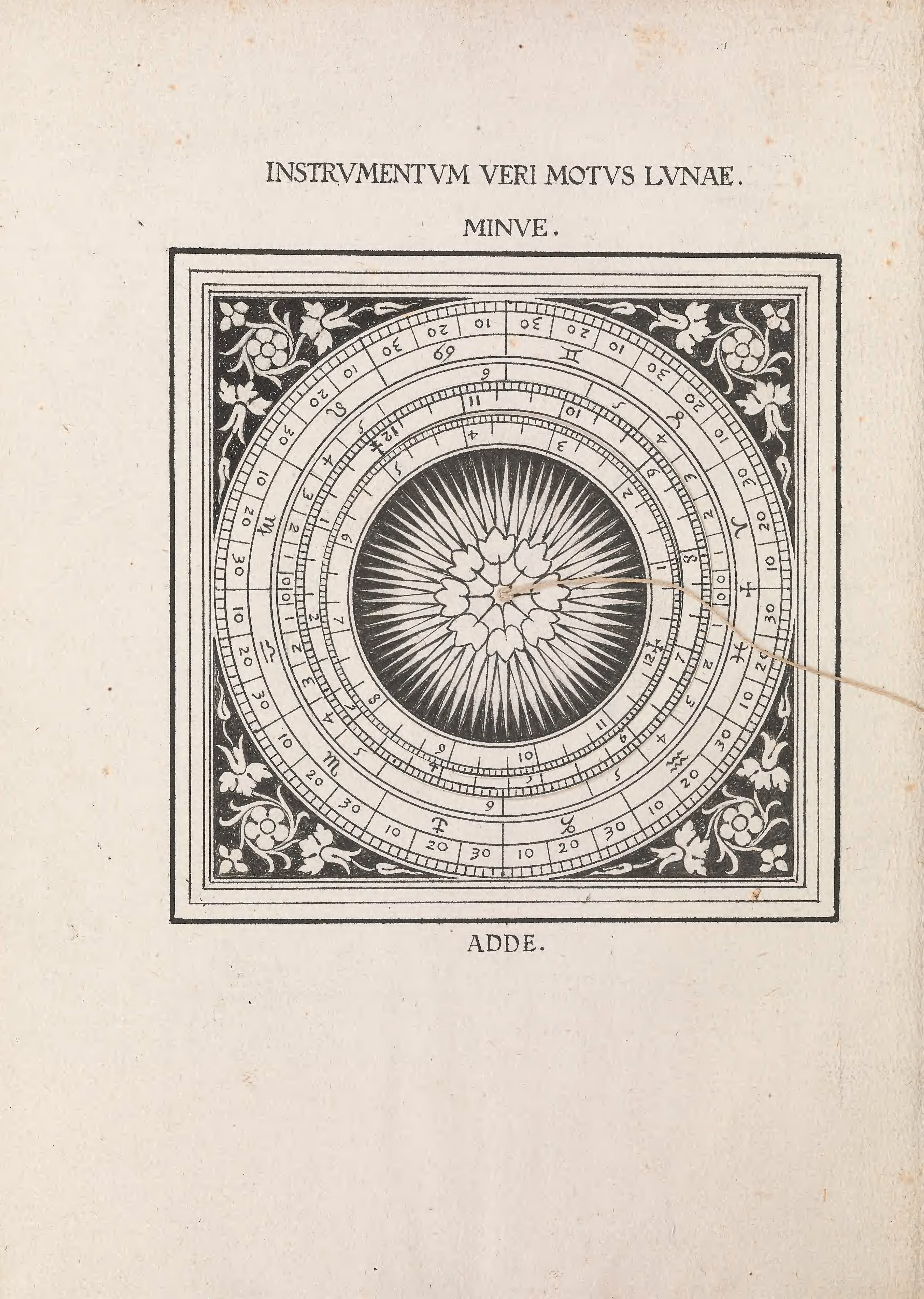
Johannes Müller of Königsberg in Franconia, Regiomontanus, printed his Kalendarium at Nuremberg in 1474, and in 1476 Bernhard Maler, Peter Löslein and Erhard Ratdolt reprinted it at Venice with the first decorated title page in a printed book. It gives, for every day of the years 1475 to 1531, the sun's place, the moon's two numbers, the feasts, the new and full moons and the eclipses, and it ends with four instruments to be cut and mounted. This is the third of them, the Instrumentum veri motus lunae, the instrument of the moon's true motion, in the Smithsonian Libraries' copy: the printer's two paper wheels turn on the page as they were meant to, and the thread that Regiomontanus tells the reader to fix at the centre is drawn afresh. Everything else is the photograph as it is.
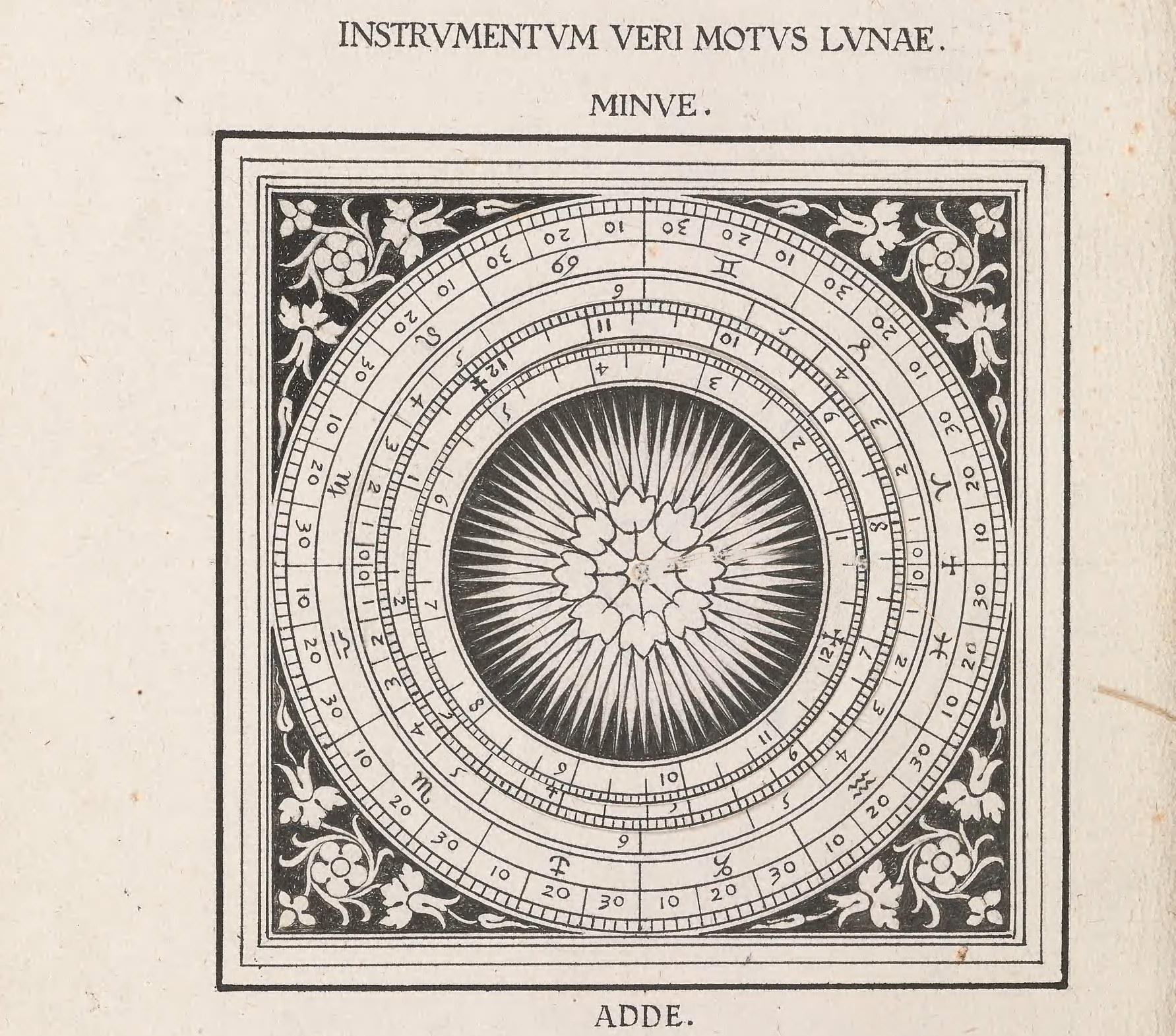
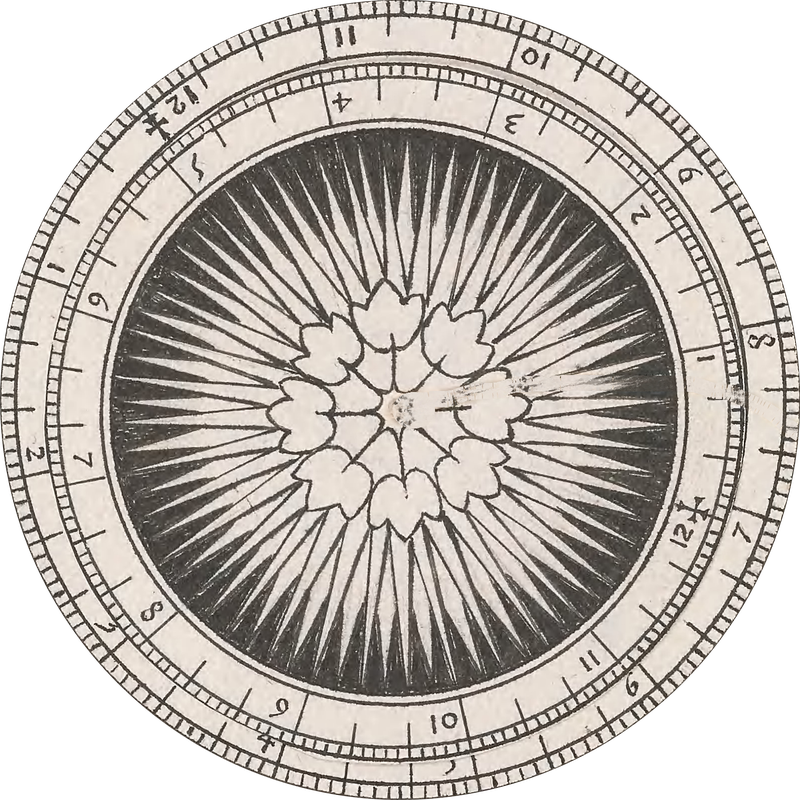
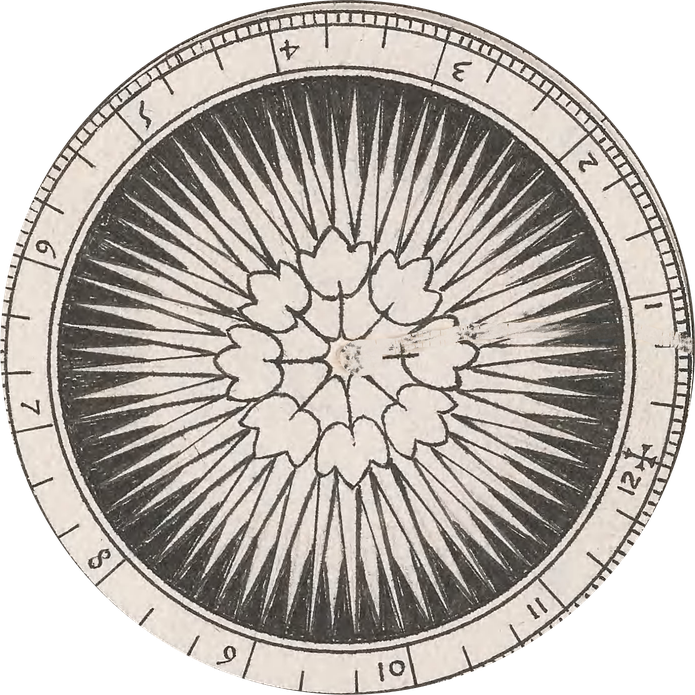
Drag the smaller wheel, the larger wheel or the thread to turn it; the thread also follows a drag on the rings outside the wheels. The keyboard turns the thread with the left and right arrows, the larger wheel with up and down, the smaller with Page Up and Page Down (hold shift for ten degrees). The wheels' heads are the crosses after the numeral 12; the zodiac's cross marks the first degree of Aries.
Under the thread
The thread
On the zodiac: —
Counted from the larger wheel's head: — · from the smaller wheel's head: —
On the moon's equator: — · as a curve, 6 sin: — · turned 0° from the photograph
The larger wheel
Its head (the cross) on the zodiac: — · turned 0°
The smaller wheel
Its head on the zodiac: — · turned 0°
How the readings are made: the centre of the printed rings and the radii of the wheels were fitted on the photograph; the zodiac's ten-degree lines were measured on the woodcut and fall within a quarter of a degree of their places; the cells of the moon's equator were measured line by line and follow six times the sine of the angle from Aries, each cell labelled with the rounded value. The wheels' scales are the zodiac's own, copied, with a cross before the line after 12: the count of signs and degrees from the head is read against the thread. The angles in the photograph are the state in which the Smithsonian's copy was photographed, not a setting from the book's table.
What the instrument does, in Regiomontanus's words
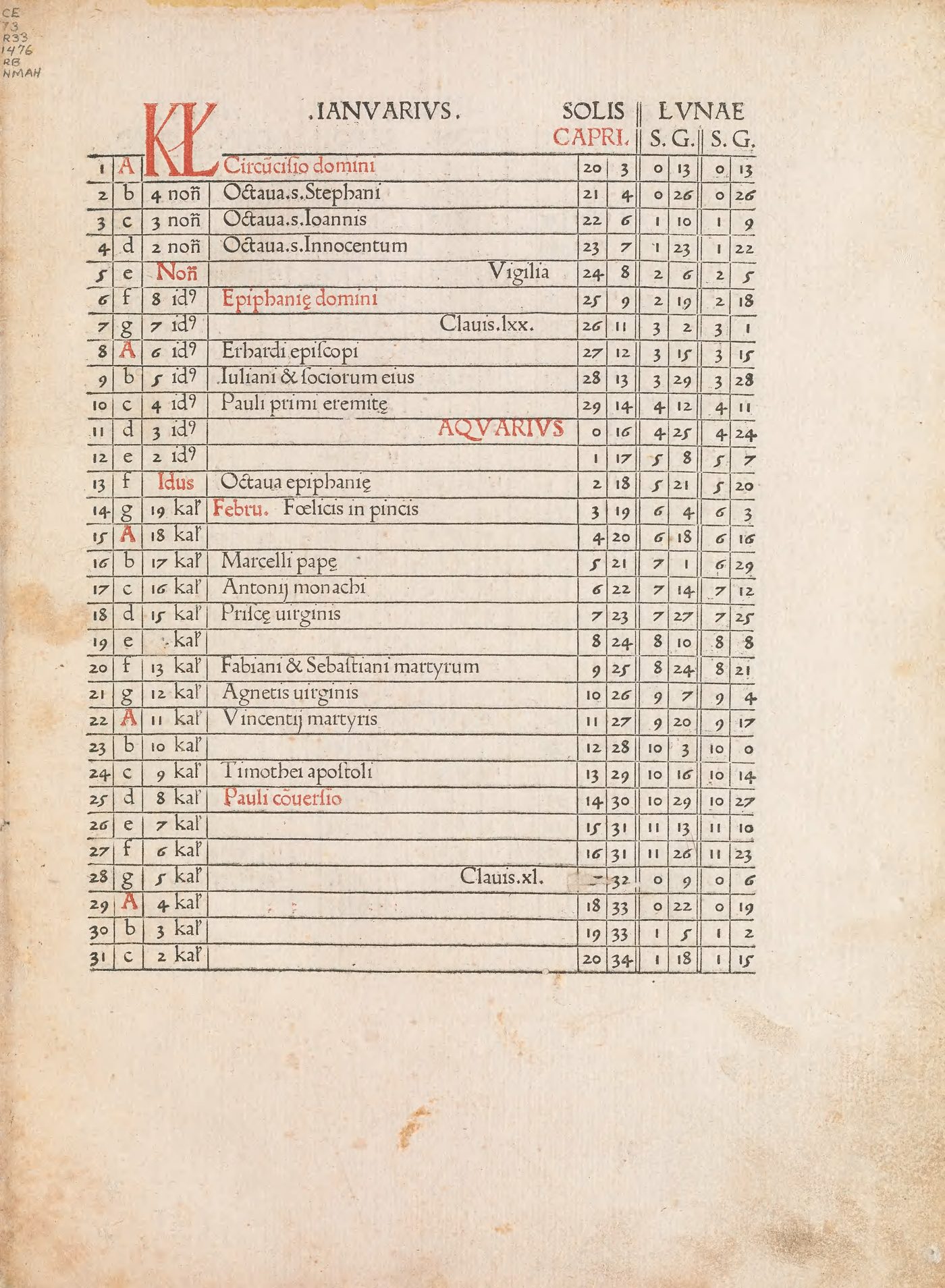
The Kalendarium gives the moon's place without an ephemeris. For each day the calendar prints two lunar numbers, each in signs and degrees: the first is the moon's mean motion counted from the start of the year, the second the motion of its anomaly, the argument that governs how far the true moon runs ahead of or behind the mean. A second table, the Tabula radicum lunae, gives for each year from 1475 to 1534 the two roots, the values at the start of the year. The instrument adds the day's numbers to the year's roots on the zodiac, and converts the anomaly into a correction with the ring inside the zodiac, which Regiomontanus calls the moon's equator. His instructions, on the leaf headed De loco lunae vero, run as follows.
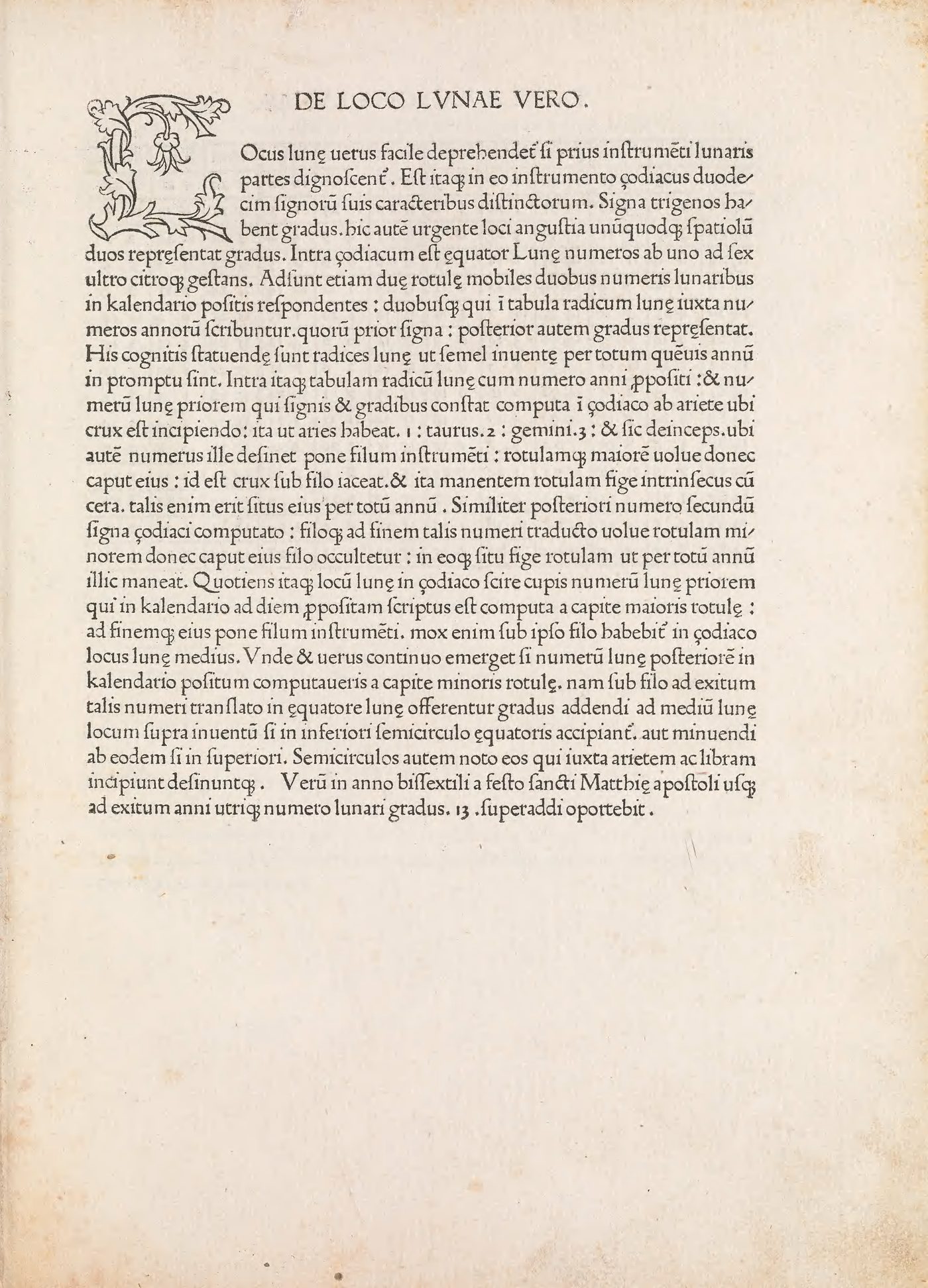
Locus lunae verus facile deprehendetur si prius instrumenti lunaris partes dignoscentur. Est itaque in eo instrumento zodiacus duodecim signorum suis caracteribus distinctorum. Signa trigenos habent gradus; hic autem urgente loci angustia unumquodque spatiolum duos repraesentat gradus. Intra zodiacum est aequator lunae, numeros ab uno ad sex ultro citroque gestans. Adsunt etiam duae rotulae mobiles, duobus numeris lunaribus in kalendario positis respondentes duobusque qui in tabula radicum lunae iuxta numeros annorum scribuntur, quorum prior signa, posterior autem gradus repraesentat.
His cognitis statuendae sunt radices lunae, ut semel inventae per totum quemvis annum in promptu sint. Intra itaque tabulam radicum lunae cum numero anni propositi, et numerum lunae priorem, qui signis et gradibus constat, computa in zodiaco ab ariete ubi crux est incipiendo, ita ut aries habeat 1, taurus 2, gemini 3, et sic deinceps; ubi autem numerus ille desinet pone filum instrumenti, rotulamque maiorem volve donec caput eius, id est crux, sub filo iaceat, et ita manentem rotulam fige intrinsecus cum cera: talis enim erit situs eius per totum annum. Similiter posteriori numero secundum signa zodiaci computato, filoque ad finem talis numeri traducto, volve rotulam minorem donec caput eius filo occultetur, in eoque situ fige rotulam ut per totum annum illic maneat.
Quotiens itaque locum lunae in zodiaco scire cupis, numerum lunae priorem qui in kalendario ad diem propositam scriptus est computa a capite maioris rotulae, ad finemque eius pone filum instrumenti: mox enim sub ipso filo habebitur in zodiaco locus lunae medius. Unde et verus continuo emerget, si numerum lunae posteriorem in kalendario positum computaveris a capite minoris rotulae: nam sub filo ad exitum talis numeri translato in aequatore lunae offerentur gradus addendi ad medium lunae locum supra inventum, si in inferiori semicirculo aequatoris accipiantur, aut minuendi ab eodem, si in superiori. Semicirculos autem noto eos qui iuxta arietem ac libram incipiunt definuntque. Verum in anno bissextili a festo sancti Matthiae apostoli usque ad exitum anni utrique numero lunari gradus 13 superaddi oportebit.
The true place of the moon is easily found once the parts of the lunar instrument are known. In the instrument there is a zodiac of twelve signs, each marked with its character. The signs have thirty degrees each, but here, for want of room, each small space stands for two degrees. Inside the zodiac is the moon's equator, carrying the numbers from one to six in both directions. There are also two movable wheels, answering to the two lunar numbers set in the calendar and to the two written in the table of the moon's roots against the numbers of the years, each in two figures, the first for signs and the second for degrees.
With these known, the moon's roots are to be set up, so that once found they are ready for the whole of any year. Enter the table of the roots with the number of the year proposed, and count the first lunar number, which is made of signs and degrees, along the zodiac beginning from Aries, where the cross is, so that Aries counts as 1, Taurus 2, Gemini 3, and so on; where that number ends, lay the instrument's thread, and turn the larger wheel until its head, that is, the cross, lies under the thread; and fix the wheel so, from beneath, with wax, for that will be its position for the whole year. In the same way count the second number along the signs of the zodiac, bring the thread to the end of it, and turn the smaller wheel until its head is hidden by the thread; and fix the wheel in that position so that it stays there for the whole year.
Whenever, then, you wish to know the moon's place in the zodiac, count the first lunar number written in the calendar against the day proposed from the head of the larger wheel, and lay the instrument's thread at its end: at once the moon's mean place will be had on the zodiac under the thread. And the true place follows directly, if you count the second lunar number set in the calendar from the head of the smaller wheel: for under the thread, brought to the end of that number, the moon's equator will offer the degrees to be added to the mean place found above, if they are taken in the lower semicircle of the equator, or subtracted from it, if in the upper. By the semicircles I mean those which begin and end at Aries and at Libra. But in a leap year, from the feast of Saint Matthias the Apostle to the end of the year, thirteen degrees must be added to each lunar number.
The transcription follows the Smithsonian copy's leaf De loco lunae vero, with abbreviations expanded and the spelling normalised; the translation is the exhibition's own. The two lunar numbers are the mean motion in longitude, 13° 10′ 35″ a day, and the mean anomaly, 13° 3′ 54″ a day, counted from the year's root and rounded to whole degrees; the calendar's January column agrees with that rule in all sixty-two of its entries, and the sixty years of the roots table advance by exactly those motions over 365 or 366 days. The equator's cells are drawn to six times the sine of the angle from Aries: Regiomontanus allows the moon's inequality a full six degrees, which is what the woodcut's cell lines give when measured.
- The larger wheel
- The outer paper wheel, whose scale of twelve signs lies just inside the equator. Its head, marked by a cross after the 12, is set to the year's first root.
- The smaller wheel
- The inner wheel, carrying the sun's face. Its head is set to the year's second root.
- The thread
- A thread fixed at the centre, laid across the scales to read them. In the Smithsonian's copy a thread is still knotted at the centre and lies loose across the page; it is drawn afresh here.
- Minue, Adde
- Subtract, add: the rule for the upper and lower halves of the equator.
Set the instrument for a date
Choose a day in the book's own calendar, the Julian one, and the page carries out the procedure: the wheels are turned so that their heads lie at the year's roots, and the thread is laid at the day's first number counted from the larger wheel's head. The two buttons move the thread between the two readings.
- The date: —
- The roots of the year: —
- The calendar's lunar numbers for the day: —
- The moon's mean place (the thread at the first number from the larger wheel's head): —
- The equator (the thread at the second number from the smaller wheel's head): —
- The moon's true place: —
Does it work? The same day by modern theory
| The instrument | Modern | Difference | |
|---|---|---|---|
| Mean place of the moon | — | — | — |
| True place of the moon | — | — | — |
| Mean anomaly | — | — | |
| Elongation | — | — |
The modern values are the moon's mean and true ecliptic longitudes for noon of that day, from the leading terms of the lunar theory in Meeus's Astronomical Algorithms, good to a few hundredths of a degree. Regiomontanus's mean motions are the Alfonsine ones and hold up: the mean place should agree within a degree or two even far outside the table, since the two daily motions differ from the modern values by a few millionths of a degree. The true place is another matter. The instrument allows one inequality of at most six degrees; the real moon also has the evection, of more than a degree, and smaller terms, so a difference of two or three degrees is the instrument working as designed, and a larger one is worth a second look. For years outside 1475 to 1534 the roots are carried on from the printed table by its own motions, an extrapolation the book never makes.
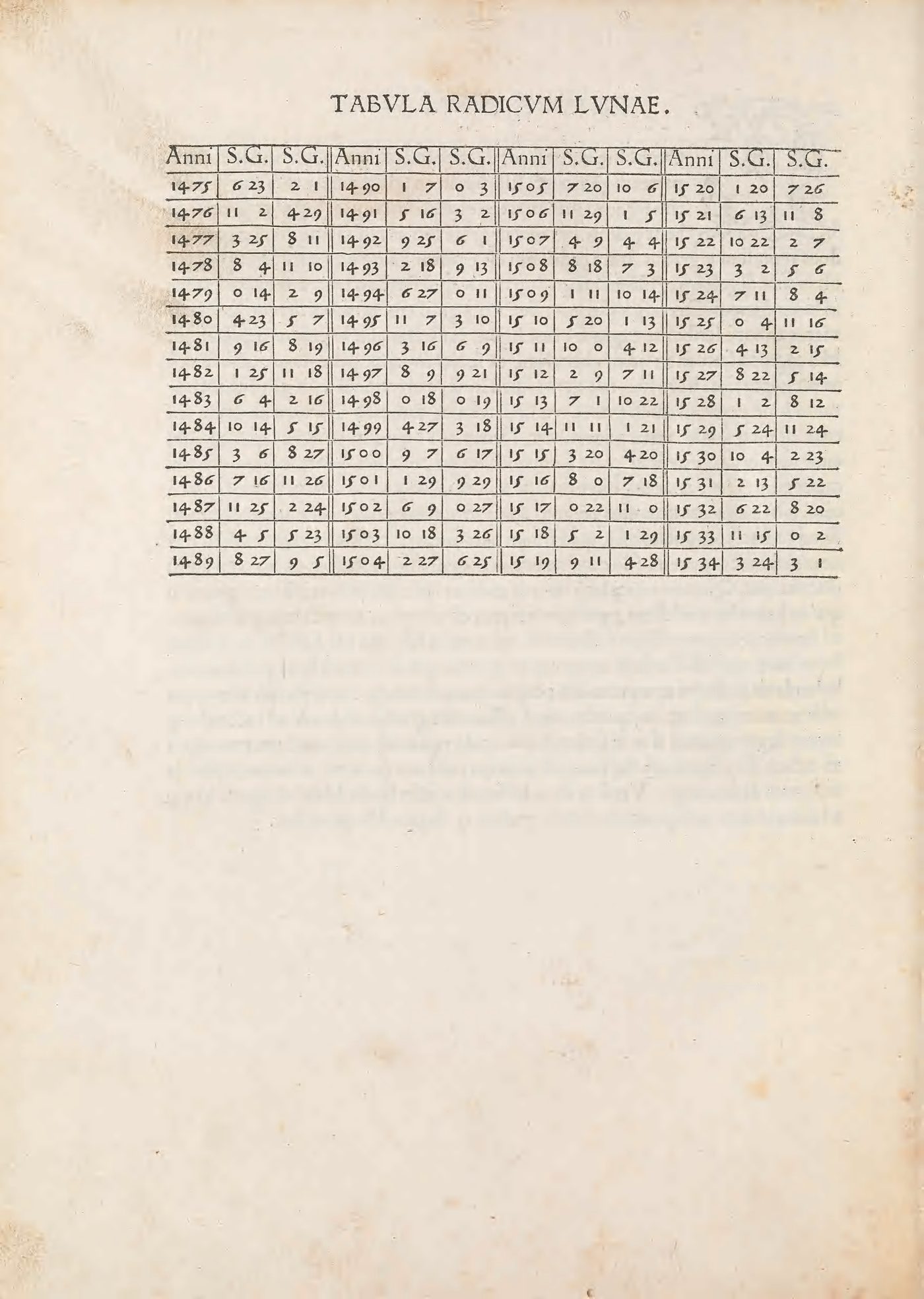
The table of the moon's roots
As printed, in four columns: the year, the first root in signs and degrees, the second root in signs and degrees. It was transcribed from the photograph of the leaf and checked for regularity: each year's roots follow from the last by the two mean motions over the days of the Julian year, with no exception.
| Anni | S. G. | S. G. | Anni | S. G. | S. G. | Anni | S. G. | S. G. | Anni | S. G. | S. G. | |||
|---|---|---|---|---|---|---|---|---|---|---|---|---|---|---|
| 1475 | 6 23 | 2 1 | 1490 | 1 7 | 0 3 | 1505 | 7 20 | 10 6 | 1520 | 1 20 | 7 26 | |||
| 1476 | 11 2 | 4 29 | 1491 | 5 16 | 3 2 | 1506 | 11 29 | 1 5 | 1521 | 6 13 | 11 8 | |||
| 1477 | 3 25 | 8 11 | 1492 | 9 25 | 6 1 | 1507 | 4 9 | 4 4 | 1522 | 10 22 | 2 7 | |||
| 1478 | 8 4 | 11 10 | 1493 | 2 18 | 9 13 | 1508 | 8 18 | 7 3 | 1523 | 3 2 | 5 6 | |||
| 1479 | 0 14 | 2 9 | 1494 | 6 27 | 0 11 | 1509 | 1 11 | 10 14 | 1524 | 7 11 | 8 4 | |||
| 1480 | 4 23 | 5 7 | 1495 | 11 7 | 3 10 | 1510 | 5 20 | 1 13 | 1525 | 0 4 | 11 16 | |||
| 1481 | 9 16 | 8 19 | 1496 | 3 16 | 6 9 | 1511 | 10 0 | 4 12 | 1526 | 4 13 | 2 15 | |||
| 1482 | 1 25 | 11 18 | 1497 | 8 9 | 9 21 | 1512 | 2 9 | 7 11 | 1527 | 8 22 | 5 14 | |||
| 1483 | 6 4 | 2 16 | 1498 | 0 18 | 0 19 | 1513 | 7 1 | 10 22 | 1528 | 1 2 | 8 12 | |||
| 1484 | 10 14 | 5 15 | 1499 | 4 27 | 3 18 | 1514 | 11 11 | 1 21 | 1529 | 5 24 | 11 24 | |||
| 1485 | 3 6 | 8 27 | 1500 | 9 7 | 6 17 | 1515 | 3 20 | 4 20 | 1530 | 10 4 | 2 23 | |||
| 1486 | 7 16 | 11 26 | 1501 | 1 29 | 9 29 | 1516 | 8 0 | 7 18 | 1531 | 2 13 | 5 22 | |||
| 1487 | 11 25 | 2 24 | 1502 | 6 9 | 0 27 | 1517 | 0 22 | 11 0 | 1532 | 6 22 | 8 20 | |||
| 1488 | 4 5 | 5 23 | 1503 | 10 18 | 3 26 | 1518 | 5 2 | 1 29 | 1533 | 11 15 | 0 2 | |||
| 1489 | 8 27 | 9 5 | 1504 | 2 27 | 6 25 | 1519 | 9 11 | 4 28 | 1534 | 3 24 | 3 1 |
The other three instruments
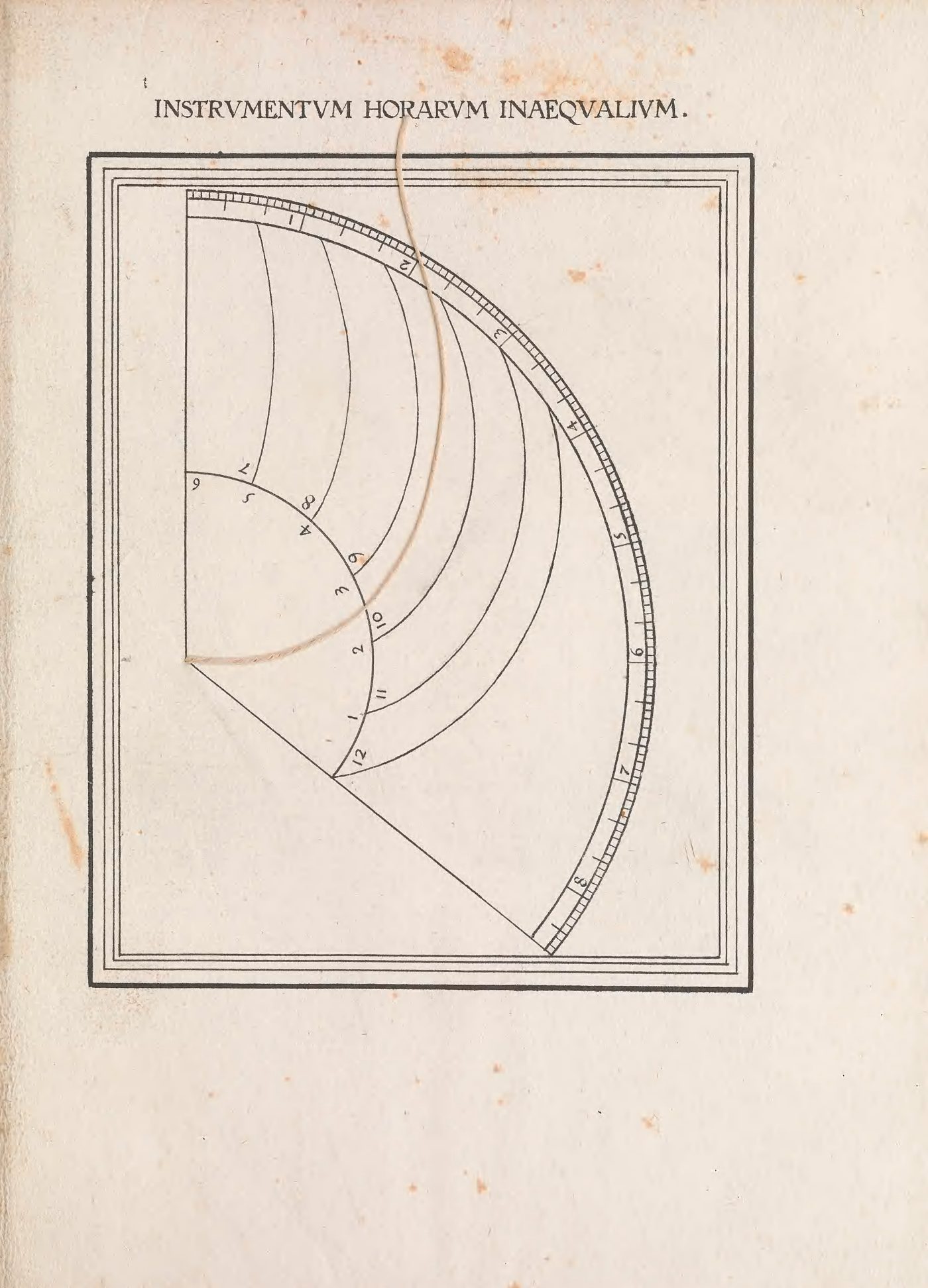
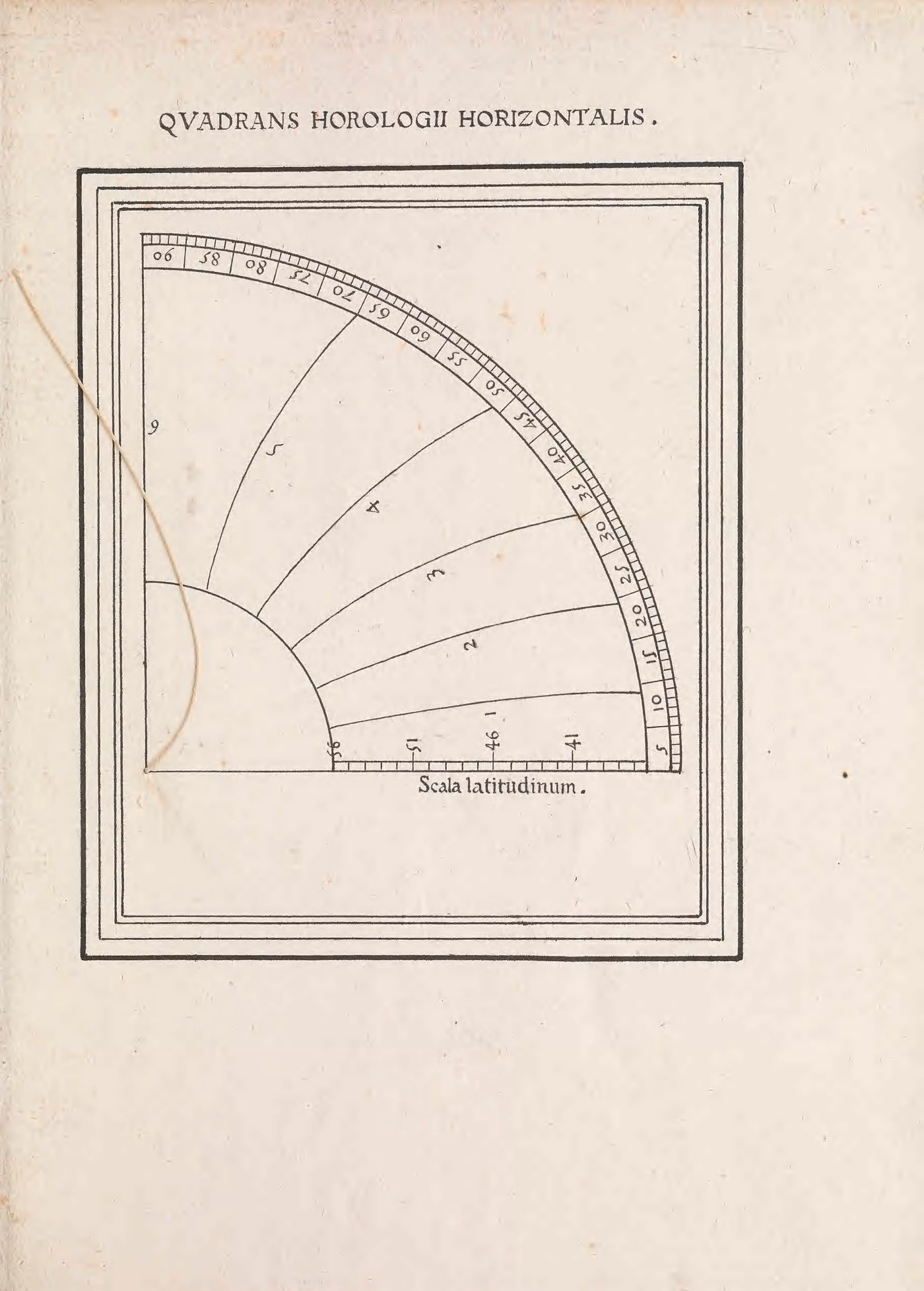
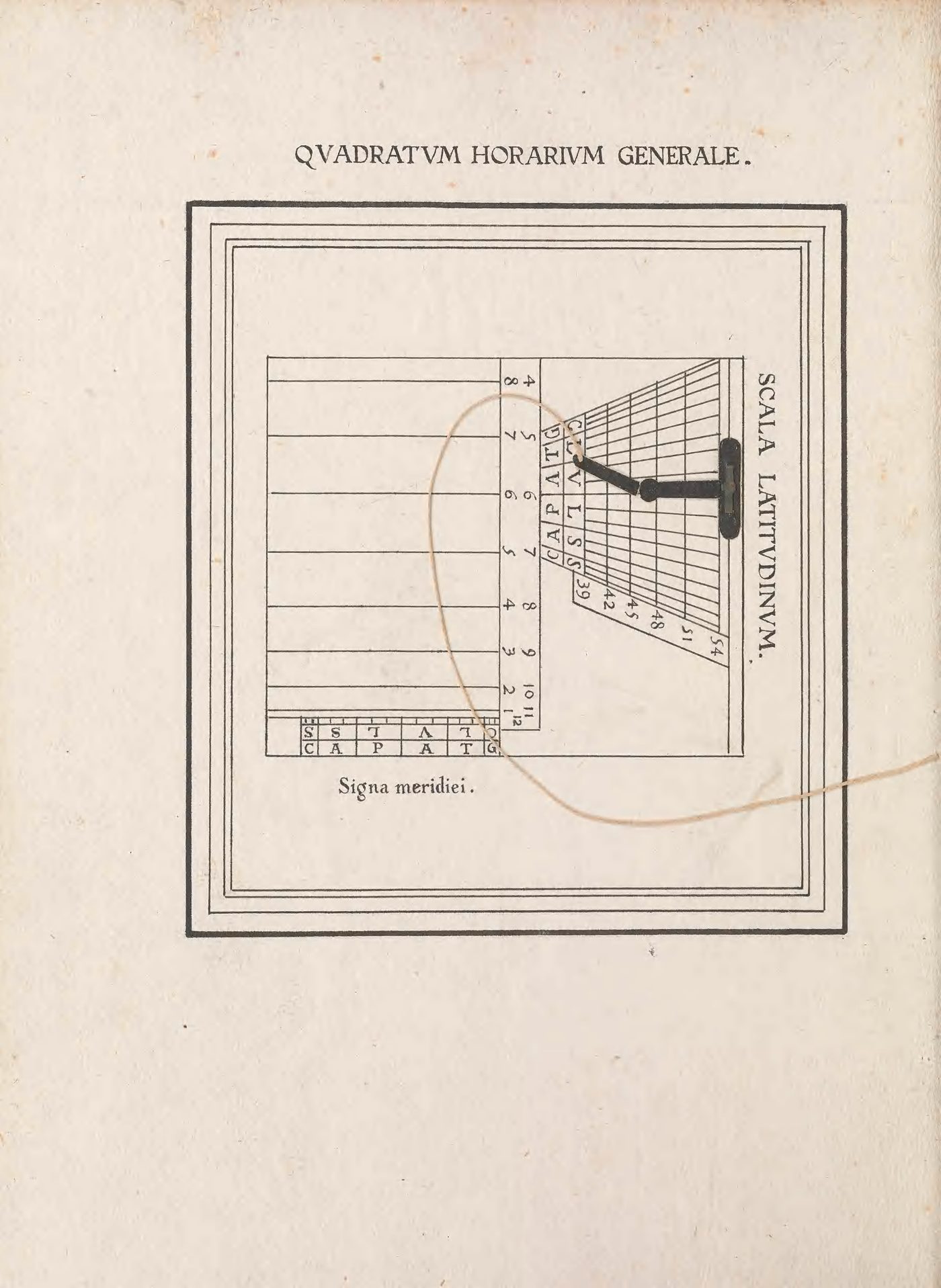
The Kalendarium ends with four full-page woodcut instruments. In this copy the lunar instrument alone has moving parts; the last, the universal horary quadrant, keeps its mounted brass pointer and a thread. The other three are shown here as photographed, and are next on the bench.
Sources and rights
Regiomontanus, Kalendarium (Venice: Bernhard Maler, Peter Löslein and Erhard Ratdolt, 1476), Smithsonian Libraries copy
Smithsonian Libraries, call number 39088000842542, digitised at 300 pixels to the inch and published on the Internet Archive (item aureushiclibere00regi). The lunar instrument is page image 42; the library's catalogue notes that the blank pages 40 and 41 are pasted together to support the volvelle, and pages 66 and 67 to support the mounted pointer of the last instrument. The full-resolution copy of the leaf is kept here, so the page does not depend on the Internet Archive's servers.
Rights: public domain. The Smithsonian's record states that the library considers the work no longer under copyright protection, and the Internet Archive lists no restriction; the moving parts are cut from that photograph.
The same book in Ratdolt's Venice reissue of 1482, Biblioteca Nazionale Centrale di Firenze
Consulted for comparison, on the Internet Archive from ProQuest's Early European Books. In that copy the two wheels have come loose from their pin and lie displaced, which shows the sun's face and its scale to be one piece; its images carry a ProQuest copyright line and are not used here.
Other copies of the 1476 edition
The Library of Congress (Rosenwald 221), the University of Oklahoma and the University of Glasgow (the 1482 reissue) hold copies with their instruments, described on their sites; the Library of Congress copy has the two instrument leaves each made of two leaves pasted together, like the Smithsonian's. None of those images is used here.
How the moving parts were made, and what is changed
The centre of the printed rings was fitted to the base circles of the woodcut, with a residual of about a pixel; the two wheels were cut from the photograph along their own paper edges, at 800 and 694 pixels from that centre, and turn about it. Their printed scales are concentric with the base to within three pixels, so nothing is re-centred. The sun's face is printed about three millimetres off the smaller wheel's centre and is left as it is; the old thread knotted at the centre, which lies loose across the rings to the lower right, is painted out of every layer with the texture of the same ring at other angles, and a straight thread is drawn in its place. Back to the photograph returns the wheels to where the photographer found them, with their heads at the fourth sign, twelve degrees, and the twelfth sign, twelve degrees: not a pair from the roots table, so the copy was not left set for a year.
Further reading
Ernst Zinner, Regiomontanus: His Life and Work, translated by Ezra Brown (Amsterdam, 1990), for the calendar and its editions; the University of Glasgow's Incunabula Project entry for the 1482 Venice edition, for the make-up of the volume; Jean Meeus, Astronomical Algorithms, 2nd edition (Richmond VA, 1998), chapter 47, for the modern lunar longitudes used in the check.