Fracture physics and Viking economics meet in the hack-silver hoard. When brittle materials are broken repeatedly and more or less at random, the resulting fragment masses follow a universal power-law distribution — a robust result from fragmentation physics that holds for shattered…
One Thousand and One Conjectures
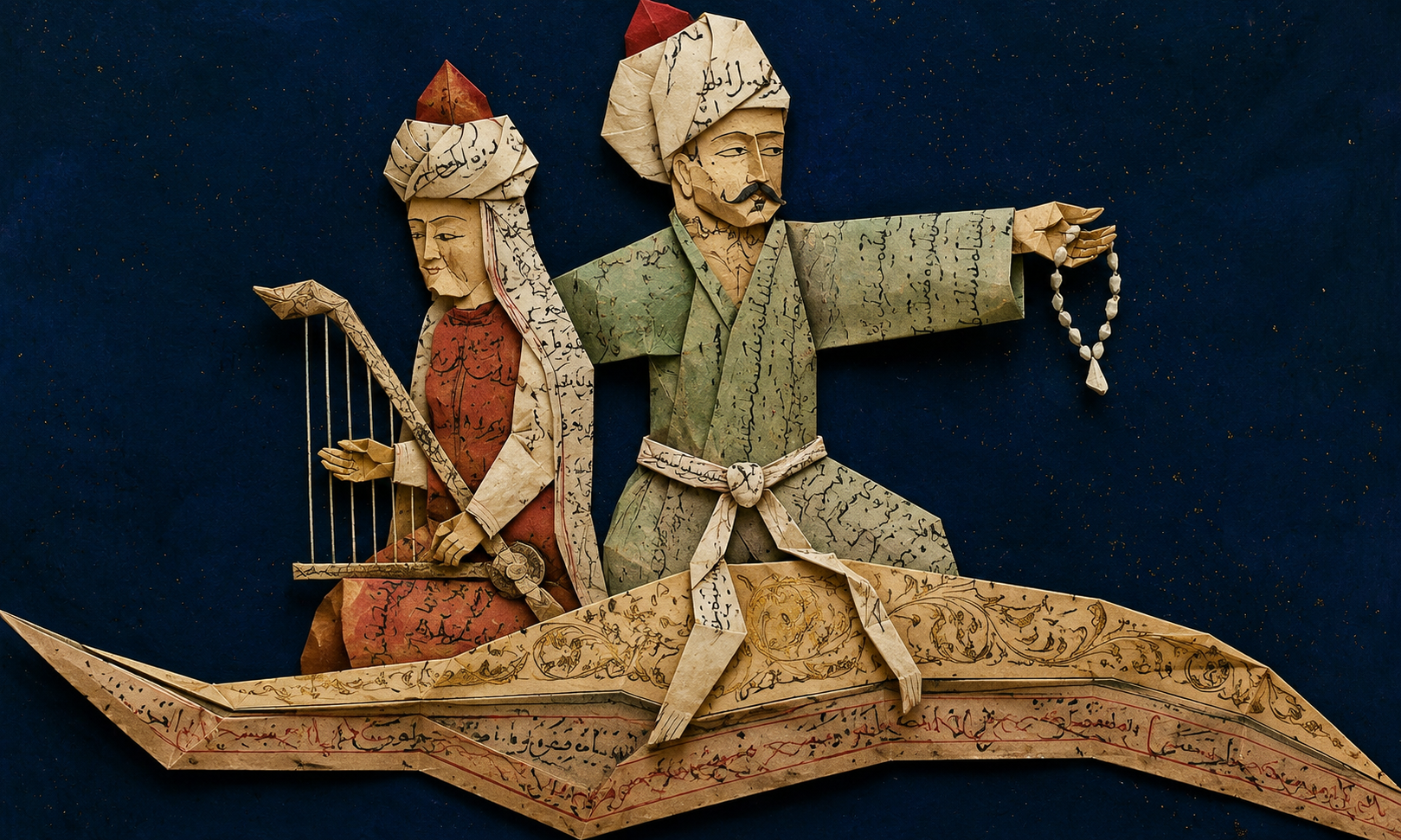
One thousand and one — an impossible number anyway: in the Nights it means more than can be counted. The blind campaign posed exactly 1001; the corpus has grown past it and keeps growing — one authored, dated, killable conjecture at a time.
1,003 posed — and counting · measured against the literature (1001 authoritative verdicts): 95 already answered · 844 anticipated — never tested · 50 no prior located · 12 resolved (6 supported / 3 killed)
Falsifiable conjectures about the pre-print world. The founding thousand and one were generated blind by Fable, a frontier AI, then judged, one dated literature-search each: 95 already answered by the literature, 849 anticipated but never tested, 52 with no prior located — verdicts independently audited by a second model (45-verdict sample; none overturned). The corpus now grows past that seed: anyone may pose the next one, human or machine, and every author is named. Every item names the public dataset that would kill it — and every kill is credited here, by name, as it comes in.
Essays What I think I don’t know · How to photograph a noetome · The 84% · The noetome, measured → · The Most-Wanted 52 →
Why these conjectures matter: charting the noetome — its structure, limits & potential →
Filter
Clear all filters
Stratum
Philosophy, theology & the schools 115
Literature & poetics 80
Institutions, law & bureaucracy 42
African book cultures 40
Eastern Christian book cultures 40
Everyday & documentary writing 40
Music, liturgy & ritual 40
South Asian text cultures 40
Byzantine book culture 35
Central & Inner Asian texts 35
Jewish book cultures 35
Texts, scribes & transmission 35
Money & economy 31
Art & iconography 30
East Asian text cultures 30
Islamicate book cultures 30
Medicine, science & the occult 30
Southeast Asian text cultures 30
The cuneiform world 30
Women & textual production 30
Book economics & scribal labour 28
Method, bridges & the corpus itself 25
Pre-Columbian American writing 25
The oral-written interface 25
Engineering, materials & building 21
Networks & trade 19
Time, sky & calendars 9
Water, land & settlement 8
Chance & decision 7
Logistics & operations 7
Navigation & discovery 4
Sound & performance 3
Community-posed 2
Conflict & collapse 2
Subject
Medieval Latin institutions and prosopography 169
Material practice and ritual action 111
Islamic and Persianate source transmission 97
South and Southeast Asian inscriptional polities 93
Greek textual transmission 83
African manuscript and source ecologies 79
Early Christian and Syriac transmission 75
East Asian manuscript and canonical transmission 73
Technical, recipe, and scientific texts 57
Jewish textual transmission 51
Egyptian papyrological and epigraphic worlds 48
Ancient Near Eastern inscriptions and succession 47
Steppe and Central Asian nomadic and Silk Road sources 42
Americas pre-Columbian and contact-era records 41
Judaism 40
Roman documentary and epigraphic culture 33
Syriac Christianity 33
Theology as a science (sacred doctrine) 24
Mediterranean maritime and connectivity sources 19
Medieval Jewish history 11
Hebrew Bible 8
Lost literary works 8
Dulia (veneration of the saints) 6
Mesopotamian administrative and accounting practice 6
Oceanic and Pacific oral-dominant source worlds 6
Lens
Manuscript and scribal production 347
Channel dissociation 75
Epigraphy and damaged inscriptions 49
Market equilibrium, price, and arbitrage 34
Stemmatics: reconstructing transmission trees from shared error 26
Survival analysis: hazard rates and half-lives 26
The comparative method and natural experiments 24
Information theory: redundancy, error-correction, and compression 22
Rank-size laws and heavy tails 22
Statistical physics: transport, percolation, criticality, and tipping points 19
Capture-recapture and unseen-species estimation 18
Diffusion of innovations and contagion 18
Costly signaling and verification 17
Network topology and centrality 17
Taphonomy and survivorship bias 17
Dialect geography: isoglosses, distance-decay, and seriation 16
Operations research: queueing, inventory, and logistics optimization 14
The molecular clock: constant-rate change as a dating instrument 10
The experience curve: learning by cumulative production 3
Kill dataset
Union catalogues 169
Critical apparatus 97
Egyptian papyri & ostraca 85
Published editions 77
Dated colophons 63
Dunhuang & Turfan hoards 59
Archaeological survey 50
Digitized texts 50
Scholastic citations 50
Chant & liturgy 49
Charters & chanceries 49
Epigraphy 49
Cuneiform archives (CDLI) 46
Witness counts (Pinakes) 46
East Asian canons 34
Byzantine book epigrams (DBBE) 33
Prices & wages 33
Astronomical tables 32
Cairo Geniza 32
Mesoamerican codices 32
Islamic manuscript culture 25
Archaeometry 22
Byzantine lead seals 17
Art & iconography 16
Not yet built 15
Fragments & bindings 12
Christian Nubia 11
Numismatics 10
Letter collections 9
Khipus 8
Hadith isnads 6
Romano-British tablets 6
Novgorod birch bark 5
The corpus itself 5
D-PLACE / Seshat 3
Browse the full kill dataset registry →
Author
Place
Status
What the tags mean
- Open — no decisive result yet
- Already answered — the specific result is already published; the citation is on the item’s page
- Anticipated · untested — the literature anticipates the direction, but this exact test has never been run — open to kill
- No prior located — a dated search found no prior formulation (in thin fields this measures the literature’s thinness, not originality)
- Supported — a registered prediction held up in data
- Falsified — a registered prediction was refuted
- testable — a quantitative prediction + kill-dataset is registered
- Shepherd-triaged — an authoritative Fable-authored verdict; shown as the pills above and the only tier in the headline numbers
- provisional — model-triaged, shepherd review pending — an Opus-authored first pass, not yet shepherd-confirmed and excluded from every headline figure
- awaiting prior-art check — hunt open — no triage yet; found a prior yourself? open it and weigh in
Triage state
Place & era tags are curatorial, authored by Claude (Opus 4.8).
Showing 1–23 of 23 matching conjectures.
Gresham's law — bad money drives out good — is here joined to the physics of phase transitions. The conjecture is that the driving-out is not gradual: when rulers debase the coinage, users tolerate the slide in silver fineness up to a…
The Polya urn — the classic mathematical model of path dependence, in which each ball drawn adds another of its color so that early luck compounds forever — is here applied to the medieval pilgrimage market. Pilgrims bought cheap metal badges at…
The gravity model of trade — flows decay with distance, and how steeply they decay depends on what the goods are worth relative to what they cost to move — is here tested on sourced ancient artifacts. Provenance science can trace both…
In the 13th century, English law adopted a rule for how far apart markets must be — the spacing derived in the classic legal reckoning from a day's return journey on foot, about 6.6 miles. The conjecture joins this statute to the…
Baltic amber moved from its northern shores to the Mediterranean through hand-to-hand exchange, and FTIR spectroscopy can certify which finds are genuinely Baltic, giving a clean tracer of prehistoric long-range flow. Physics offers a ready model for such flow: the advection–diffusion equation,…
The Cistercian order expanded by filiation — mother abbeys founding daughter houses — under statutes and economic pressures that discouraged crowding, since each abbey lived off its own granges and lands. That is the setup of competitive exclusion in ecology, where territorial…
The medieval Champagne fairs ran as a fixed annual cycle of six fairs in four towns, and the merchants of Flanders and Italy worked the whole circuit. Seen with modern eyes, scheduling that cycle is a traveling-merchant optimization: fair dates and durations…
The Shapley value, cooperative game theory's canonical answer to fair division, pays each member of a coalition its average marginal contribution to the coalition's worth. The Hanseatic League was such a coalition: member cities jointly controlled Baltic and North Sea trade routes,…
Iron Age hillforts were often built within sight of one another, and lines of sight are functional links: signals, warnings, and social monitoring all flow along intervisibility. Computed from digital elevation models, the intervisibility graph of a hillfort landscape can therefore be…
As chess spread from India across Eurasia, both its objects and its rules mutated regionally: the piece carved as an elephant in the Islamic world became the bishop in Europe, and the moves themselves varied between documented regional rule sets. Linguistics maps…
Roman aqueducts held gradients of centimeters per kilometer over tens of kilometers, and how surveyors achieved this with simple instruments is a genuine puzzle. Statistics offers a diagnostic: if each leg of a survey adds a small independent error, accumulated error grows…
Gothic churches were built in successive campaigns over decades, and masons could watch how earlier bays and earlier buildings cracked, leaned, or stood. Modern limit analysis can compute, for any buttress geometry, how far it sits from the thrust-line optimum — the…
This joins medieval craft practice to modern acoustics. An organ builder must decide how pipe diameter should vary with pipe length across a rank — too narrow and the trebles turn thin and stringy, too wide and the basses go dull —…
This joins Viking shipbuilding to modern fracture mechanics. A clinker hull is a shell of overlapping oak planks, and its worst enemy is a running split: a crack that starts at a fastening and propagates along the grain. Fracture mechanics says such…
The Bass diffusion model, the workhorse of new-technology adoption studies, splits uptake into two forces: an innovation coefficient p (adopters persuaded by external influence) and an imitation coefficient q (adopters copying their neighbours). Medieval Europe's watermill boom is a textbook diffusion process,…
Medieval masons cut personal marks into the blocks they dressed — piece-work signatures for the paymaster — and a cathedral wall therefore carries, frozen in stone, a record of who cut what. Work organisation leaves statistical fingerprints: if masons produced blocks in…
Joins stream-power hydrology to the great fiscal cadastre of 1086: the Domesday survey, in recording what each water-mill rendered to its lord, unwittingly logged a physics meter across England. A mill's earning power was set by the hydraulic power of its site…
Common-value auction theory predicts the winner's curse — the highest bidder is the one who most overestimated the shared value — and that experienced bidders learn to shade their bids downward. This conjecture finds the earliest documented correction in Venetian state finance:…
Medieval painters had almost no access to antique painting or free-standing portrait sculpture, but Roman coins passed through their world by the thousand. If coinage was the operative model medium for picturing antiquity, ancient rulers should be drawn in strict numismatic profile…
Ornament in stained glass — border types, diaper grounds, grisaille foliage — is studied inside glass scholarship, but glaziers stocked their cartoon chests from painters' books. Ornament families should therefore appear in dated manuscripts before dated glass of the same region, with…
Donor portraiture is one genre under two theologies of presence. Latin donation imagery kept renegotiating scale as lay patronage broadened and purgatorial accounting personalized the stakes; the Byzantine proskynesis format was liturgically frozen. The handbook impression that donors get bigger is not…
That Japanese handscroll action tends right-to-left is a specialist commonplace; the unestablished claim is the full mechanism test across cultures. If lateral bias comes from the reading technology — the image must hand the eye onward to the next scene — then…