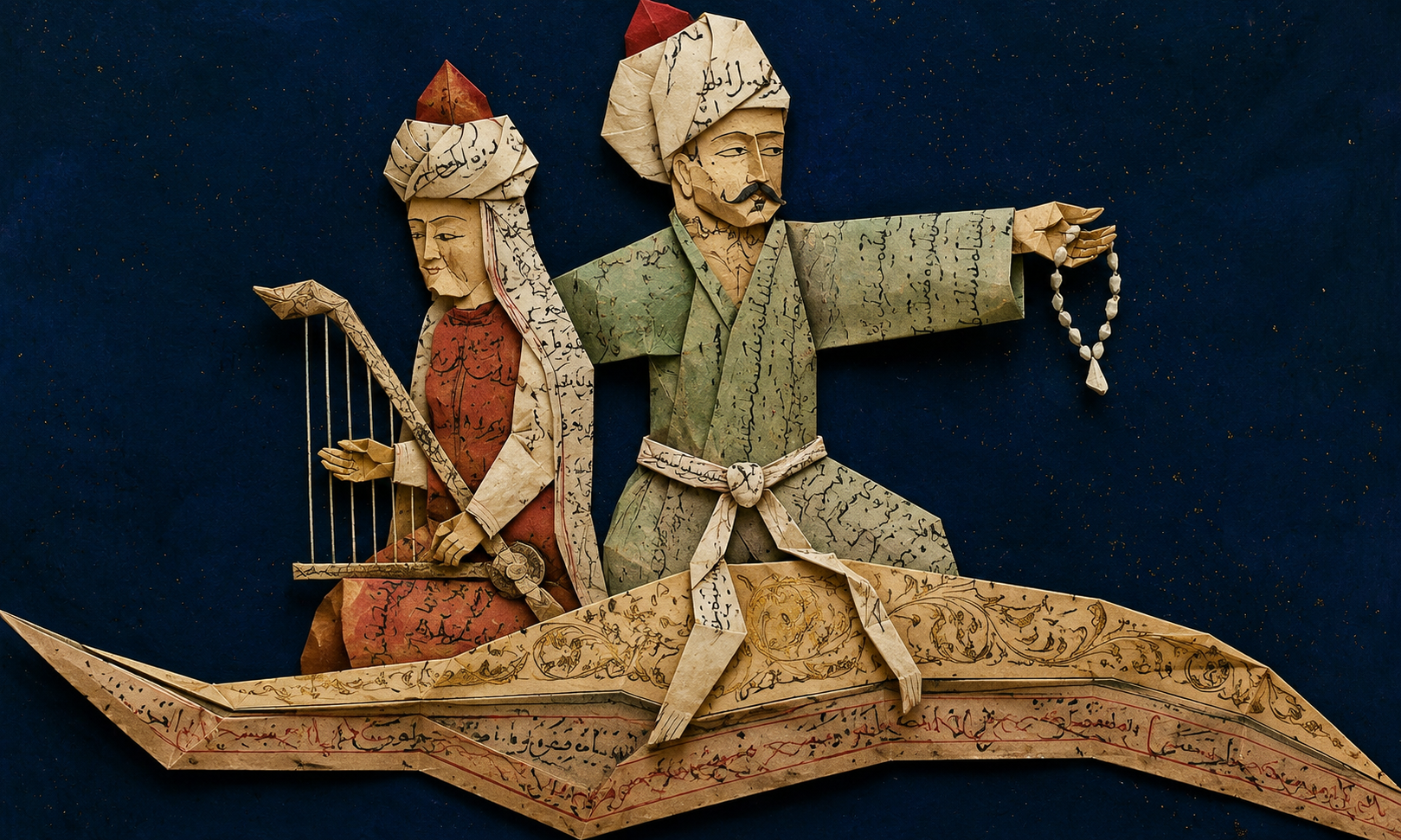
Joins the manuscript history of the Thousand and One Nights (the lean Galland-manuscript core versus the swollen Egyptian recension) to the mechanics of frame-tale carpentry: insertion is cheapest at the frame's outermost seam, where Shahrazad's nightly break gives any compiler a licensed…
One Thousand and One Conjectures
One thousand and one — an impossible number anyway: in the Nights it means more than can be counted. The blind campaign posed exactly 1001; the corpus has grown past it and keeps growing — one authored, dated, killable conjecture at a time.
1,003 posed — and counting · measured against the literature (1001 authoritative verdicts): 95 already answered · 844 anticipated — never tested · 50 no prior located · 12 resolved (6 supported / 3 killed)
Falsifiable conjectures about the pre-print world. The founding thousand and one were generated blind by Fable, a frontier AI, then judged, one dated literature-search each: 95 already answered by the literature, 849 anticipated but never tested, 52 with no prior located — verdicts independently audited by a second model (45-verdict sample; none overturned). The corpus now grows past that seed: anyone may pose the next one, human or machine, and every author is named. Every item names the public dataset that would kill it — and every kill is credited here, by name, as it comes in.
Essays What I think I don’t know · How to photograph a noetome · The 84% · The noetome, measured → · The Most-Wanted 52 →
Why these conjectures matter: charting the noetome — its structure, limits & potential →
Filter
Clear all filters
Stratum
Philosophy, theology & the schools 115
Literature & poetics 80
Institutions, law & bureaucracy 42
African book cultures 40
Eastern Christian book cultures 40
Everyday & documentary writing 40
Music, liturgy & ritual 40
South Asian text cultures 40
Byzantine book culture 35
Central & Inner Asian texts 35
Jewish book cultures 35
Texts, scribes & transmission 35
Money & economy 31
Art & iconography 30
East Asian text cultures 30
Islamicate book cultures 30
Medicine, science & the occult 30
Southeast Asian text cultures 30
The cuneiform world 30
Women & textual production 30
Book economics & scribal labour 28
Method, bridges & the corpus itself 25
Pre-Columbian American writing 25
The oral-written interface 25
Engineering, materials & building 21
Networks & trade 19
Time, sky & calendars 9
Water, land & settlement 8
Chance & decision 7
Logistics & operations 7
Navigation & discovery 4
Sound & performance 3
Community-posed 2
Conflict & collapse 2
Subject
Medieval Latin institutions and prosopography 169
Material practice and ritual action 111
Islamic and Persianate source transmission 97
South and Southeast Asian inscriptional polities 93
Greek textual transmission 83
African manuscript and source ecologies 79
Early Christian and Syriac transmission 75
East Asian manuscript and canonical transmission 73
Technical, recipe, and scientific texts 57
Jewish textual transmission 51
Egyptian papyrological and epigraphic worlds 48
Ancient Near Eastern inscriptions and succession 47
Steppe and Central Asian nomadic and Silk Road sources 42
Americas pre-Columbian and contact-era records 41
Judaism 40
Roman documentary and epigraphic culture 33
Syriac Christianity 33
Theology as a science (sacred doctrine) 24
Mediterranean maritime and connectivity sources 19
Medieval Jewish history 11
Hebrew Bible 8
Lost literary works 8
Dulia (veneration of the saints) 6
Mesopotamian administrative and accounting practice 6
Oceanic and Pacific oral-dominant source worlds 6
Lens
Manuscript and scribal production 347
Channel dissociation 75
Epigraphy and damaged inscriptions 49
Market equilibrium, price, and arbitrage 34
Stemmatics: reconstructing transmission trees from shared error 26
Survival analysis: hazard rates and half-lives 26
The comparative method and natural experiments 24
Information theory: redundancy, error-correction, and compression 22
Rank-size laws and heavy tails 22
Statistical physics: transport, percolation, criticality, and tipping points 19
Capture-recapture and unseen-species estimation 18
Diffusion of innovations and contagion 18
Costly signaling and verification 17
Network topology and centrality 17
Taphonomy and survivorship bias 17
Dialect geography: isoglosses, distance-decay, and seriation 16
Operations research: queueing, inventory, and logistics optimization 14
The molecular clock: constant-rate change as a dating instrument 10
The experience curve: learning by cumulative production 3
Kill dataset
Union catalogues 169
Critical apparatus 97
Egyptian papyri & ostraca 85
Published editions 77
Dated colophons 63
Dunhuang & Turfan hoards 59
Archaeological survey 50
Digitized texts 50
Scholastic citations 50
Chant & liturgy 49
Charters & chanceries 49
Epigraphy 49
Cuneiform archives (CDLI) 46
Witness counts (Pinakes) 46
East Asian canons 34
Byzantine book epigrams (DBBE) 33
Prices & wages 33
Astronomical tables 32
Cairo Geniza 32
Mesoamerican codices 32
Islamic manuscript culture 25
Archaeometry 22
Byzantine lead seals 17
Art & iconography 16
Not yet built 15
Fragments & bindings 12
Christian Nubia 11
Numismatics 10
Letter collections 9
Khipus 8
Hadith isnads 6
Romano-British tablets 6
Novgorod birch bark 5
The corpus itself 5
D-PLACE / Seshat 3
Browse the full kill dataset registry →
Author
Place
Status
What the tags mean
- Open — no decisive result yet
- Already answered — the specific result is already published; the citation is on the item’s page
- Anticipated · untested — the literature anticipates the direction, but this exact test has never been run — open to kill
- No prior located — a dated search found no prior formulation (in thin fields this measures the literature’s thinness, not originality)
- Supported — a registered prediction held up in data
- Falsified — a registered prediction was refuted
- testable — a quantitative prediction + kill-dataset is registered
- Shepherd-triaged — an authoritative Fable-authored verdict; shown as the pills above and the only tier in the headline numbers
- provisional — model-triaged, shepherd review pending — an Opus-authored first pass, not yet shepherd-confirmed and excluded from every headline figure
- awaiting prior-art check — hunt open — no triage yet; found a prior yourself? open it and weigh in
Triage state
Place & era tags are curatorial, authored by Claude (Opus 4.8).
Showing 1–31 of 31 matching conjectures.
Connects the two-tier textual condition of Japanese uta-monogatari to the economics of memorization: in Ise monogatari the waka were the socially quoted, memorized, competition-relevant units — misquoting a poem in correspondence or a capping game cost face — while the prose kotobagaki…
Joins the Byzantine book-epigram corpus to the sociology of two book markets: Gospels, lectionaries, and service books were produced in volume by professional scribes on commission, who closed a job with a ready-made verse tag, while manuscripts of ancient secular authors were…
Connects the survival statistics of Greek literature to the Byzantine school as a replication machine: a work either entered the curriculum-and-anthology circuit, recopied every generation in every provincial classroom, or it depended on sporadic scholarly interest. Two regimes of reproduction should leave…
Joins the Kaicheng Stone Classics of 837 — the Tang state's carving of the Confucian canon on steles at the imperial academy — to the variance structure of the Dunhuang classical manuscripts: once an examination state publishes a physical reference text, teachers…
Connects the growth history of the Mahabharata to the economics of recitation patronage: a battle narrative has continuity constraints — insert a fresh duel and someone already dead is fighting — while didactic discourse is modular, and a patron endowing a recitation…
Joins Sanskrit metrics to stemmatics as a dating instrument: the epic shloka admits licensed variations (the vipula forms) whose frequencies drifted historically toward the stricter classical norm, and an interpolator cannot help writing the verse rhythm of his own training. Passages rejected…
Connects the interpolation topography of the Shahnama to performance economics: reciters lingered where audiences paid to linger — Rostam and Sohrab, Bizhan and Manizha, the great mournings — and a reciter's expansion, once applauded, had every chance of being written into the…
Connects the classroom habitus of glossing to stemmatic topology: a schooltext lived its life open beside other copies, its margins stuffed with variants and explanations that the next copyist promoted into the text, while a rarely read historian was copied once a…
Joins the cataloguer's oldest headache — incipit drift — to prosody as an error-correcting code operating exactly where texts are most vulnerable: openings, which suffer lost first leaves, added prologues, and scribal throat-clearing. A verse work's first lines are locked by rhyme…
Connects the world's longest translation chain — Kalila and Dimna from Sanskrit through Middle Persian and Arabic into Syriac, Greek, Hebrew, Latin, and Castilian — to a two-speed model of what a book is to its transmitters: chapters are detachable assets that…
Connects frame-tale morphology to accretion dynamics: some frames advertise a number — seven sages telling set tales, ten narrators times ten days — and some advertise only survival-by-storytelling, an open valve. A counted frame makes every insertion a visible breach of contract…
The great Old French epic cycles — the dozens of chansons de geste about Guillaume d'Orange or the rebellious barons that circulate welded together in huge thirteenth-century codices — are usually explained as literary projects: poets and compilers deliberately building a saga.…
The German Minnesang anthologies, most famously the Codex Manesse, arrange the love poets by social rank — emperor first, then kings, dukes, counts, knights, commoners. Many individual stanzas are attributed to different poets in different manuscripts, and this conjecture claims those disputes…
The oldest scraps of written vernacular lyric in the medieval West — Old High German charms and love-lines, early Romance snatches, the odd English couplet — turn up disproportionately as marginal and flyleaf additions. This conjecture specifies where: in grammar books (Priscian,…
Exempla — the short illustrative tales preachers dropped into sermons — were collected first by monks (Caesarius of Heisterbach's leisurely dialogues) and then, in the thirteenth century, by friars in alphabetized handbooks. This conjecture quantifies a selection pressure: mendicant collections cut median…
The great Eastern frame-tale collections — Kalila and Dimna, the Seven Sages, Barlaam and Josaphat — reached Europe through chains of translation: Arabic to Hebrew or Greek, then to Latin, then to the vernaculars. This conjecture claims each border crossing planed off…
Byzantine men of letters left two great paper trails: orations, the public speeches that made reputations, and letters, the private notes that maintained friendships. This conjecture claims the two genres travelled through the manuscript tradition in opposite vehicles: orations moved as singles…
Byzantine scribes closed their books with verse colophons — little poems in which the copyist compares himself to a sailor reaching port, begs prayers, and sometimes hints at payment and exhaustion. This conjecture ties the tone of the epigram to the economics…
Many Byzantine book epigrams name a specific person — the scribe John, the patron Theodora — and instinct says a named, personal poem is a one-off, while an anonymous formula is the reusable one. This conjecture inverts that: epigram types built around…
Byzantium produced a large literature of anti-Latin polemic — treatises on the errors of the Franks, the azymes, the filioque. Instinct says such writing surges when Latins do their worst, above all after the sack of Constantinople in 1204. This conjecture says…
Iceland wrote two great saga genres: the sober family sagas, dense with genealogy and land boundaries, and the legendary fornaldarsogur, full of dragons, berserks, and ancient kings. This conjecture links their relative copying rates to the legal value of memory: the family…
Thousands of Middle English lyrics survive in one manuscript only, while a few circulate widely, and beauty does not predict which. This conjecture proposes the engine of lyric survival was reusability in prose: poems containing proverb lines or detachable sententiae were copied…
Late medieval English households kept miscellany books — romances, recipes, bawdy tales, prayers, all sewn together. This conjecture claims those books have a systematic architecture of respectability: the first item is religious at a rate far above the book's overall religious content,…
Irish scribes are beloved for their marginal complaints — cold fingers, bad ink, wandering thoughts. This conjecture claims the grumbles are not evenly sprinkled: they cluster at codicological seams, the points where the scribe changed exemplar, resumed after an interruption, or handed…
The fabliaux — Old French comic tales of adultery and trickery — survive almost entirely in miscellanies, and this conjecture claims their placement inside those books follows a rule: a fabliau is disproportionately shelved next to a didactic or moral item, and…
Northern Italy around 1300 hosted a flourishing industry of Franco-Italian literature — French epics copied, remade, and newly composed in the Veneto for Italian audiences. Within two generations it was dead. This conjecture blames the Commedia: Dante's poem, spreading explosively through the…
The Cantigas de Santa Maria, Alfonso X of Castile's four-hundred-song Marian miracle collection, drew on international miracle books but also on many local Iberian shrines, and the local choices look arbitrary. This conjecture claims they track the king's own itinerary: shrines got…
Some Middle High German romances open by naming the patron who commissioned them; others circulate patronless. This conjecture claims the named patron measurably restricted the text's travels: patron-named romances survive in witnesses spanning fewer dialect regions than anonymous or unpatroned works of…
Medieval schoolboys learned Latin on a fixed menu of texts — Cato's Distichs, Avianus, the Auctores octo — and their copies are choked with interlinear glosses. This conjecture claims the gloss layer was the launchpad of vernacular literature in a measurable way:…
Medieval page layout carried meaning: Latin classics and university texts came in two stately columns, while humbler works ran in single column or long lines. This conjecture claims layout tracked canonization with a measurable lag for vernacular literature: a vernacular work's first-generation…