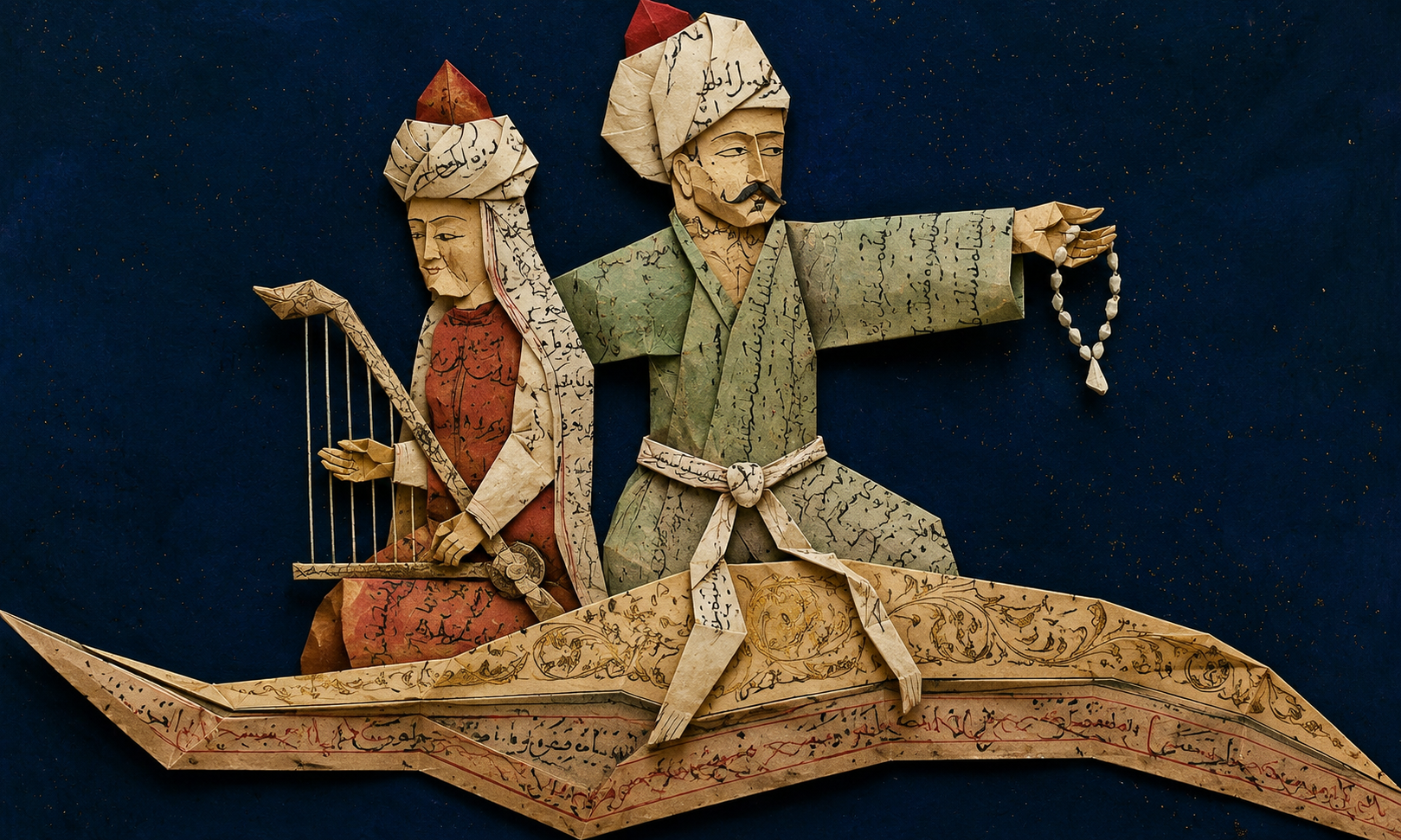
One thousand and one — an impossible number anyway: in the Nights it means more than can be counted. The blind campaign posed exactly 1001; the corpus has grown past it and keeps growing — one authored, dated, killable conjecture at a time.
Falsifiable conjectures about the pre-print world. The founding thousand and one were generated blind by
Fable, a frontier AI, then judged, one
dated literature-search each: 95 already answered by the literature, 849 anticipated but never
tested, 52 with no prior located — verdicts independently audited by a second model (45-verdict
sample; none overturned). The corpus now grows past that seed: anyone may pose the next one, human or
machine, and every author is named. Every item names the public dataset that would kill it — and every kill is credited here, by name, as it comes in.
The Yule process — the preferential-attachment mathematics behind power laws in citations, city sizes, and web links — is here applied to the medieval book world. A text gets copied because copies of it exist to be found and read: every extant…
The Tabula Peutingeriana, the famous medieval copy of a Roman route map, was almost certainly compiled from multiple earlier itineraries rather than drawn from any single survey. Each source itinerary would carry its own error habits — its own units, rounding conventions,…
Joins the econometrics of common shocks — identifying a shared cause from synchronized movements in otherwise unrelated series — to Eastern Christian codicology. Syriac and Armenian manuscript production ran in different languages, churches, and scribal cultures; almost the only thing the two…
In critical phenomena, systems that differ microscopically collapse onto a single curve after rescaling — the signature of a shared universality class. This conjecture claims textual survival has exactly one such class. Greek works at large, catalogued in Pinakes' 21,500 works, and…
Parchment is made from animal skins, so a sheet of vellum is effectively a livestock derivative — every codex embodies a slaughtered calf, sheep, or goat. This ties the medieval book trade to the health of the herd: when a cattle plague…
Medieval Easter tables list several parallel columns — golden number, epact, dominical letter, indiction — each computed from the same underlying calendrical cycles, so any one column can in principle be re-derived from the others. That mutual derivability is exactly the structure…
Scribes routinely closed their work with self-deprecating apologies — “forgive the faults of the unworthy scribe” — and the naive reading treats these as confessions from careless copyists. The claim inverts that: such formulae are costly quality signals, the mark of a…
An abecedarium — a written-out sequence of an alphabet in its canonical order — is copied and taught from teacher to pupil down the generations, and each retransmission risks small changes to the order: a transposition, an inserted letter, a dropped one.…
When binders needed stiffening material they cannibalised old manuscripts, cutting them into the waste fragments now recovered from bindings. The naive model treats this as physical wear-out — books used until they fell apart — which would produce a smooth aging hazard.…
Monastic scribes copied in the gaps left by the agricultural year, bending to the pen most heavily in the dead of winter when the fields demanded nothing; urban professional copyists, decoupled from farm labour, worked to a flat year-round rhythm driven by…
A scribe copying from an exemplar in front of him makes errors of the eye — confusing letters that look alike — whereas a scribe taking down a text read aloud, as in dictation or the pecia system of mass university production,…
Island biogeography famously finds that the number of species an island supports scales with its area as a power law, S = cA^z, with a characteristically shallow exponent. The claim ports this law to writing: a region is an “island” for scripts,…
Guido of Arezzo's staff notation — the 11th-century invention that fixed pitches on lines rather than leaving them to memory-jogging squiggles — is here treated as an error-correcting code, and its effect on transmission is claimed to be discontinuous rather than gradual.…
Radiocarbon dating works because decay happens at a constant rate; the conjecture is that manuscript copying does too. Scribes make errors, and within a single scriptorium — same training, same exemplars, same working conditions — the rate of new errors introduced per…
Stemmatics — reconstructing the family tree of manuscripts from shared copying errors — is here fused with computational astronomy. A dated horoscope is a calculation: the astrologer looked up planetary positions in one specific physical copy of a set of astronomical tables…
Two transmission technologies for Sanskrit ran side by side for centuries: the mnemonic machinery of Vedic recitation — interlocking recitation modes and error-checking permutations built to preserve the Rigveda syllable-perfect — and ordinary manuscript copying, which carried texts like the Mahābhārata. Philologists…
Joins capture-recapture ecology to Greek philology: ecologists estimate how many species they have never seen from the ratio of species observed exactly once to species observed exactly twice, and the same arithmetic applies to books. Each surviving witness to a Greek work…
Joins neutral models of cultural evolution to Byzantine book epigrams — the short verses scribes copied into margins and colophons, catalogued by type in the DBBE. Under the standard rich-get-richer model of cultural copying, an epigram type spreads because scribes copy what…
Joins the statistics of radioactive decay and modern firm-survival analysis to monastic geography: manuscript-producing places, the claim runs, went extinct at a constant hazard, like unstable isotopes. The mechanism is that the deaths of scriptoria were dominated by external shocks — raids,…
Joins the cognitive psychology of recall to the stemmatics of oral law. The serial-position curve is among psychology's oldest findings: in reproducing a fixed sequence, people hold the beginning and end best and blur the middle. Iceland's law was exactly such a…
In asset pricing, the single-factor market model says every stock, however idiosyncratic, loads positively on one common market factor. This conjecture applies it to Eastern Christian book production: the Syriac, Armenian, Coptic, Ethiopic, Georgian and other traditions were doctrinally separated and institutionally…
Phase separation in soft-matter physics says a mixture of immiscible components does not sit stably at half-and-half: it demixes into nearly pure domains, depleting the middle of the composition spectrum. This conjecture applies that instability to monastic geography in the vHMML catalogues…
The cutting-stock problem of operations research — how to cut standard stock into pieces with minimal waste — meets codicology. This conjecture holds that parchment page sizes were not aesthetic free choices but near-optimal cuts of animal skins: a skin is a…
Technology-diffusion theory describes adoption lags that collapse as a transmission channel routinizes; this conjecture measures that lag curve in Timbuktu codicology. Between 1400 and 1600 the Sahara's intellectual bandwidth tripled: pilgrimage traffic, commercial caravan routes, and the rise of Sankore scholarship turned…
Packet-switched content distribution splits a file into chunks that travel independently and reassemble at the destination; the medieval university book trade did the same with texts. Under the pecia system, stationers chunked an exemplar into pieces rented out separately, so a single…
Joins the manuscript history of the Thousand and One Nights (the lean Galland-manuscript core versus the swollen Egyptian recension) to the mechanics of frame-tale carpentry: insertion is cheapest at the frame's outermost seam, where Shahrazad's nightly break gives any compiler a licensed…
Connects the two-tier textual condition of Japanese uta-monogatari to the economics of memorization: in Ise monogatari the waka were the socially quoted, memorized, competition-relevant units — misquoting a poem in correspondence or a capping game cost face — while the prose kotobagaki…
Joins the Byzantine book-epigram corpus to the sociology of two book markets: Gospels, lectionaries, and service books were produced in volume by professional scribes on commission, who closed a job with a ready-made verse tag, while manuscripts of ancient secular authors were…
Connects the survival statistics of Greek literature to the Byzantine school as a replication machine: a work either entered the curriculum-and-anthology circuit, recopied every generation in every provincial classroom, or it depended on sporadic scholarly interest. Two regimes of reproduction should leave…
Joins the Kaicheng Stone Classics of 837 — the Tang state's carving of the Confucian canon on steles at the imperial academy — to the variance structure of the Dunhuang classical manuscripts: once an examination state publishes a physical reference text, teachers…
Connects the growth history of the Mahabharata to the economics of recitation patronage: a battle narrative has continuity constraints — insert a fresh duel and someone already dead is fighting — while didactic discourse is modular, and a patron endowing a recitation…
Joins Sanskrit metrics to stemmatics as a dating instrument: the epic shloka admits licensed variations (the vipula forms) whose frequencies drifted historically toward the stricter classical norm, and an interpolator cannot help writing the verse rhythm of his own training. Passages rejected…
Connects the interpolation topography of the Shahnama to performance economics: reciters lingered where audiences paid to linger — Rostam and Sohrab, Bizhan and Manizha, the great mournings — and a reciter's expansion, once applauded, had every chance of being written into the…
Connects the classroom habitus of glossing to stemmatic topology: a schooltext lived its life open beside other copies, its margins stuffed with variants and explanations that the next copyist promoted into the text, while a rarely read historian was copied once a…
Joins the cataloguer's oldest headache — incipit drift — to prosody as an error-correcting code operating exactly where texts are most vulnerable: openings, which suffer lost first leaves, added prologues, and scribal throat-clearing. A verse work's first lines are locked by rhyme…
Connects the world's longest translation chain — Kalila and Dimna from Sanskrit through Middle Persian and Arabic into Syriac, Greek, Hebrew, Latin, and Castilian — to a two-speed model of what a book is to its transmitters: chapters are detachable assets that…
Connects frame-tale morphology to accretion dynamics: some frames advertise a number — seven sages telling set tales, ten narrators times ten days — and some advertise only survival-by-storytelling, an open valve. A counted frame makes every insertion a visible breach of contract…
the Mithila school's teaching monopoly in early Navya-Nyaya was a copying monopoly too, and it left a permanent physical signature. Works of the monopoly period should circulate almost exclusively in eastern scripts, while pre-monopoly Nyaya classics show pan-Indian script spread — institutional…
Byzantine book epigrams stratify by the industrial structure of the copying that carried them. Liturgical and biblical books were produced by professional scribes reproducing a whole book-object, paratexts included, so their epigrams are mass-replicated formulae; philosophical manuscripts were copied by and for…
This connects Arabic quire structure with the economics of the paper trade. Arabic codices characteristically use quinions (five-bifolium gatherings) where Greek, Syriac, and Latin books use quaternions, and the difference is usually filed under scribal custom. The conjecture: the quinion is a…
This connects hisba-literature complaints about copyists with measurable page economics. The market inspectors' manuals warn that copyists paid by the quire enlarge their script and widen spacing to inflate the folio count. If the warning tracked real practice rather than moralist boilerplate,…
This connects collation practice with the error spectrum of the resulting copies. Muqabala was typically performed aloud: one party reads the exemplar while the other follows the new copy. An acoustic channel catches what the ear can hear, namely omitted words, skipped…
This connects paper-trade standardization with the size distribution of surviving books. Paper left the mill in named full-sheet formats, and books were cut as the full sheet, its half, its quarter, its eighth; a warraq's stock was a ladder, not a continuum.…
This connects the known takeover of the Islamic paper market by European mills with a datable moving boundary in the codicological record. Watermarked Italian paper displaced Oriental laid paper, but not everywhere at once: it should have swept as a front, arriving…
This connects a demographer's instrument with scribal diplomatics. Dates recalled or reconstructed from memory heap on round numbers; dates written down on the day itself do not. A colophon is written at the moment of completion, often with weekday and month attached…
This connects the colophon's weekday with devotional time-keeping in the workshop. Completion of a copy was an event, and the khatma carried blessing; a scribe nearing the end of the final quire could steer the finish to a blessed day, and had…
This connects recension competition with institutional canonization dynamics. Malik's Muwatta circulated in well over a dozen riwayat; today one, that of Yahya al-Laythi, simply is the Muwatta. The conjecture: recension shares do not drift smoothly toward a winner. They show punctuated equilibrium,…
This connects the composite volume (majmuʿa) with the curriculum's fossil record. A majmuʿa looks like a miscellany, but owners bound the treatises they studied together, in the order and company they studied them. Across thousands of independently assembled volumes, the same small…
This connects art patronage with textual growth in the Persian epic tradition. Shahnama copies vary by thousands of verses, and the variation is usually treated as scribal drift. The conjecture: interpolation was patron-driven. A royal commission was a completeness market, the fullest…
This connects the palimpsest census with the communal boundaries of the paper economy. Once paper was cheap, scraping parchment stopped paying for anyone who bought materials on the open market, and the Muslim urban book trade lived on that market. Monastic communities…