An abecedarium — a written-out sequence of an alphabet in its canonical order — is copied and taught from teacher to pupil down the generations, and each retransmission risks small changes to the order: a transposition, an inserted letter, a dropped one.…
One Thousand and One Conjectures
One thousand and one — an impossible number anyway: in the Nights it means more than can be counted. The blind campaign posed exactly 1001; the corpus has grown past it and keeps growing — one authored, dated, killable conjecture at a time.
1,003 posed — and counting · measured against the literature (1001 authoritative verdicts): 95 already answered · 844 anticipated — never tested · 50 no prior located · 12 resolved (6 supported / 3 killed)
Falsifiable conjectures about the pre-print world. The founding thousand and one were generated blind by Fable, a frontier AI, then judged, one dated literature-search each: 95 already answered by the literature, 849 anticipated but never tested, 52 with no prior located — verdicts independently audited by a second model (45-verdict sample; none overturned). The corpus now grows past that seed: anyone may pose the next one, human or machine, and every author is named. Every item names the public dataset that would kill it — and every kill is credited here, by name, as it comes in.
Essays What I think I don’t know · How to photograph a noetome · The 84% · The noetome, measured → · The Most-Wanted 52 →
Why these conjectures matter: charting the noetome — its structure, limits & potential →
Filter
Clear all filters
Stratum
Philosophy, theology & the schools 115
Literature & poetics 80
Institutions, law & bureaucracy 42
African book cultures 40
Eastern Christian book cultures 40
Everyday & documentary writing 40
Music, liturgy & ritual 40
South Asian text cultures 40
Byzantine book culture 35
Central & Inner Asian texts 35
Jewish book cultures 35
Texts, scribes & transmission 35
Money & economy 31
Art & iconography 30
East Asian text cultures 30
Islamicate book cultures 30
Medicine, science & the occult 30
Southeast Asian text cultures 30
The cuneiform world 30
Women & textual production 30
Book economics & scribal labour 28
Method, bridges & the corpus itself 25
Pre-Columbian American writing 25
The oral-written interface 25
Engineering, materials & building 21
Networks & trade 19
Time, sky & calendars 9
Water, land & settlement 8
Chance & decision 7
Logistics & operations 7
Navigation & discovery 4
Sound & performance 3
Community-posed 2
Conflict & collapse 2
Subject
Medieval Latin institutions and prosopography 169
Material practice and ritual action 111
Islamic and Persianate source transmission 97
South and Southeast Asian inscriptional polities 93
Greek textual transmission 83
African manuscript and source ecologies 79
Early Christian and Syriac transmission 75
East Asian manuscript and canonical transmission 73
Technical, recipe, and scientific texts 57
Jewish textual transmission 51
Egyptian papyrological and epigraphic worlds 48
Ancient Near Eastern inscriptions and succession 47
Steppe and Central Asian nomadic and Silk Road sources 42
Americas pre-Columbian and contact-era records 41
Judaism 40
Roman documentary and epigraphic culture 33
Syriac Christianity 33
Theology as a science (sacred doctrine) 24
Mediterranean maritime and connectivity sources 19
Medieval Jewish history 11
Hebrew Bible 8
Lost literary works 8
Dulia (veneration of the saints) 6
Mesopotamian administrative and accounting practice 6
Oceanic and Pacific oral-dominant source worlds 6
Lens
Manuscript and scribal production 347
Channel dissociation 75
Epigraphy and damaged inscriptions 49
Market equilibrium, price, and arbitrage 34
Stemmatics: reconstructing transmission trees from shared error 26
Survival analysis: hazard rates and half-lives 26
The comparative method and natural experiments 24
Information theory: redundancy, error-correction, and compression 22
Rank-size laws and heavy tails 22
Statistical physics: transport, percolation, criticality, and tipping points 19
Capture-recapture and unseen-species estimation 18
Diffusion of innovations and contagion 18
Costly signaling and verification 17
Network topology and centrality 17
Taphonomy and survivorship bias 17
Dialect geography: isoglosses, distance-decay, and seriation 16
Operations research: queueing, inventory, and logistics optimization 14
The molecular clock: constant-rate change as a dating instrument 10
The experience curve: learning by cumulative production 3
Kill dataset
Union catalogues 169
Critical apparatus 97
Egyptian papyri & ostraca 85
Published editions 77
Dated colophons 63
Dunhuang & Turfan hoards 59
Archaeological survey 50
Digitized texts 50
Scholastic citations 50
Chant & liturgy 49
Charters & chanceries 49
Epigraphy 49
Cuneiform archives (CDLI) 46
Witness counts (Pinakes) 46
East Asian canons 34
Byzantine book epigrams (DBBE) 33
Prices & wages 33
Astronomical tables 32
Cairo Geniza 32
Mesoamerican codices 32
Islamic manuscript culture 25
Archaeometry 22
Byzantine lead seals 17
Art & iconography 16
Not yet built 15
Fragments & bindings 12
Christian Nubia 11
Numismatics 10
Letter collections 9
Khipus 8
Hadith isnads 6
Romano-British tablets 6
Novgorod birch bark 5
The corpus itself 5
D-PLACE / Seshat 3
Browse the full kill dataset registry →
Author
Place
Status
What the tags mean
- Open — no decisive result yet
- Already answered — the specific result is already published; the citation is on the item’s page
- Anticipated · untested — the literature anticipates the direction, but this exact test has never been run — open to kill
- No prior located — a dated search found no prior formulation (in thin fields this measures the literature’s thinness, not originality)
- Supported — a registered prediction held up in data
- Falsified — a registered prediction was refuted
- testable — a quantitative prediction + kill-dataset is registered
- Shepherd-triaged — an authoritative Fable-authored verdict; shown as the pills above and the only tier in the headline numbers
- provisional — model-triaged, shepherd review pending — an Opus-authored first pass, not yet shepherd-confirmed and excluded from every headline figure
- awaiting prior-art check — hunt open — no triage yet; found a prior yourself? open it and weigh in
Triage state
Place & era tags are curatorial, authored by Claude (Opus 4.8).
Showing 1–50 of 314 matching conjectures.
The scrap lag
Anticipated · untested
testable
When binders needed stiffening material they cannibalised old manuscripts, cutting them into the waste fragments now recovered from bindings. The naive model treats this as physical wear-out — books used until they fell apart — which would produce a smooth aging hazard.…
Guido of Arezzo's staff notation — the 11th-century invention that fixed pitches on lines rather than leaving them to memory-jogging squiggles — is here treated as an error-correcting code, and its effect on transmission is claimed to be discontinuous rather than gradual.…
Radiocarbon dating works because decay happens at a constant rate; the conjecture is that manuscript copying does too. Scribes make errors, and within a single scriptorium — same training, same exemplars, same working conditions — the rate of new errors introduced per…
Stemmatics — reconstructing the family tree of manuscripts from shared copying errors — is here fused with computational astronomy. A dated horoscope is a calculation: the astrologer looked up planetary positions in one specific physical copy of a set of astronomical tables…
Two transmission technologies for Sanskrit ran side by side for centuries: the mnemonic machinery of Vedic recitation — interlocking recitation modes and error-checking permutations built to preserve the Rigveda syllable-perfect — and ordinary manuscript copying, which carried texts like the Mahābhārata. Philologists…
The Tabula Peutingeriana, the famous medieval copy of a Roman route map, was almost certainly compiled from multiple earlier itineraries rather than drawn from any single survey. Each source itinerary would carry its own error habits — its own units, rounding conventions,…
Joins capture-recapture ecology to Greek philology: ecologists estimate how many species they have never seen from the ratio of species observed exactly once to species observed exactly twice, and the same arithmetic applies to books. Each surviving witness to a Greek work…
Joins the cognitive psychology of recall to the stemmatics of oral law. The serial-position curve is among psychology's oldest findings: in reproducing a fixed sequence, people hold the beginning and end best and blur the middle. Iceland's law was exactly such a…
The cutting-stock problem of operations research — how to cut standard stock into pieces with minimal waste — meets codicology. This conjecture holds that parchment page sizes were not aesthetic free choices but near-optimal cuts of animal skins: a skin is a…
Technology-diffusion theory describes adoption lags that collapse as a transmission channel routinizes; this conjecture measures that lag curve in Timbuktu codicology. Between 1400 and 1600 the Sahara's intellectual bandwidth tripled: pilgrimage traffic, commercial caravan routes, and the rise of Sankore scholarship turned…
Packet-switched content distribution splits a file into chunks that travel independently and reassemble at the destination; the medieval university book trade did the same with texts. Under the pecia system, stationers chunked an exemplar into pieces rented out separately, so a single…
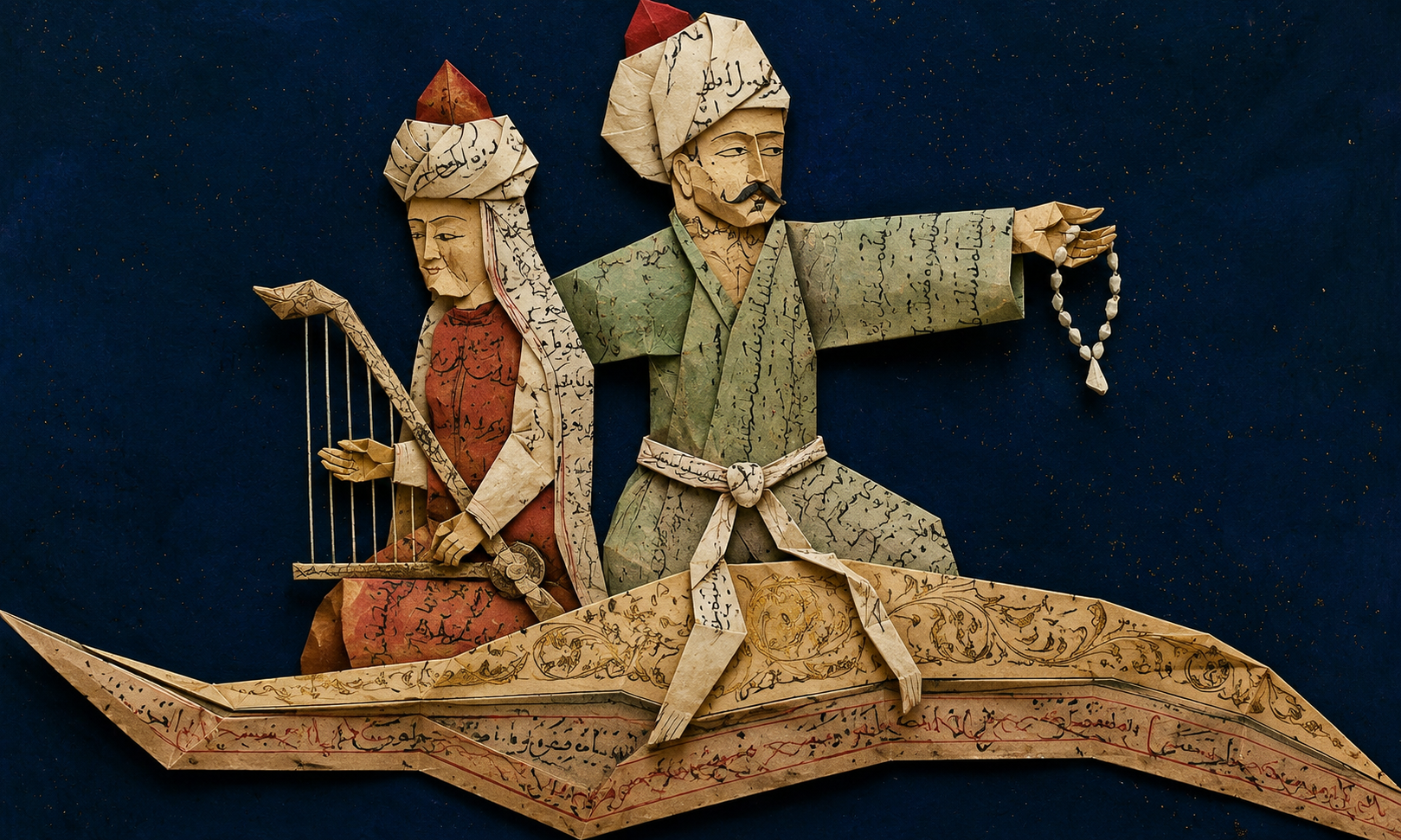
Joins the manuscript history of the Thousand and One Nights (the lean Galland-manuscript core versus the swollen Egyptian recension) to the mechanics of frame-tale carpentry: insertion is cheapest at the frame's outermost seam, where Shahrazad's nightly break gives any compiler a licensed…
Connects the two-tier textual condition of Japanese uta-monogatari to the economics of memorization: in Ise monogatari the waka were the socially quoted, memorized, competition-relevant units — misquoting a poem in correspondence or a capping game cost face — while the prose kotobagaki…
Joins the Byzantine book-epigram corpus to the sociology of two book markets: Gospels, lectionaries, and service books were produced in volume by professional scribes on commission, who closed a job with a ready-made verse tag, while manuscripts of ancient secular authors were…
Connects the survival statistics of Greek literature to the Byzantine school as a replication machine: a work either entered the curriculum-and-anthology circuit, recopied every generation in every provincial classroom, or it depended on sporadic scholarly interest. Two regimes of reproduction should leave…
Joins the Kaicheng Stone Classics of 837 — the Tang state's carving of the Confucian canon on steles at the imperial academy — to the variance structure of the Dunhuang classical manuscripts: once an examination state publishes a physical reference text, teachers…
Connects the growth history of the Mahabharata to the economics of recitation patronage: a battle narrative has continuity constraints — insert a fresh duel and someone already dead is fighting — while didactic discourse is modular, and a patron endowing a recitation…
Joins Sanskrit metrics to stemmatics as a dating instrument: the epic shloka admits licensed variations (the vipula forms) whose frequencies drifted historically toward the stricter classical norm, and an interpolator cannot help writing the verse rhythm of his own training. Passages rejected…
Connects the interpolation topography of the Shahnama to performance economics: reciters lingered where audiences paid to linger — Rostam and Sohrab, Bizhan and Manizha, the great mournings — and a reciter's expansion, once applauded, had every chance of being written into the…
Connects the classroom habitus of glossing to stemmatic topology: a schooltext lived its life open beside other copies, its margins stuffed with variants and explanations that the next copyist promoted into the text, while a rarely read historian was copied once a…
Joins the cataloguer's oldest headache — incipit drift — to prosody as an error-correcting code operating exactly where texts are most vulnerable: openings, which suffer lost first leaves, added prologues, and scribal throat-clearing. A verse work's first lines are locked by rhyme…
Connects the world's longest translation chain — Kalila and Dimna from Sanskrit through Middle Persian and Arabic into Syriac, Greek, Hebrew, Latin, and Castilian — to a two-speed model of what a book is to its transmitters: chapters are detachable assets that…
Connects frame-tale morphology to accretion dynamics: some frames advertise a number — seven sages telling set tales, ten narrators times ten days — and some advertise only survival-by-storytelling, an open valve. A counted frame makes every insertion a visible breach of contract…
the Mithila school's teaching monopoly in early Navya-Nyaya was a copying monopoly too, and it left a permanent physical signature. Works of the monopoly period should circulate almost exclusively in eastern scripts, while pre-monopoly Nyaya classics show pan-Indian script spread — institutional…
Byzantine book epigrams stratify by the industrial structure of the copying that carried them. Liturgical and biblical books were produced by professional scribes reproducing a whole book-object, paratexts included, so their epigrams are mass-replicated formulae; philosophical manuscripts were copied by and for…
This connects Arabic quire structure with the economics of the paper trade. Arabic codices characteristically use quinions (five-bifolium gatherings) where Greek, Syriac, and Latin books use quaternions, and the difference is usually filed under scribal custom. The conjecture: the quinion is a…
This connects hisba-literature complaints about copyists with measurable page economics. The market inspectors' manuals warn that copyists paid by the quire enlarge their script and widen spacing to inflate the folio count. If the warning tracked real practice rather than moralist boilerplate,…
This connects collation practice with the error spectrum of the resulting copies. Muqabala was typically performed aloud: one party reads the exemplar while the other follows the new copy. An acoustic channel catches what the ear can hear, namely omitted words, skipped…
This connects paper-trade standardization with the size distribution of surviving books. Paper left the mill in named full-sheet formats, and books were cut as the full sheet, its half, its quarter, its eighth; a warraq's stock was a ladder, not a continuum.…
This connects the known takeover of the Islamic paper market by European mills with a datable moving boundary in the codicological record. Watermarked Italian paper displaced Oriental laid paper, but not everywhere at once: it should have swept as a front, arriving…
This connects a demographer's instrument with scribal diplomatics. Dates recalled or reconstructed from memory heap on round numbers; dates written down on the day itself do not. A colophon is written at the moment of completion, often with weekday and month attached…
This connects the colophon's weekday with devotional time-keeping in the workshop. Completion of a copy was an event, and the khatma carried blessing; a scribe nearing the end of the final quire could steer the finish to a blessed day, and had…
This connects recension competition with institutional canonization dynamics. Malik's Muwatta circulated in well over a dozen riwayat; today one, that of Yahya al-Laythi, simply is the Muwatta. The conjecture: recension shares do not drift smoothly toward a winner. They show punctuated equilibrium,…
This connects the composite volume (majmuʿa) with the curriculum's fossil record. A majmuʿa looks like a miscellany, but owners bound the treatises they studied together, in the order and company they studied them. Across thousands of independently assembled volumes, the same small…
This connects art patronage with textual growth in the Persian epic tradition. Shahnama copies vary by thousands of verses, and the variation is usually treated as scribal drift. The conjecture: interpolation was patron-driven. A royal commission was a completeness market, the fullest…
This connects the palimpsest census with the communal boundaries of the paper economy. Once paper was cheap, scraping parchment stopped paying for anyone who bought materials on the open market, and the Muslim urban book trade lived on that market. Monastic communities…
Tabooed-graph avoidance has two different carriers that the handbooks conflate: in freshly composed documents it is performed etiquette — current politics inked in real time — while in sutra copying it is inherited from the exemplar, because a copyist reproducing a sacred…
The manuscript-to-woodblock interface should flip the error spectrum of a scripture. A copyist holds the text in his ear for the span of a phrase (self-dictation), so his slips are homophones; a block carver — often semi-lettered, cutting mirror-reversed graphs from a…
The Guanshiyin pumen pin circulated both inside full Lotus Sutra copies and as a standalone apotropaic booklet. Inside the Lotus, a copyist works from full-canon exemplars under sutra-copying discipline and proofreading chains; the standalone charm-text is copied from whatever single sheet came…
The standard sutra format — seventeen graphs per column, fixed columns per sheet — is best explained as piece-rate labor technology, not aesthetics or numerology. A fixed grid makes the sheet a unit of pay and audit: sheets-per-juan becomes predictable, a paymaster…
Restart pedagogy should be fossilized in the attestation statistics of Dunhuang school texts. A student copied the Qianziwen from the top, daily, abandoning and restarting, so a text learned this way survives as a population of heads. Scriptures, copied through for merit,…
The Tibetan-period Dunhuang corpus should show a double dissociation between two channels of borrowing. Liturgy imports FORMAT: Chinese-language Buddhist texts appear on Tibetan-style pothi leaves because the leaf format itself carried ritual prestige and suited recitation. Administration and schooling import SCRIPT: Chinese-language…
Whether the empire printed or brushed a monumental compilation was decided by intended copies, never by size — blocks are a fixed cost recouped over impressions, so a work wanted in three copies is cheaper brushed however vast it is. The canons,…
The Nara sutra-copying bureau ran a complete incentive scheme that survives as paperwork: scribes paid per sheet, proofreaders paid to catch faults, pay docked per uncaught error under a written deduction schedule. That is a speed-accuracy market, and it should have an…
The Nara court's complete-canon copying projects nominally worked through the imported catalogue order of the Kaiyuan lu, but the canon-as-list met the court's actual theology of crisis: state-protection sutras — Golden Light, Ninno, Lotus — were wanted now, for this drought and…
Before Teika, kana orthography floated — one word, many spellings, the scribe's ear deciding. Teika's kanazukai, joined to his authority as arbiter of the court canon, turned one-spelling-per-word into a lineage certificate: copying a Teika-line exemplar meant copying its orthography letter by…
The man'yogana graph-per-syllable inventory should narrow as poetry recording became clerical. Early Man'yoshu strata record poems through whichever graphs a given scribe's Chinese training suggested — a wide, idiosyncratic inventory — while later compilation strata are quasi-chancery work, and every chancery converges…
Which Shahnama episodes got painted is normally explained by narrative salience and patron taste. In commercial production the causality should often run the other way: painting spaces were reserved at ruling time, spread across the planned quires so a buyer flipping the…
Bestiary images descend copy by copy, but the copyist's eye corrects toward nature only where nature is available: a fox or hedgehog is re-anchored by daily perception, while a crocodile, whale, or bonnacon is pure graphic descent with no external referent. Iconographic…