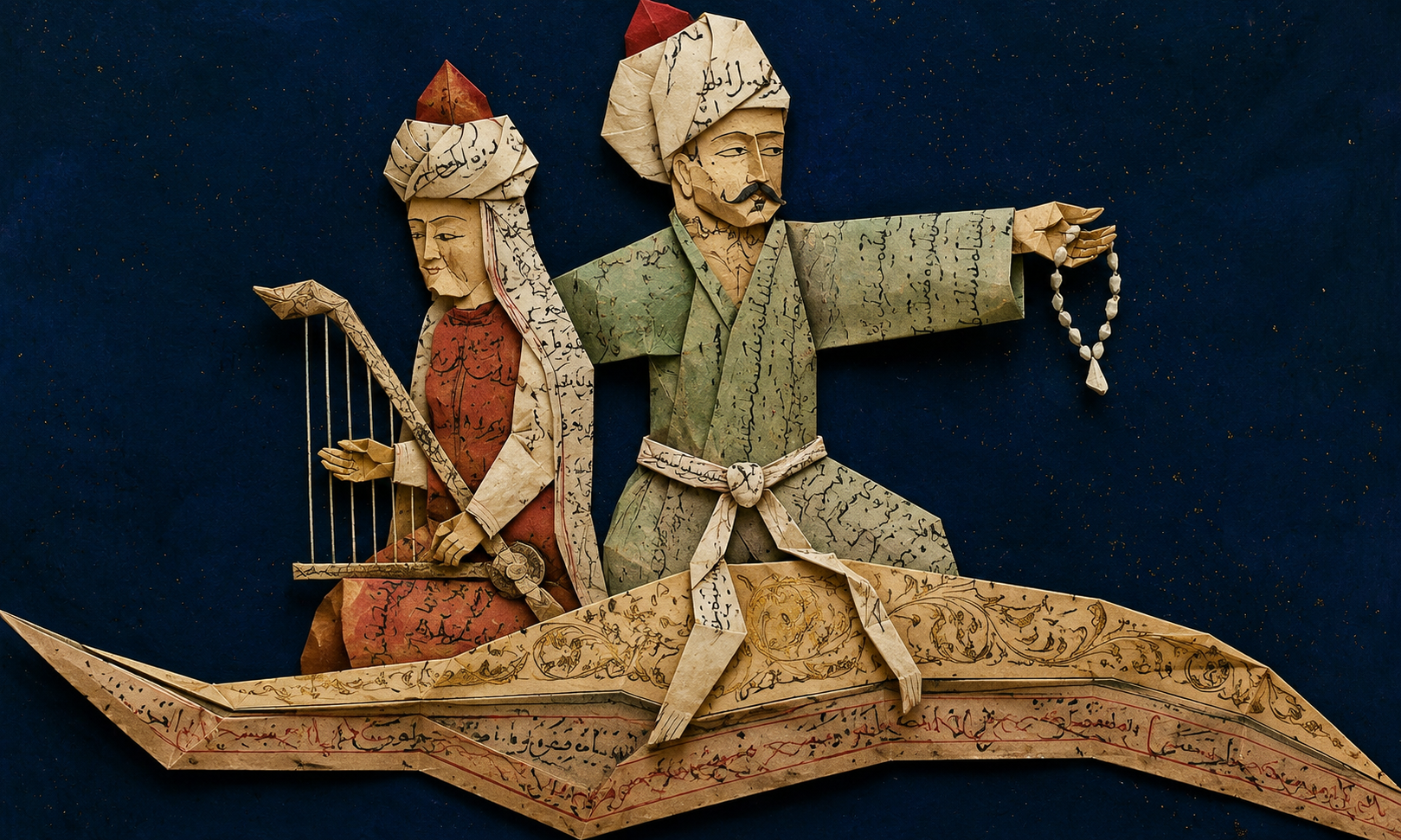
One thousand and one — an impossible number anyway: in the Nights it means more than can be counted. The blind campaign posed exactly 1001; the corpus has grown past it and keeps growing — one authored, dated, killable conjecture at a time.
Falsifiable conjectures about the pre-print world. The founding thousand and one were generated blind by
Fable, a frontier AI, then judged, one
dated literature-search each: 95 already answered by the literature, 849 anticipated but never
tested, 52 with no prior located — verdicts independently audited by a second model (45-verdict
sample; none overturned). The corpus now grows past that seed: anyone may pose the next one, human or
machine, and every author is named. Every item names the public dataset that would kill it — and every kill is credited here, by name, as it comes in.
Joins measurement theory — the idea that the error bar is itself a signal — to third-century political history. A papyrus can be dated only as precisely as its own dating apparatus allows: regnal formulas, titulature, and bureaucratic boilerplate are what let…
Joins Shannon information theory to Mesopotamian political cycles, under the slogan that strong states make boring archives. Shannon entropy measures the diversity of a distribution — here, the mix of genres (receipts, contracts, letters, school texts, literature) among a period's surviving cuneiform…
Selection bias in art-market economics says a market run on glamour is a high-pass filter: dealers keep and promote what sells and discard the dull. This conjecture turns that filter on Assyriology's sampling problem. Unprovenienced tablets are overwhelmingly market-bought, so they passed…
Joins the statistics of radioactive decay and modern firm-survival analysis to monastic geography: manuscript-producing places, the claim runs, went extinct at a constant hazard, like unstable isotopes. The mechanism is that the deaths of scriptoria were dominated by external shocks — raids,…
Joins statistical seismology to archival formation processes: an administrative archive, the claim runs, forms like an earthquake sequence. A main shock — a reform, a new institution, a royal accession — sets off a burst of documentation, and what follows obeys the…
Joins the bunching estimators of modern public finance — the kink analysis that detects tax brackets as piles of taxpayers stacked exactly at the threshold — to the Chinese examination system. If jinshi degrees simply tracked the geography of talent and schooling,…
Joins the economics of crime — Gary Becker's principle that offenses rise when their returns rise and legitimate wages fall — to the Deir el-Medina archives of the royal tomb-builders. The workmen were paid in grain, and the ostraca record their ration…
Joins the concentration indices of industrial organization — the tools economists use to tell competitive markets from managed ones — to Indus glyptic. Stamp seals were the emblems of whoever ran Indus commerce, and if their animal motifs were the competing badges…
Joins modern campaign geography to Pompeian electoral epigraphy. Political scientists mapping yard signs and canvassing find both decay with distance from the candidate's home, because campaigns run on the candidate's own network of neighbours, clients, and friends, and that network is spatially…
Institutional isomorphism, from organizational sociology, says organizations under one coercive centre converge on the same forms and paperwork. This conjecture reads that convergence in cuneiform archaeology: the Ur III state was an aggressively centralizing regime that imposed standardized accounting across its cities,…
Sublinear scaling laws — the urban-economics finding that infrastructure grows more slowly than city size — meet museum acquisition history. This conjecture claims the dispersal of a cuneiform site's tablets across the world's collections scales sublinearly with the size of the find.…
Priority queueing theory has a textbook pathology: give one class of customers near-absolute priority and their waiting times stay compact while low-priority waits blow up into a heavy tail. This conjecture finds that pathology in the Heian court's promotion ladder as recorded…
Monastic forgery of Anglo-Saxon charters is usually pictured as a slow pious habit; this conjecture joins it instead to legal procedure, the sequence of royal challenges that made written title the winning move in court. The claim is that forgery was a…
This conjecture joins the archaeology of abandoned Egyptian towns — offices and houses buried with their papers still inside — to the records-management practice of living institutions that weeded their files for centuries. Archives transmitted continuously by surviving institutions were filtered by…
Historians often read the rising count of English private charters as a gauge of the land market or of spreading literacy; this conjecture joins the charter-production curve instead to the menu of royal remedies. The claim is that ordinary people bought documentation…
The wax seal and the witness list were the two proof technologies carried by the same single-sheet deed, and this conjecture treats them as substitutes with a measurable exchange rate. As sealing spread down the English social ladder in the twelfth and…
We estimate medieval government output from surviving acta, but survival was decided by the recipients, not the chancery — and this conjecture joins the diplomatists' category of deperdita (documents known only because something else mentions them) to the sociology of who could…
This conjecture joins the purported dates written into forged charters with the shape of the forging house's own genuine holdings. The claim is that forgers dated their fabrications into the decades from which their archive held few or no authentic documents —…
A cartulary — the bound book into which a monastery copied its loose charters — is usually treated as a photocopier; this conjecture treats it as an investment portfolio. Copying cost scribal labour, so the compiler triaged by future litigation value: perpetual…
Petitions on papyrus often carry two dates: the day the aggrieved party submitted the complaint and the day an official subscribed the answer. This conjecture joins that humble interval to the grand narrative of Roman imperial crisis: petition-answering was a queue served…
This conjecture imports burstiness statistics — the tools used to describe irregular human communication patterns — into the study of itinerant medieval kingship. An itinerant chancery issued documents where and when the king was available: acta came in bursts at assemblies, sieges,…
This conjecture joins forgery to risk management: whose name do you dare to fake? A diploma attributed to a living ruler or his recent line could be checked against a functioning chancery, its personnel, and its registers; a diploma of a long-extinct…
Diplomatists distinguish two forgery technologies: doctoring a genuine old charter (interpolation) and fabricating one wholesale. This conjecture maps that choice onto archival wealth: a house with deep muniments had authentic parchment, scripts, and formulae to modify, while a burned or refounded house…
English private deeds of the twelfth and thirteenth centuries are famously undated, and then dating clauses flood back around 1300; this conjecture joins that curiosity to limitation law. A date on a deed was legally inert while courts reckoned title by living…
The chirograph — a deed written out twice on one sheet and then cut apart in a wavy or lettered line, so the matching halves authenticate each other — is a physical checksum, and this conjecture joins the choice of that format…
Anglo-Saxon royal charters pair a Latin dispositive text with an Old English boundary clause, and this conjecture reads the pairing as two proof regimes fossilized in one object. The Latin grant was proof-as-relic — its authority lay in being verbally unchanged —…
Justinianic legislation relocated the legally operative core of a private contract into its subscriptions — the parties' declarations and the notary's completio at the foot of the document. This conjecture joins that doctrinal shift to a feature anyone can count: subscription length.…
We treat surviving family papers from Roman Egypt as a fair sample of ancient economic life, but this conjecture claims litigation was the great engine of preservation: documents were copied, certified, bundled into dossiers, and locked away because someone was fighting over…
Offices in Greco-Roman Egypt did not keep files forever: they weeded, and weeded sheets were reused — flipped over for letters and school exercises or sold off in bulk. Every papyrus carrying a dated document on the front and a dated reuse…
An archive fire or a viking sack is usually where a documentary story ends; this conjecture makes it where one begins. A house that lost its muniments still held its lands — and now held them without proof — so documented archive…
Demotic — the everyday Egyptian script with a thousand-year notarial tradition behind it — stops being used for contracts early in Roman rule, and the standard picture blames a slow decline of Egyptian literacy. This conjecture joins the disappearance instead to an…
The Hellenistic 'double document' wrote a contract twice on one papyrus: a rolled and sealed inner text, tamper-proof, and an open outer text for consultation. This conjecture treats the sealed inner copy as do-it-yourself security whose size should track institutional trust in…
Contracts in Roman Egypt stipulate cash penalties for default, and this conjecture joins those clauses to monetary expectations: a penalty prices a breach that may occur years in the future, so in a depreciating currency, notaries and creditors should pad penalty-to-principal ratios…
This conjecture joins the chronology of English famines to the typology of English charters. In subsistence crises smallholders sell land to eat, and the buyer of a desperate seller insists on parchment precisely because hungry men's kin come back to court later;…
Clauses recording a wife's consent to her husband's land sales are usually read as sentiment about family property; this conjecture reads them as buyer's insurance and joins their frequency to the enforcement of dower. A consent clause is worth drafting only once…
Witnessing a deed looks like a neighbourly duty, but this conjecture claims late thirteenth-century England grew a semi-professional attestor class: the same small set of local names recurring across many unrelated parties' deeds, clustered around scribes and courts. As proof of deeds…
Counts of medieval government output lean on surviving original documents, but archives curated by impressiveness: a great sealed privilege on fine parchment was a treasure and a permanent legal weapon, while a small mandate was scrap the day it was obeyed. This…
In a personal monarchy, beneficiaries feared their rights lapsed with the grantor's last breath, so each accession triggered a rush to have old grants confirmed. This conjecture turns that rush into a gauge: confirmations as a share of chancery output should spike…
Medieval dating clauses encode the date redundantly — indiction, regnal year, year of the incarnation — and the redundancy lets us catch clerks in errors. This conjecture claims the internal-inconsistency rate of dating elements in royal and imperial acta is a chancery-stress…
A vacancy of the throne or of the papal see stopped the sealing but not the wanting: petitions and unrenewed privileges accumulated. This conjecture models medieval chanceries as queueing systems and claims their output shows a measurable overshoot after every long interregnum…
A genuine charter's content could survive perfectly well as a copy in a cartulary; a forgery's whole point was frequently the exhibitable object — venerable-looking script, an old seal — to be produced at an inquest or in court. This conjecture therefore…
The backs of medieval charters carry archival endorsements — shelfmarks, one-line summaries, notes like 'inutile' — added whenever someone reorganized the muniments. This conjecture claims endorsement was not steady housekeeping but crisis behaviour: the endorsing hands on a house's single sheets should…