Hugh of Saint Victor
Addressable memory
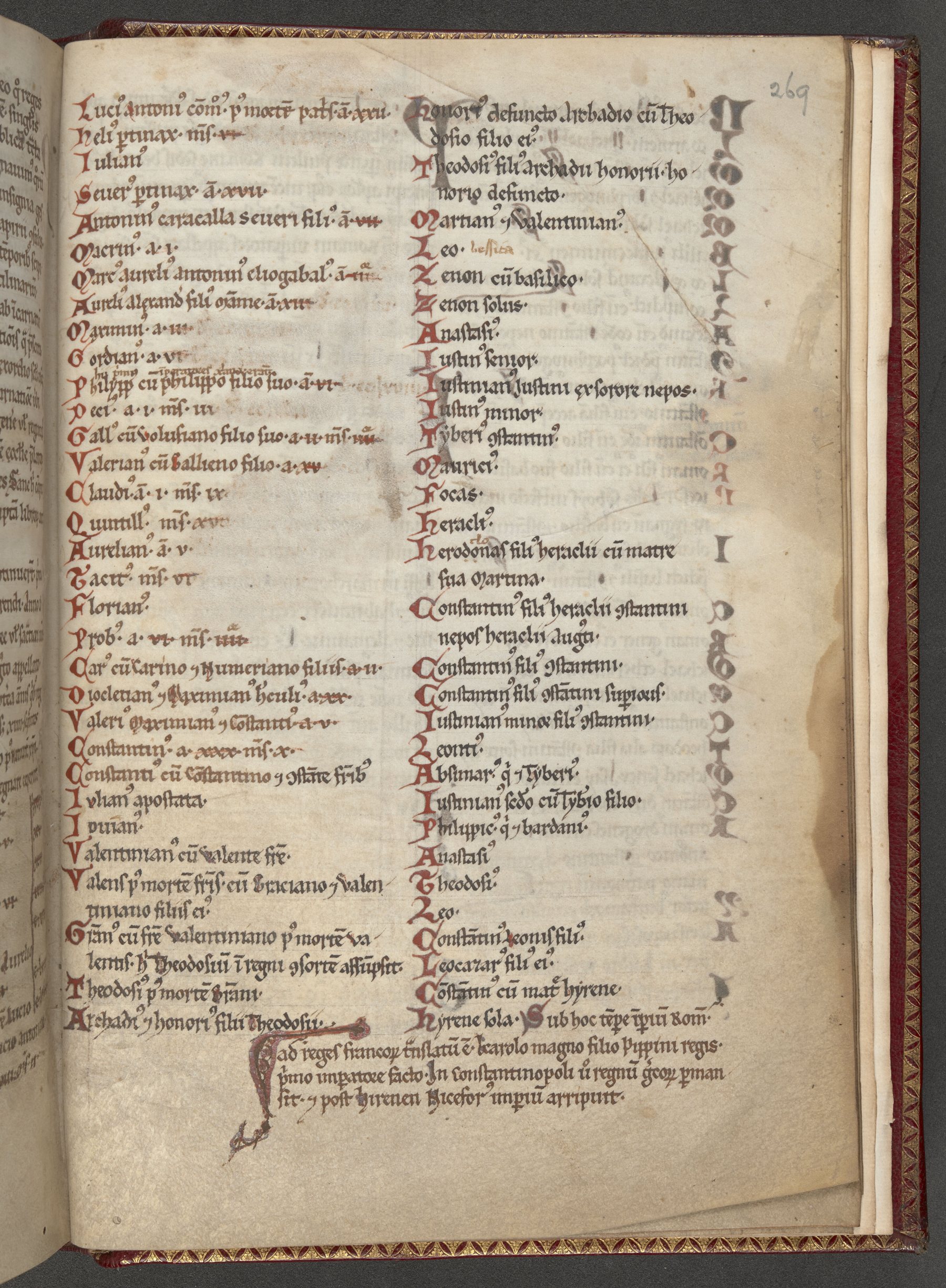
Hugh of Saint Victor taught the canons of the abbey of Saint-Victor in Paris, a house of clergy living under a rule, and died there in 1141. About 1130 he compiled a Chronicle for his students: not a narrative, but tables of persons, places and times, the patriarchs, popes, emperors and kings with their years. In front of it he set a prologue that is a lesson in how to hold such a thing in the head. Fix the numbers in the mind first, he tells the student, in a line, firm and in order. Then hang on each number the beginning of the thing to be remembered. His example is the psalter, whose hundred and fifty psalms the canons sang through every week in the office. The point is not to recite the psalms in order. It is to be able to jump: to give the psalm at seventeen without counting up from one, and, given a psalm, to say its number at once. This page lets a visitor learn a short stretch of that line as Hugh prescribes, and then takes the words away, and then the line. The text is read from a copy made within a generation of Hugh's death, Bamberg Msc.Patr.21, with a copy dated 1135 and the abbey's own copy beside it.
Stage 0 · Read
Look at the line. The numbers come first, fixed and in order; the opening words of the psalms hang beneath them.
The line scrolls sideways. Press a point to dwell on it; with the keyboard, the left and right arrows walk the line, Home and End go to its ends, and Enter dwells on the point you are on. Nothing here is timed.
Prompt
You mark your own answer. The page cannot read what you were thinking, and does not try.
Not a test
Choose any three psalms by their numbers, and say in one sentence how a preacher might join them. Nothing is marked here: this is what the line was for.
The stages
Hugh's instruction for this stage
Primum de discretione numeri. Disce contemplari in animo tuo lineam naturalis numeri ab uno in qualibet longam porrectionem, quasi ante oculos cordis tui extensam.
First, on the distinguishing of number. Learn to contemplate in your mind the line (linea) of the natural number, running out from one to whatever length you please, as though stretched out before the eyes of your heart.
How long a line
Hugh's own exercise is the whole psalter of 150. Start shorter.
Your tally
Nothing asked yet.
This page stores nothing about you. The tally is held in the page while it is open, and in nothing else: no cookie, no browser storage, no account, no request to a server. Close the tab and it is gone. Nobody, including us, learns how you did.
What Hugh says
Everything the machine does is supposed to come from one short stretch of prose: the prologue Hugh put in front of his Chronicle. Below is the witness, the manuscript copy the text is read from, photographed leaf by leaf, then the Latin as we read it, then our English, then the particular sentences the machine leans on. Each of those sentences carries a link to the part of the machine it warrants, so a reader can check the one against the other.
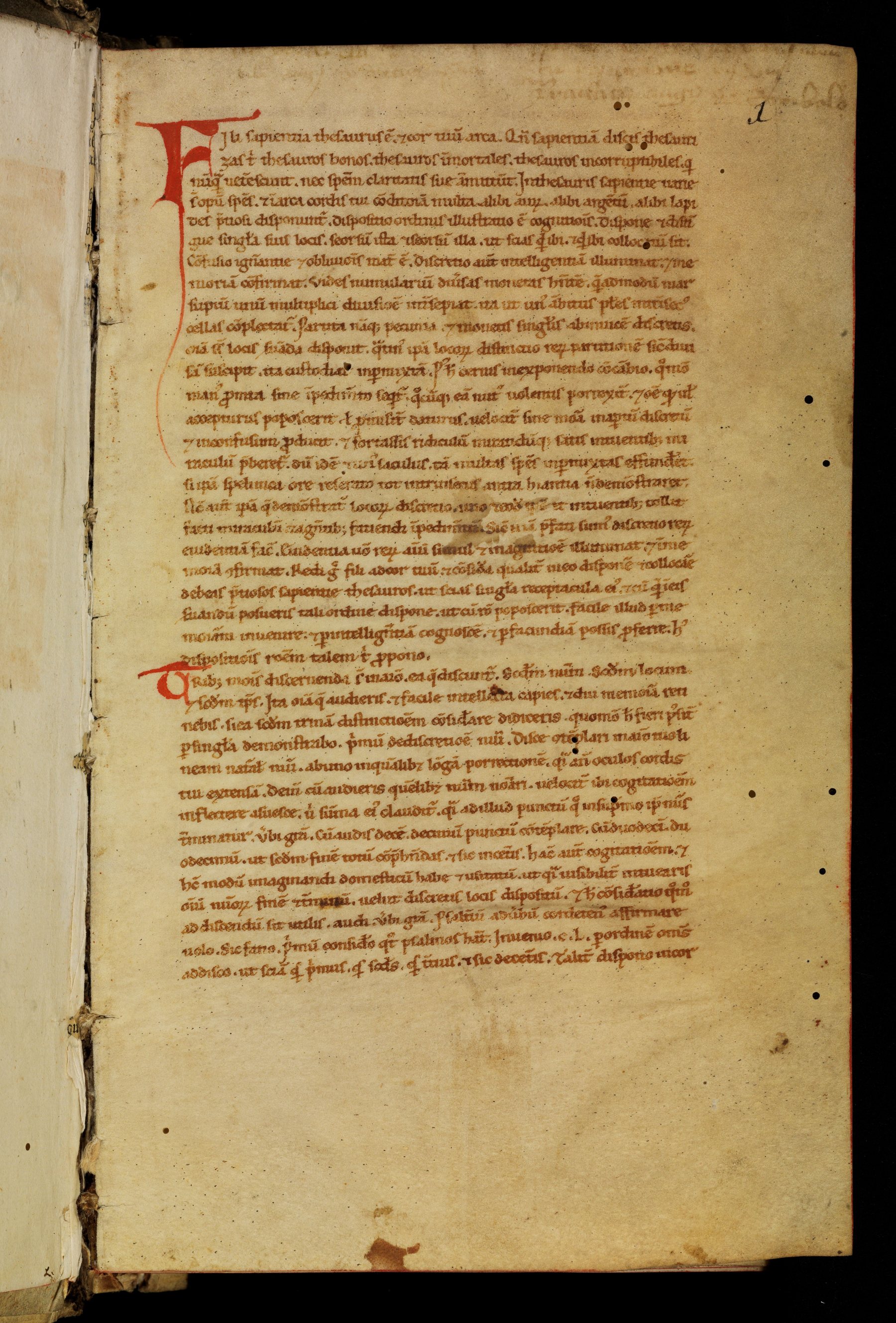
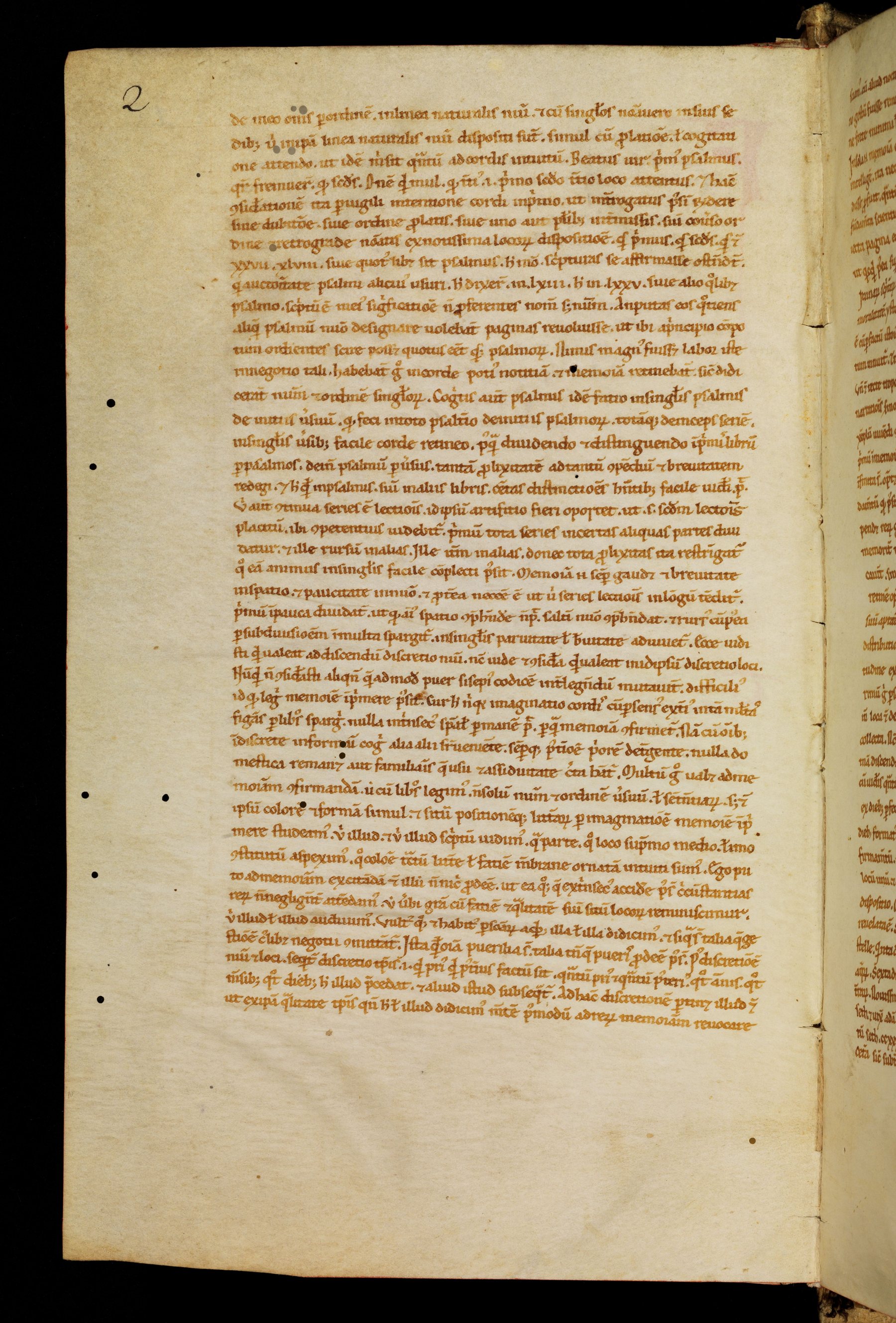
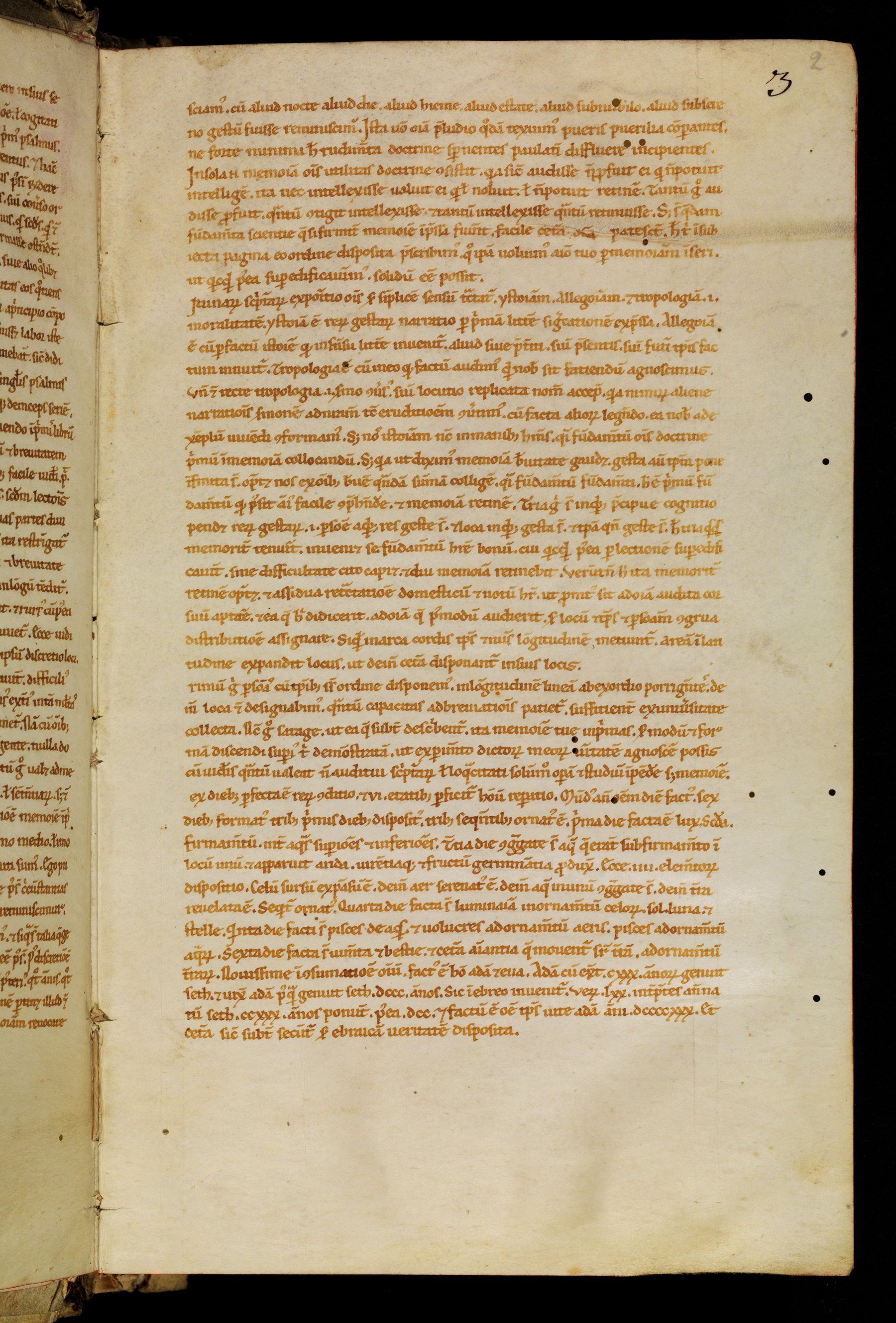
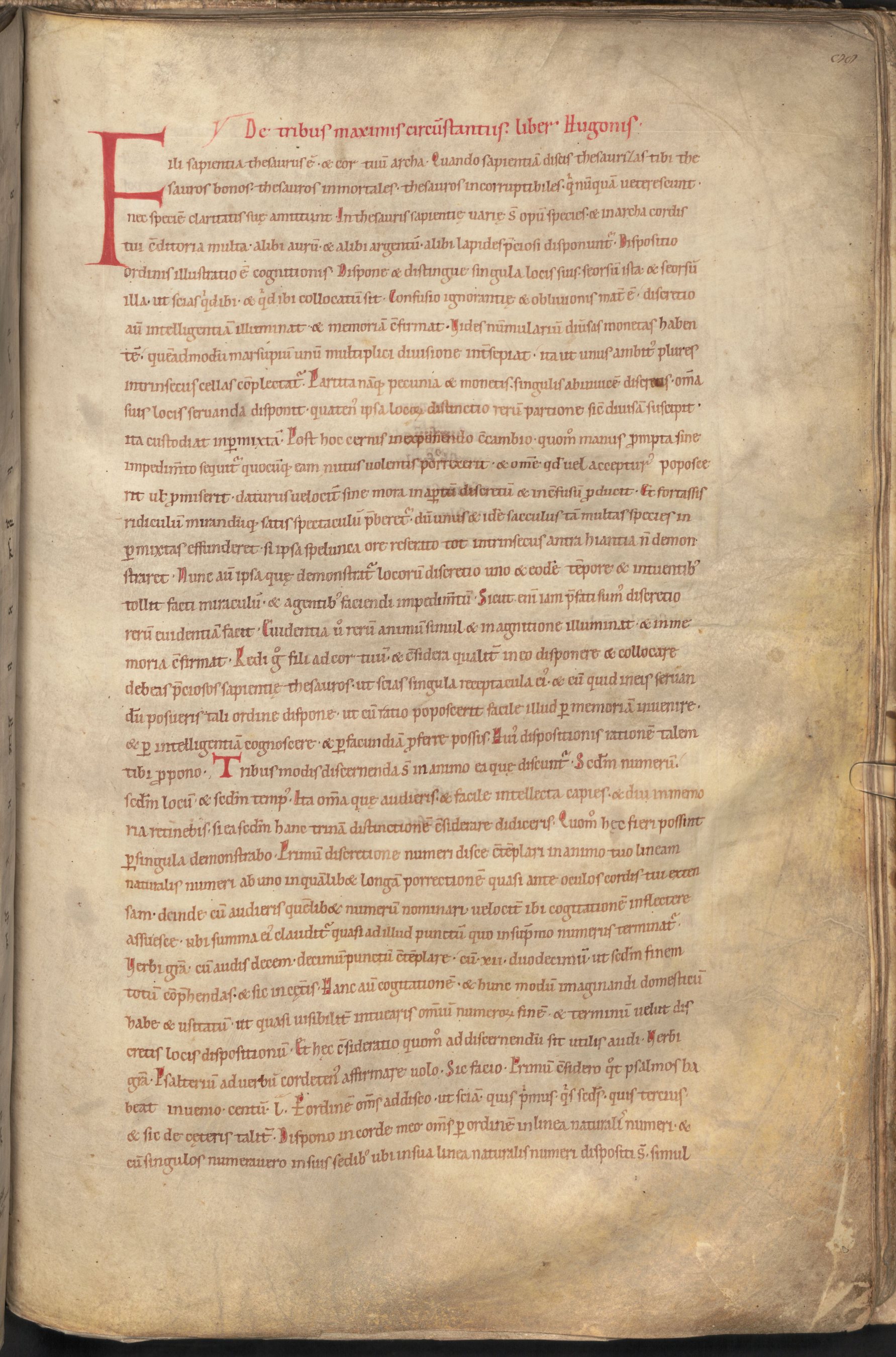
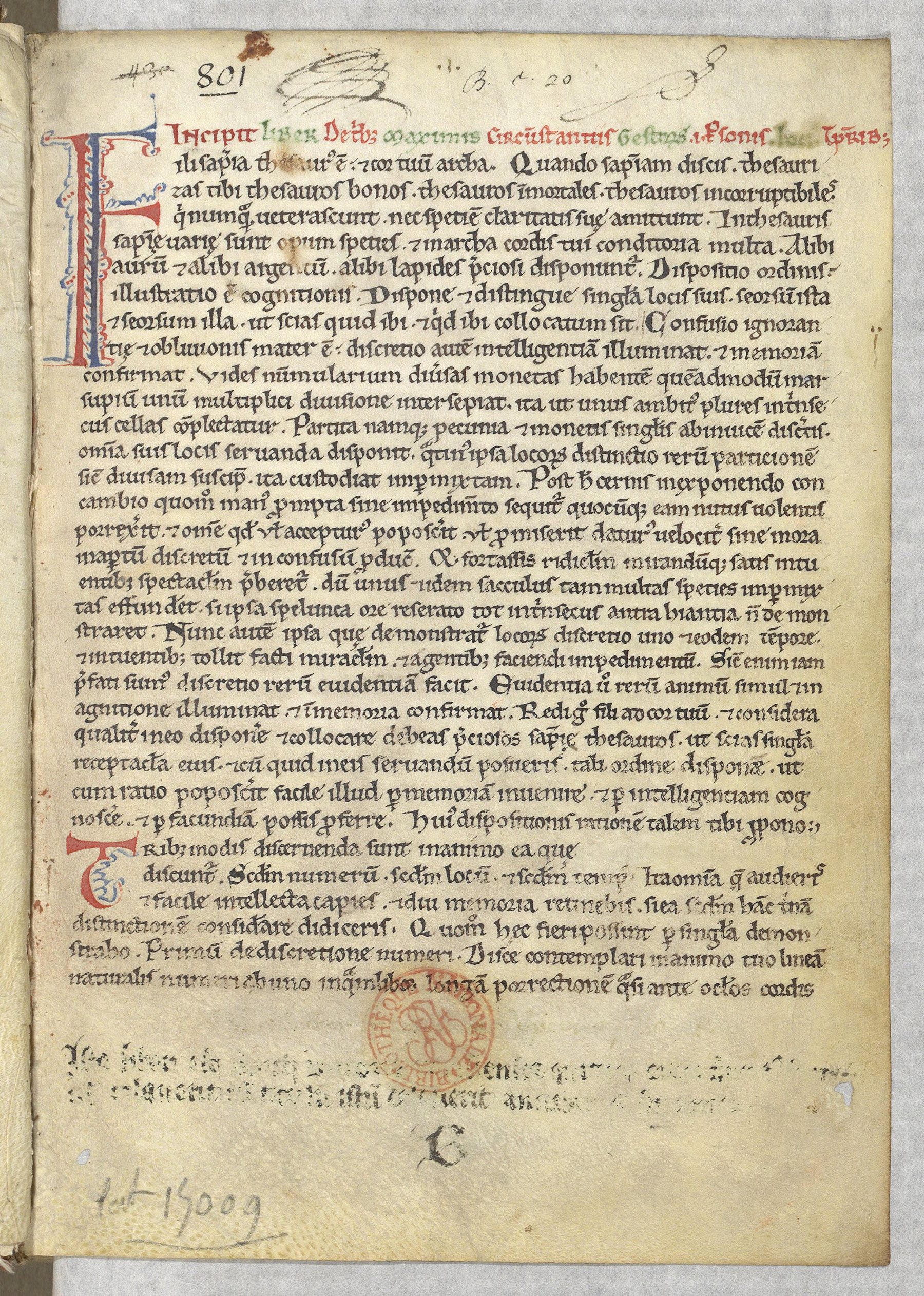
The Latin
Fili, sapientia thesaurus est et cor tuum arca. Quando sapientiam discis, thesaurizas tibi thesauros bonos, thesauros immortales, thesauros incorruptibiles, qui numquam veterescunt nec speciem claritatis suae amittunt. In thesauris sapientiae variae sunt opum species, et in arca cordis tui conditoria multa: alibi aurum, alibi argentum, alibi lapides pretiosi disponuntur. Dispositio ordinis illustratio est cognitionis. Dispone et distingue singula suis locis, seorsum ista et seorsum illa, ut scias quid ibi et quid ibi collocatum sit.
Confusio ignorantiae et oblivionis mater est; discretio autem intelligentiam illuminat et memoriam confirmat. Vides nummularium diversas monetas habentem, quemadmodum marsupium unum multiplici divisione intersepiat, ita ut unus ambitus plures intrinsecus cellas complectatur. Partita namque pecunia et monetas, singulis abinvicem discretis, omnia cum locis servanda disponit, quatenus ipsa locorum distinctio rerum partitionem, sic divisa, suscepit, ita custodiat impermixtam. Post hoc cernis, in exponendo concambio, quomodo manus prompta sine impedimento sequitur quocumque eam nutus volentis porrexerit, et omne quod vel accepturus poposcerit et promissum daturus, velociter, sine mora, in aptum, discretum et inconfusum producat. Et fortassis ridiculum mirandumque satis intuentibus miraculum praeberet, dum idem et unus sacculus tam multas species impermixtas effunderet, si ipsa spelunca, ore reserato, tot intrinsecus antra hiantia non demonstraret. Nunc autem ipsa quae demonstrat locorum discretio uno et eodem tempore et intuentibus tollit facti miraculum et agentibus faciendi impedimentum.
Sic enim, iam praefati sumus, discretio rerum evidentiam facit; evidentia vero rerum animum simul et agnitione illuminat et in memoriam confirmat. Redi ergo, fili, ad cor tuum, et considera qualiter in eo disponere et collocare debeas pretiosos sapientiae thesauros, ut scias singula receptacula, cui et cum quid in eis servandum posueris. Tali ordine dispone, ut cum ratio poposcerit facile illud per memoriam invenire et per intelligentiam cognoscere et per facundiam possis proferre. Huius dispositionis rationem talem tibi propono.
Tribus modis discernenda sunt in animo ea quae discuntur: secundum numerum, secundum locum et secundum tempus. Ita omnia quae audieris et facile intellecta capies et diu memoria retinebis, si ea secundum hanc trinam distinctionem considerare didiceris. Quomodo haec fieri possint per singula demonstrabo.
Primum de discretione numeri. Disce contemplari in animo tuo lineam naturalis numeri ab uno in qualibet longam porrectionem, quasi ante oculos cordis tui extensam. Deinde, cum audieris quaelibet numerum nominari, velociter ibi cogitationem inflectere assuesce ubi summa eam clauditur, quasi ad illud punctum quo in supremo ipse numerus terminatur. Verbi gratia: cum audis decem, decimum punctum contemplare; cum duodecim, duodecimum, ut secundum finem totum comprehendas; et sic in ceteris. Hanc autem cogitationem et hunc modum imaginandi domesticum habe et usitatum, ut quasi visibiliter intuearis omnium numerorum finem et terminum velut discretas locorum dispositiones. Et haec consideratio quomodo ad discendum sit utilis, audi.
Verbi gratia: psalterium ad verbum corde tenus affirmare volo. Sic facio. Primum considero quot psalmos habeat: invenio centum quinquaginta. Per ordinem omnes addisco, ut sciam qui primus, qui secundus, qui tertius, et sic deinceps. Taliter dispono in corde meo omnes per ordinem in linea naturalis numeri; et cum singulos numeravero in suis sedibus, ubi in sua linea naturalis numeri disposita sunt, simul cum prolatione et cogitatione attendo ut idem insit quantum ad cordis intuitum: Beatus vir, primus psalmus; Quare fremuerunt, qui secundus; Domine quid multiplicati, qui tertius. Et primo, secundo, tertio loco attentius. Et hac consideratione ita pervigili intentione cordi imprimo, ut interrogatus possim respondere sine dubitatione, sive ordine prolatus, sive uno aut pluribus intermissis, sive converso ordine et retrograde nominatis, ex notissima locorum dispositione, qui primus, qui secundus, qui tertius, XXVII, XLVIII, sive quotuslibet sit psalmus.
Hoc modo scripturas se affirmasse ostendit, qui auctoritate psalmi alicuius usuri hoc dixerit in LXIII, hoc in LXXV, sive alio quolibet psalmo scriptum est, in eius significatione non proferentes nomen sed numerum. An putas eos, quotiens aliquem psalmum numero designare volebant, paginas revoluisse, ut ibi a principio corporum ordientes scire posset quotus esset quisque psalmorum? Nimis magnus fuisset labor iste in negotio tali: habebat in corde potius notitiam et memoriam retinebat. Sic didicerat numerum et ordinem singulorum.
Cognitis autem psalmis, idem facio in singulis psalmis de initiis versuum quod feci in toto psalterio de initiis psalmorum; totamque deinceps seriem in singulis versibus facile corde retineo, postquam, dividendo et distinguendo ipsum librum per psalmos, deinde psalmum per versus, tantam prolixitatem ad tantum compendium et brevitatem redegi. Et hoc idem in psalmis sive aliis libris certas distinctiones habentibus facile videri potest.
Quod autem continua series est lectionis, id ipsum artificio fieri oportet, ut scilicet secundum lectoris placitum, ibi competentius videbitur, primum tota series in certas aliquas partes dividatur, et illae rursum in alias, illae iterum in alias, donec tota prolixitas ita restringatur quam eam animus in singulis facile complecti possit. Memoria enim semper gaudet et brevitate in spatio et paucitate in numero; et propterea necesse est ut, ubi series lectionum in longum tenditur, primum in pauca dividatur, ut quod animus spatio comprehendere non potest saltim numero comprehendat, et rursus, cum postea per subdivisionem in multa spargatur, in singulis parvitate vel brevitate adiuvetur. Ecce vidisti quid valeat ad discendum discretio numeri.
Nunc vide et considera quid valeat in id ipsum discretio loci. Numquid non considerasti aliquando quemadmodum puer, si saepius codicem in legendum mutavit, difficilius id quod legitur memoriae imprimere possit? Cur hoc, nisi quia imaginatio cordis, cum per sensus exteriores in tam multas figuras per libros spargitur, nulla intrinsecus spiritalis species permanere potest per quam memoria confirmetur? Nam cum omnibus indiscrete informari cogitur, alia alii superveniente, saepeque posteriore priorem delente, nulla domestica remanet aut familiaris quae usu et assiduitate certa habeatur.
Multum ergo valet ad memoriam confirmandam ut, cum librum legimus, non solum numerum et ordinem versuum vel sententiarum, sed et ipsum colorem et formam simul et situm positionemque litterarum per imaginationem memoriae imprimere studeamus: ubi illud et ubi illud scriptum vidimus, qua parte, quo loco, supremo, medio et imo, constitutum aspexerimus, quo colore tractum litterae vel faciem membranae ornatam intuiti simus. Ego puto ad memoriam excitandam et illud non nihil prodesse,
ut eas quae quasi extrinsecus accidere pro circumstantiis rerum non negligenter attendamus: verbi gratia, cum faciem et qualitatem sive situm locorum reminiscamur ubi illud vel illud audivimus; vultus quoque et habitum personarum a quibus illa et illa didicerimus; et si qua sunt talia quae gestione cuilibet negotii committantur.
Ista quidem omnia puerilia sunt, et talia tamen quae pueris prodesse possunt. Post discretionem numeri et loci sequitur discretio temporis, id est quid prius, quid posterius factum sit, quantum prius et quantum posterius, quot annis, quot mensibus, quot diebus hoc illud praecedat et aliud istud subsequatur. Ad hanc discretionem pertinet illud quod, ut ex illa qualitate temporis quando hoc vel illud didicerimus mentem per modum ad rerum memoriam revocare sciamus, cum aliud nocte, aliud die, aliud hieme, aliud aestate, aliud sub nubilo, aliud sub sereno gestum fuisse reminiscamur.
Ista vero omnia praeludio quodam pertexuimus, pueris puerilia comparantes, ne forte, minima haec rudimenta doctrinae spernentes, paulatim diffluere incipiamus. In sola enim memoria omnis utilitas doctrinae consistit; quia sic audisse non profuit ei qui non potuit intelligere, ita nec intellexisse valuit ei qui et noluit vel non potuit retinere. Tantum ergo audisse profuit quantum contigit intellexisse, et tantum intellexisse quantum retinuisse. Sed sunt quaedam fundamenta scientiae quae, si firmiter memoriae impressa fuerint, facile cetera patescunt. Haec et in subiecta pagina eo ordine disposita praescribimus, quo ipsa volumus animo tuo per memoriam inseri, ut quicquid postea superaedificaverimus solidum esse possit.
Divinarum scripturarum expositio omnis secundum triplicem sensum tractatur: historiam, allegoriam et tropologiam, id est moralitatem. Historia est rerum gestarum narratio, per primam litterae significationem expressa. Allegoria est cum per factum historiae, quod in sensu litterae invenitur, aliud sive praeteriti sive praesentis sive futuri temporis factum innuitur. Tropologia est cum in eo quod factum audimus quid nobis sit faciendum agnoscimus. Unde et recte tropologia, id est sermo conversus sive locutio replicata, nomen accepit; quia nimirum alienae narrationis sermonem ad nostram tunc eruditionem convertimus, cum facta aliorum legendo ea nobis ad exemplum vivendi conformamus.
Sed nos historiam nunc in manibus habemus, quasi fundamentum omnis doctrinae primum in memoriam collocandum. Sed quia, ut diximus, memoria brevitate gaudet, gesta autem temporum paene infinita sunt, oportet nos ex omnibus brevem quandam summam colligere, quasi fundamentum fundamenti, hoc est primum fundamentum quod possit animus facile comprehendere et memoria retinere. Tria autem sunt in quibus praecipue cognitio pendet rerum gestarum, id est personae a quibus res gestae sunt, et loca in quibus gesta sunt, et tempora quando gestae sunt. Haec tria quisquis memoriter tenuerit, inveniet se fundamentum habere bonum, cui quicquid postea per lectionem superaedificaverit sine difficultate cito capiet et diu memoria retinebit. Verumtamen hoc ita memoriter retinere oportet et assidua retractatione domesticum et notum habere, ut promptum sit ad omnia audita cor suum aptare, et ea quae hic didicerit ad omnia quae per modum audierit secundum locum, tempus et personam congrua distributione assignare. Sicque in arca cordis tempus et numerus longitudinem metiuntur; arcam in latitudine expandit locus, ut deinde cetera disponantur in suis locis.
Primum ergo personas cum temporibus tali ordine disponemus, in longitudinem lineam ab exordio porrigentem; deinde loca etiam designabimus, quantum capacitas abbreviationis patietur, sufficient ex universitate collecta. Illud ergo satage, ut ea quae subter describentur ita memoriae tuae imprimas secundum modum et formam discendi superius demonstratam, ut ex puncto dictorum meorum utilitatem agnoscere possis, cum videris quantum valeat non auditui scripturarum vel loquacitati solum operam et studium impendere, sed memoriae.
In English
Son, wisdom is a treasure and your heart the strongbox (arca). When you learn wisdom you are storing up good treasures for yourself: undying treasures, incorruptible treasures, which never grow old and never lose the look (species) of their brightness. In the treasuries of wisdom there are riches of many kinds, and in the strongbox of your heart there are many compartments (conditoria): gold is laid up in one place, silver in another, precious stones in another. The arrangement of order is the lighting-up of knowledge. Arrange and distinguish each thing in its own places (locis), these apart and those apart, so that you know what has been put here and what has been put there.
Confusion is the mother of ignorance and of forgetting; distinguishing (discretio), on the other hand, lights up the understanding and steadies the memory. You see the money-changer keeping different coins, and how he partitions a single purse by manifold division, so that one outer compass holds several cells inside it. For once the money and the coins have been divided up, each kind kept apart from the others, he arranges everything so that it is kept with its places (cum locis), so that the very distinction of the places may keep unmixed the division of the things thus divided. After this you see, when he lays money out and changes it, how his hand goes ready and unhindered wherever the nod of his will reaches it out, and how whatever he is to receive at request, or to hand over as promised, he brings out quickly, without delay, fitting, distinct and unconfused. And perhaps one and the same purse would be offering onlookers a laughable and quite astonishing marvel, pouring out so many unmixed kinds, if the cave itself, with its mouth opened, did not show so many hollows gaping inside. But as it is, that same distinction of places which does show them takes away, at one and the same time, the marvel of the thing from those who watch and the hindrance of doing it from the one who acts.
For, as we have already said, the distinguishing of things makes them evident; and the evidence of things lights up the mind both at once and in recognition, and steadies it in memory. Return then, my son, to your heart, and consider how you ought to arrange and store the precious treasures of wisdom in it, so that you may know each receptacle - for what, and along with what, you have put something in them to be kept. Arrange it in such an order that, when reason calls for it, you can easily find that thing by memory, know it by understanding, and bring it out in speech. This is the plan of arrangement that I set before you.
There are three ways in which the things one learns are to be distinguished in the mind: by number, by place (locus), and by time. In this way everything you hear you will both grasp easily once it is understood and keep long in memory, if you have learned to consider it according to this threefold distinction. I shall show point by point how this can be done.
First, on the distinguishing of number. Learn to contemplate in your mind the line (linea) of the natural number, running out from one to whatever length you please, as though stretched out before the eyes of your heart. Then, whenever you hear any number named, train yourself to bend your thought quickly to the place where the total closes it, as if to that point at which the number itself comes to its end at the top. For example: when you hear ten, contemplate the tenth point; when twelve, the twelfth, so that you take in the whole by its end; and so with the rest. Keep this way of thinking and this manner of imagining familiar and habitual, so that you may look, as if with your eyes, on the end and limit of all the numbers as on distinct arrangements of places (locorum dispositiones). And now hear how useful this way of considering is for learning.
For example: I want to fix the psalter in my memory word for word. This is what I do. First I consider how many psalms it has: I find a hundred and fifty. I learn them all in order, so that I know which is first, which second, which third, and so on. In this way I arrange them all in my heart in order on the line (linea) of the natural number; and when I have numbered each one in its own seat (sedes), where they are set out on its own line of the natural number, I attend to them at once in utterance and in thought, so that the same thing is present so far as the heart's gaze is concerned: Blessed is the man - the first psalm; Why have the nations raged - which is the second; Lord, how are they multiplied - which is the third. And I go over them more attentively in first, second and third place. And by this considering I press them on my heart with such wakeful attention that, when questioned, I can answer without hesitation - whether they are put to me in order, or with one or several skipped, or named in reversed and backward order - from the well-known arrangement of the places (locorum dispositio): which is first, which second, which third, the twenty-seventh, the forty-eighth, or whatever number the psalm may be.
The Scriptures show that this is how men have made their statements: whoever means to use the authority of some psalm will have said 'this in the sixty-third', 'this in the seventy-fifth', or 'it is written in whatever other psalm', in referring to it bringing out not the name but the number. Or do you suppose that, as often as they wanted to designate a psalm by its number, they turned over the pages, so that beginning there from the start of the volumes they could know which each of the psalms was? That labour would have been far too great for such a business: rather, he had the knowledge in his heart and held it by memory. That is how he had learned the number and the order of each one.
Once the psalms are known, I do with the beginnings of the verses in each single psalm what I did with the beginnings of the psalms in the whole psalter; and after that I hold the whole series easily in my heart verse by verse, once I have brought so great a length down to so small a compass and brevity by dividing and distinguishing the book itself into psalms, and then the psalm into verses. And the same thing can easily be seen in the psalms, or in other books that have fixed divisions.
But where the series of a reading runs on continuously, this very thing has to be done by art: that is, according to the reader's own judgement, wherever it will look most fitting, the whole series should first be divided into certain definite parts, and those again into others, and those again into others, until the whole length is drawn in so far that the mind can easily take it in piece by piece. For memory always delights both in shortness of extent and in fewness of number; and therefore, where the series of readings stretches out at length, it must first be divided into a few parts, so that what the mind cannot take in by extent it may at least take in by number; and again, when it is afterwards scattered into many by subdivision, it may be helped in each part by its smallness or brevity. There - you have seen what the distinguishing of number can do for learning.
Now see and consider what the distinguishing of place (locus) can do for the same thing. Have you never noticed how a boy, if he has changed his book too often while reading, can impress what he reads on his memory only with more difficulty? Why is this, unless because the heart's imagination, when it is scattered through the outer senses into so many shapes across different books, can keep no inward image (species) in being through which the memory might be steadied? For when it is forced to be shaped by all of them indiscriminately, one coming on top of another, and the later constantly blotting out the earlier, nothing stays homely or familiar, nothing that is held as certain by use and constant practice.
It is worth a great deal, then, for steadying the memory, that when we read a book we should try to impress on memory through the imagination not only the number and order of the verses or sentences, but also the very colour and shape, and at the same time the site and position of the letters: where we saw this and where that written, in which part, in which place - at the top, in the middle, at the foot - we looked at it set down, with what colour we saw the stroke of the letter or the decorated face of the parchment. I hold that this too does no little good for waking the memory:
namely, that we should attend, and not carelessly, to the things that come, so to speak, from outside, as circumstances (circumstantiae) of the matter: for example, when we call to mind the look and character, or the site, of the places (loca) where we heard this or that; and also the faces and bearing of the persons (personae) from whom we learned this and that; and anything else of the kind that is bound up with a given piece of business.
All this is indeed childish - and yet it is the sort of thing that can do children good. After the distinguishing of number and of place comes the distinguishing of time: that is, what was done earlier and what later, how much earlier and how much later, by how many years, how many months, how many days this precedes that, and another thing follows this. To this distinction belongs also being able to call the mind back, by way of the matter, to the memory of things from the quality of the time at which we learned this or that, when we remember that one thing was done at night and another by day, one in winter and another in summer, one under cloud and another under a clear sky.
All of this we have woven together as a kind of prelude, matching childish things to children, lest perhaps, despising these least rudiments of teaching, we should little by little begin to drain away. For the whole usefulness of teaching rests on memory alone; since, just as hearing has done no good to the man who could not understand, so understanding has been worth nothing to the man who both would not and could not retain. Hearing, then, has done good only so far as understanding followed, and understanding only so far as retaining followed. But there are certain foundations of knowledge which, if they have been firmly impressed on the memory, make everything else open up easily. These we set out beforehand on the page below, in the very order in which we want them planted in your mind through memory, so that whatever we afterwards build on top may be able to stand solid.
Every exposition of the divine Scriptures is handled according to a threefold sense: history (historia), allegory, and tropology, that is, the moral sense. History is the narration of things done (res gestae), expressed through the first signification of the letter. Allegory is when, through a deed of the history which is found in the sense of the letter, some other deed of past or present or future time is intimated. Tropology is when, in what we hear was done, we recognise what we ought to do. Hence tropology - that is, turned speech, or folded-back utterance - rightly got its name: because, of course, we turn the speech of someone else's narrative to our own instruction at the moment when, reading the deeds of others, we shape them into a pattern of living for ourselves.
But it is history that we have in hand now, as the foundation of all teaching, to be lodged in memory first. And since, as we said, memory delights in brevity, while the deeds of the ages are almost without number, we must gather out of them all a short summary of some kind, a foundation for the foundation as it were, that is, a first foundation which the mind can easily take in and keep in memory. There are three things on which knowledge of things done (res gestae) chiefly depends: that is, the persons (personae) by whom the deeds were done, and the places (loca) in which they were done, and the times (tempora) when they were done. Whoever holds these three in his memory will find that he has a good foundation, on which whatever he afterwards builds by reading he will take in quickly and without difficulty, and hold long in memory. All the same, he must hold it in memory in such a way, and make it homely and known by constant going-over, that his heart is ready to fit to it everything he hears, and to assign what he has learned here to everything he hears in due course, by a fitting distribution of place, time and person. And so, in the strongbox of the heart, time and number measure out the length; place spreads the strongbox out in breadth, so that everything else can then be arranged in its own places.
First, then, we shall set out the persons together with the times in such an order, running the line (linea) out lengthways from the beginning; then we shall mark in the places (loca) as well, as far as the capacity of an abridgement allows - what has been gathered out of the whole will be enough. Set yourself to this, then: that you impress what is written below on your memory in the manner and form of learning shown above, so that you can recognise the usefulness of my words from the point at issue, when you see how much it is worth to spend effort and study not on the hearing of the Scriptures or on talk alone, but on memory.
The sentences the machine rests on
-
Primum de discretione numeri. Disce contemplari in animo tuo lineam naturalis numeri ab uno in qualibet longam porrectionem, quasi ante oculos cordis tui extensam.
First, on the distinguishing of number. Learn to contemplate in your mind the line (linea) of the natural number, running out from one to whatever length you please, as though stretched out before the eyes of your heart.
Bamberg fol. 1r, lines 29 to 31. The line comes first in Hugh's order: before anything is hung on it, the bare numbers are laid out as one line, seen in the mind. Stage 0 draws that line.
-
Taliter dispono in corde meo omnes per ordinem in linea naturalis numeri; et cum singulos numeravero in suis sedibus, ubi in sua linea naturalis numeri disposita sunt, simul cum prolatione et cogitatione attendo ut idem insit quantum ad cordis intuitum: Beatus vir, primus psalmus; Quare fremuerunt, qui secundus; Domine quid multiplicati, qui tertius.
In this way I arrange them all in my heart in order on the line (linea) of the natural number; and when I have numbered each one in its own seat (sedes), where they are set out on its own line of the natural number, I attend to them at once in utterance and in thought, so that the same thing is present so far as the heart's gaze is concerned: Blessed is the man - the first psalm; Why have the nations raged - which is the second; Lord, how are they multiplied - which is the third.
Bamberg fol. 1r, line 39, to fol. 1v, line 4. Each psalm is numbered in its own seat on the line, and the number and the opening words are held together in one act, in utterance and in thought. Stage 1 does this for the first twenty psalms.
Warrants: Stage 1, Learn: the beginnings hung on the numbers
-
Et hac consideratione ita pervigili intentione cordi imprimo, ut interrogatus possim respondere sine dubitatione, sive ordine prolatus, sive uno aut pluribus intermissis, sive converso ordine et retrograde nominatis, ex notissima locorum dispositione, qui primus, qui secundus, qui tertius, XXVII, XLVIII, sive quotuslibet sit psalmus.
And by this considering I press them on my heart with such wakeful attention that, when questioned, I can answer without hesitation - whether they are put to me in order, or with one or several skipped, or named in reversed and backward order - from the well-known arrangement of the places (locorum dispositio): which is first, which second, which third, the twenty-seventh, the forty-eighth, or whatever number the psalm may be.
Bamberg fol. 1v, lines 4 to 8. The test Hugh sets himself: to answer at once, whether the numbers come in order, or with one or several skipped, or backwards. Skipping is the jump the prompts of stage 2 ask for. He states the way from number to psalm outright; the way from psalm to number he implies a few lines later, where the Fathers cite a psalm by its number and not by its name.
Warrants: Stage 2, Withdraw the words: any psalm from its number, in order or with numbers skipped
-
An putas eos, quotiens aliquem psalmum numero designare volebant, paginas revoluisse, ut ibi a principio corporum ordientes scire posset quotus esset quisque psalmorum? Nimis magnus fuisset labor iste in negotio tali: habebat in corde potius notitiam et memoriam retinebat.
Or do you suppose that, as often as they wanted to designate a psalm by its number, they turned over the pages, so that beginning there from the start of the volumes they could know which each of the psalms was? That labour would have been far too great for such a business: rather, he had the knowledge in his heart and held it by memory.
Bamberg fol. 1v, lines 10 to 13. No page is turned and no line is looked at: the knowledge is in the heart. Stage 3 takes the drawn line away for that reason.
Warrants: Stage 3, Withdraw the line: the knowledge in the heart, not on the page
-
sive ordine prolatus, sive uno aut pluribus intermissis, sive converso ordine et retrograde nominatis
whether they are put to me in order, or with one or several skipped, or named in reversed and backward order
The middle of the sentence quoted for stage 2 (Bamberg fol. 1v, lines 5 to 6): the series is to be run forwards, with gaps, and backwards. Stage 4 asks for the backward runs.
-
Cognitis autem psalmis, idem facio in singulis psalmis de initiis versuum quod feci in toto psalterio de initiis psalmorum; totamque deinceps seriem in singulis versibus facile corde retineo, postquam, dividendo et distinguendo ipsum librum per psalmos, deinde psalmum per versus, tantam prolixitatem ad tantum compendium et brevitatem redegi.
Once the psalms are known, I do with the beginnings of the verses in each single psalm what I did with the beginnings of the psalms in the whole psalter; and after that I hold the whole series easily in my heart verse by verse, once I have brought so great a length down to so small a compass and brevity by dividing and distinguishing the book itself into psalms, and then the psalm into verses.
Bamberg fol. 1v, lines 14 to 17. The same line applied one level down, psalter into psalms and psalm into verses. This page stops at the psalms; the verses are declared and not operated.
Warrants: What have we added: the same line inside each psalm, not yet operated here
-
Multum ergo valet ad memoriam confirmandam ut, cum librum legimus, non solum numerum et ordinem versuum vel sententiarum, sed et ipsum colorem et formam simul et situm positionemque litterarum per imaginationem memoriae imprimere studeamus: ubi illud et ubi illud scriptum vidimus, qua parte, quo loco, supremo, medio et imo, constitutum aspexerimus, quo colore tractum litterae vel faciem membranae ornatam intuiti simus.
It is worth a great deal, then, for steadying the memory, that when we read a book we should try to impress on memory through the imagination not only the number and order of the verses or sentences, but also the very colour and shape, and at the same time the site and position of the letters: where we saw this and where that written, in which part, in which place - at the top, in the middle, at the foot - we looked at it set down, with what colour we saw the stroke of the letter or the decorated face of the parchment.
Bamberg fol. 1v, lines 31 to 35, from Hugh's second distinction, place. He would have the colour, the shape and the position of the letters on the page remembered along with the number. Our plain drawn line leaves that out, on purpose, so that the visitor can picture it away from the screen; the leaves photographed above show what Hugh's students actually looked at.
Warrants: What have we added: the look of the line, which Hugh would have coloured and placed
-
Tria autem sunt in quibus praecipue cognitio pendet rerum gestarum, id est personae a quibus res gestae sunt, et loca in quibus gesta sunt, et tempora quando gestae sunt.
There are three things on which knowledge of things done (res gestae) chiefly depends: that is, the persons (personae) by whom the deeds were done, and the places (loca) in which they were done, and the times (tempora) when they were done.
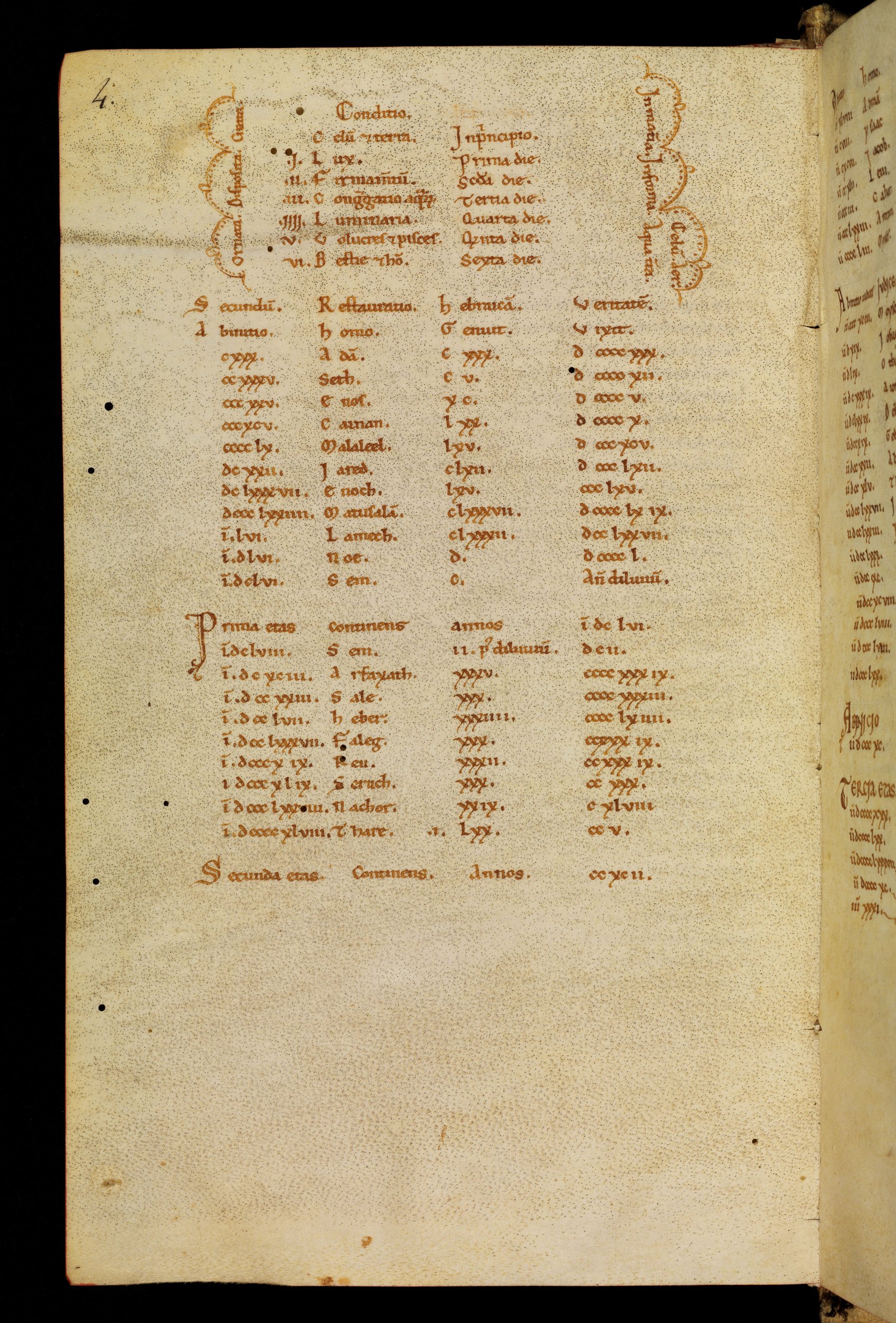
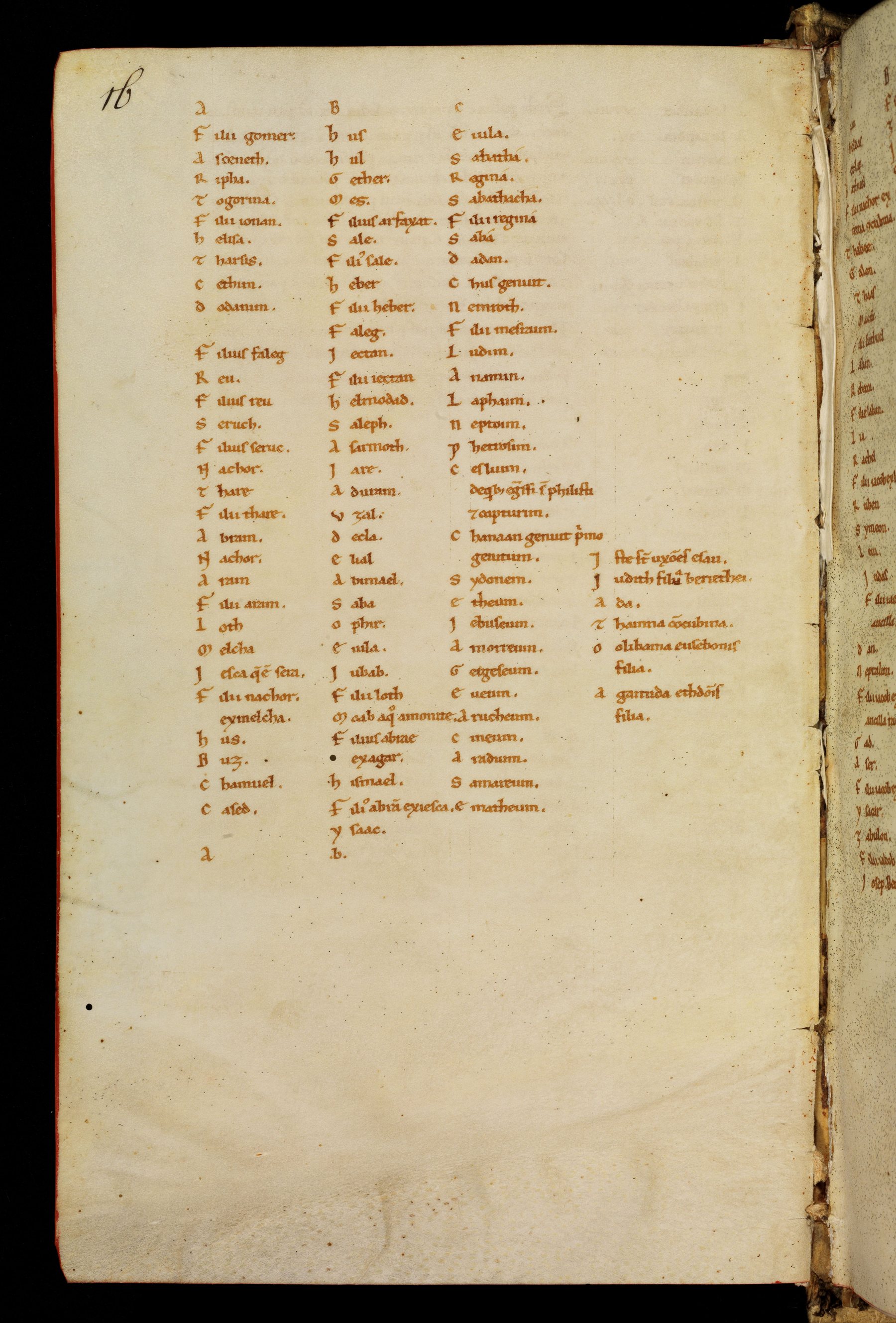
Bamberg fol. 2r, lines 19 to 20: the sentence that gives the work its title, De tribus maximis circumstantiis gestorum. The tables that follow the prologue set persons and times along a line and places across it, which is the next machine.
Warrants: The next machine: persons, places and times in the tables
What have we added
Hugh describes a goal, not a training schedule, and he wrote for students who already knew the psalms. Everything this page does beyond his sentences is ours, and is set out here element by element. The grade says how firmly Hugh's own words carry that element: what he states outright, what follows from what he states, and what we simply chose in order to make something a visitor can work.
| Element | Grade | Hugh says | We infer | We chose |
|---|---|---|---|---|
| The line of numbers | high | Learn to contemplate in your mind the line (linea) of the natural number, running out from one to whatever length you please, as though stretched out before the eyes of your heart (fol. 1r). | That the line is one-dimensional, begins at one and runs in a fixed direction, so that a number is a place: Hugh calls the numbers' ends distinct arrangements of places. | To draw it horizontally, left to right, with twenty points by default; ten or thirty on request. |
| Attaching each beginning to its number | high | When I have numbered each one in its own seat (sedes) on the line, I attend to them at once in utterance and in thought: Beatus vir, the first psalm; Quare fremuerunt, the second (fols. 1r to 1v). | That the beginning is the opening words, enough to recall the whole, and that the attaching is done by saying and thinking the number and the words together. | The opening four to six words of each psalm in the Clementine Vulgate, the medieval psalter's text, with a short English gloss of ours. |
| Access by number, and by the words | high for the number; inferred for the words | When questioned, I can answer without hesitation, whether in order, or with one or several skipped, or backwards: which is the twenty-seventh, the forty-eighth, or whatever number the psalm may be (fol. 1v). | That the answer runs the other way too: the Fathers cite a psalm by its number and not by its name, so the number must come from the words as readily as the words from the number. | Four prompt kinds: number to words, words to number, neighbours, and jumps between distant numbers. |
| Answering without the page | high | Do you suppose that they turned over the pages, to know which each of the psalms was? That labour would have been far too great: he had the knowledge in his heart (fol. 1v). | That the drawn line is scaffolding and the goal is recall with nothing to look at. | To withdraw the words first and then the line itself, in two stages, with the same prompts. |
| Running both ways | high | Or named in reversed and backward order (converso ordine et retrograde) (fol. 1v). | That the line can be walked in either direction from any point. | The traversal prompts of the last stage, up the line and down it. |
| The psalms as the example | high | I want to fix the psalter in my memory word for word. This is what I do. First I consider how many psalms it has: I find a hundred and fifty (fol. 1r). | Nothing beyond the text. | To test the first twenty psalms only, as a visitor can learn in a sitting; the full hundred and fifty can be shown. |
| The same line inside each psalm | high in the text; not operated here | Once the psalms are known, I do with the beginnings of the verses in each psalm what I did with the beginnings of the psalms in the whole psalter (fol. 1v). | That the method is meant to be applied again one level down, and once more for any book with fixed divisions. | Not to operate the verses; the page says so. |
| The three circumstances: persons, places, times | high as a principle; the tables not yet operated | There are three things on which knowledge of things done chiefly depends: the persons by whom, the places in which, and the times when (fol. 2r). | That the Chronicle's tables are the same ordering applied to history: time and number along the line, places across it, in Hugh's own image of the strongbox. | To show table leaves and leave their operation to the next machine. |
| The staged withdrawal of the words and then of the line | ours | Hugh states the capacity to be reached, not a schedule of practice (fol. 1v). | Nothing beyond the goal. | Five stages, from reading to unaided use, as one way of reaching that capacity in a sitting. |
| Self-marking and the tally | ours | none | Nothing. | The visitor recalls, reveals and marks right or wrong; the tally lives only in the page and is never stored or sent. |
| The look of the line | ours; Hugh would differ | We should impress on memory not only the number and order of the verses, but the very colour and shape, and the site and position of the letters: at the top, in the middle, at the foot (fol. 1v). | That Hugh's own line was not a bare abstraction: it lived on remembered pages, in their colours and places. | A plain rule with numbered points, so that it can be pictured away from the screen; the photographed leaves stand beside it for what Hugh's students actually saw. |
What this page is not: a claim to reproduce Hugh's teaching, or a measurement of anybody's memory. There is no control group and no comparison, because that would be an experiment on people and would need their consent and a plan for their data. The exercise is an exhibit, not a study.
The next machine
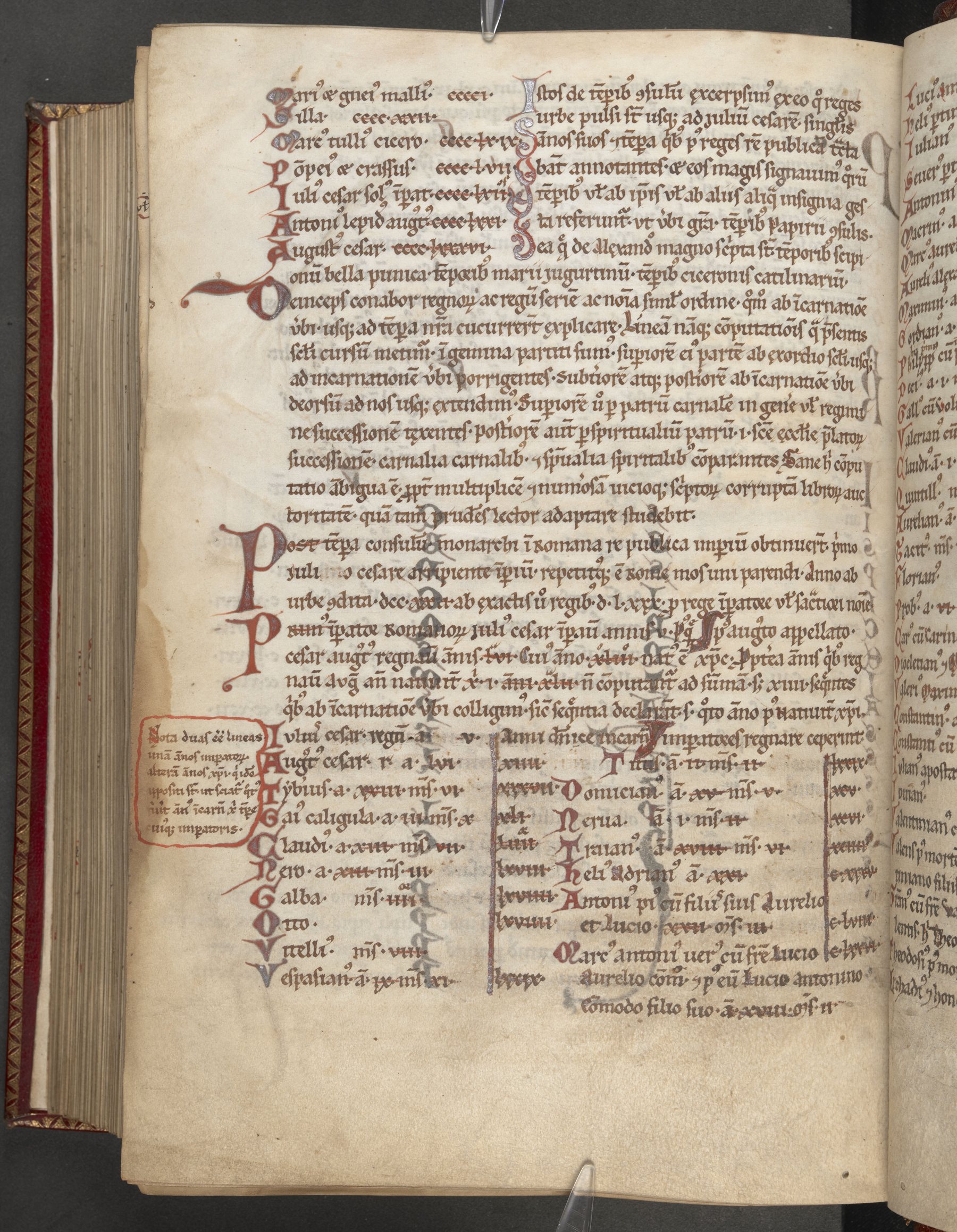
Hugh does not stop at the psalms. He applies the same ordering to what he calls the three circumstances of any historical event, the persons, the places and the times, and the tables that fill the rest of the Chronicle are that ordering set out on the page: columns of names and reigns to be read across as well as down. Those tables are the second Hugh machine, The line of years, where the line after the Incarnation runs from AD 1 to Hugh's own day with the popes and emperors set against it.
Sources and rights
-
The witness: Bamberg, Staatsbibliothek, Msc.Patr.21, part I, fols. 1r-2r (prologue), 2v-36v (tables)
second quarter of the twelfth century; Germany (the copy now in Bamberg); the text Paris, abbey of Saint-Victor, c. 1130. The leaves shown on this page are local copies made from that library's photographs and served from this site, so the page never asks another institution's image server for anything.
Rights: Public Domain Mark 1.0 (Staatsbibliothek Bamberg via the Munich Digitisation Centre, MDZ); images reproduced and cut here under that mark
-
Munich, Bayerische Staatsbibliothek, Clm 2, fols. 88-111
dated 1135, Augsburg cathedral: a copy made within Hugh's lifetime, about five years after the text was written.
Rights: Public Domain Mark 1.0.
-
Paris, Bibliothèque nationale de France, latin 15009, fols. 1-41
the abbey of Saint-Victor's own twelfth-century copy.
Rights: domaine public; non-commercial re-use free with the credit Source gallica.bnf.fr / BnF.
-
London, British Library, Stowe MS 4, fols. 267r-272v
tables only, no prologue; late twelfth century, eastern France; the leaves shown for the next machine.
Rights: Public Domain in most countries, other than the UK (British Library; Polonsky Foundation digitisation).
-
The Latin of the psalms' opening words
The incipits are quoted from the Clementine Vulgate, the Latin Bible authorised in 1592 and long out of copyright, in the plain-text edition of the vulsearch project. The numbering is the Vulgate's own, which is the one Hugh and his students used: from Psalm 10 onwards it is usually one less than the number the same psalm carries in most modern Bibles.
Rights: public domain. Only the opening words of each psalm are quoted, as Hugh's method requires.
-
Our transcription, our translation, our glosses
The Latin of the prologue is transcribed by this exhibition from the witness named above, with the abbreviations expanded and the spelling normalised; the English of the prologue, and the short English glosses beside the psalms, are ours. The glosses say what a psalm is about in a few words; they are not a translation of it.
Corrections are welcome: the transcription is a reading, and readings can be wrong.
-
The machine itself
The line, the four kinds of prompt, the marking of one's own answer, the staged withdrawal of the words and then of the line, and the length of the line are the exhibition's design, not Hugh's prescription. What each of them rests on is set out in What have we added.
The page runs entirely in the browser. It makes no request of its own, sets no cookie, and keeps no record of any visit.