Hugh of Saint Victor
Construct the Ark
Around 1128, at the abbey of Saint Victor outside Paris, Hugh set out the construction of an extraordinary image of Noah's ark. It is a plan seen from above, and on it he lays the whole of history: the line of generations running the length of the hull, the peoples along its sides, the ages of the world marked along its length, the ladders climbing the corners, and the world itself drawn as an oval around the whole. The text, the Libellus de formatione arche, is not a description of a finished picture. It is instructions, sentence by sentence, in the first person: I look for the middle point, I draw a small square, I lay gold over the cross. Whether it records a painting that once existed, directs new drawings, cultivates an image in the mind, or does more than one of these, is debated. This page explores what happens when the instructions are made visible, one instruction at a time, and shows its working: read the passage, apply it, and see the drawing grow by exactly what those words warrant — no more. Every component carries a verdict: HUGH SAYS when the passage states it, WE INFER when it follows from what he states, WE MUST CHOOSE when the text leaves it open and somebody has to decide.
The instructions
39 passages of construction and 6 of raising, in Hugh's order, from Migne's columns. The words in this colour are the ones that become lines. Apply them one at a time, or jump to any point in the construction. Reading an instruction never changes the drawing; only the buttons do.
-
1 Cap. I, col. 681
The centre and the cubit
Primum ad mysticam arcae Noe descriptionem, in planitie ubi arcam depingere volo, medium centrum quaero, et ibi fixo puncto parvam quadraturam aequilateram ad similitudinem illius cubiti, in quo consummata est arca, et circumduco. Item quoque illi quadraturae aliam paulo majorem circumscribo. Ita ut id spatium, quod est inter exteriorem et interiorem quadraturam, quasi limbus cubiti esse videatur.
First, for the mystical drawing of Noah's ark, in the flat surface where I mean to paint the ark I look for the middle point, and there, fixing a point, I draw round it a small equal-sided square, after the likeness of that cubit in which the ark was finished. Round that square I likewise draw another, a little larger, so that the space between the outer square and the inner one looks like a rim to the cubit.
HUGH SAYS
Shape, place and the “slightly larger” rim are all stated; the absolute size is not. Our scale makes the inner square four picture cubits (see step 7). The Cambridge and Mazarine copies open flatly "Primum in planitie"; Migne's "ad mysticam arcae Noe descriptionem" is the editor's, not Hugh's.
On the leaf. CCC 294, fol. 30r, col. a, line 15: (P)RIMVM in planitie ubi archa(m) depingere uolo. mediu(m) centru(m) quero — Migne opens 'Primum AD MYSTICAM ARCAE NOE DESCRIPTIONEM, in planitie ubi arcam depingere volo'. The manuscript has no such phrase: it runs straight from the rubric into 'Primum in planitie'. Also 'archam' for 'arcam' (so throughout), 'quero' for 'quaero'. The Mazarine control reads the same (display capitals 'PRIMVM IN PLANITIE', then 'ubi archam depingere uolo').
-
2 Cap. I, col. 681
The gold cross
Hoc facto in interiori quadratura crucem pingo, ita ut cornua ejus singula latera quadraturae attingant, eamque auro superduco.
That done, in the inner square I paint a cross, so that each of its arms touches a side of the square, and I lay gold over it.
HUGH SAYS
Cross, arms touching the sides of the square, gold — all stated. The thickness of the arms is ours.
On the leaf. CCC 294, fol. 30r, col. a, line 23: Hoc facto. in int(er)iori q(ua)dratura cruce(m) pingo ÷ ita ut cornua ei(us) — 'quadraturae ... attingat' (singular) for Migne 'attingant'; otherwise as Migne.
-
3 Cap. I, col. 681
Fire above, cloud below
Deinde spatia illa, quae in superficie quadraturae inter quatuor angulos crucis et quadraturae remanent, colore vestio, duo superiora flammeo, et duo inferiora sapphirino. Ita ut medietas una cubiti in flammeo colore ignem, et altera medietas in sapphirino colore nubem repraesentare videatur.
Then those spaces which are left on the face of the square, between the four angles of the cross and of the square, I clothe with colour: the two upper ones flame-colour, the two lower ones sapphire — so that one half of the cubit, in its flame colour, seems to show fire, and the other half, in its sapphire colour, cloud.
HUGH SAYS
The four spaces, their two colours and what each colour shows are stated. We lay the colour only where the cross does not, so that the gold still reads.
On the leaf. CCC 294, fol. 30r, col. a, line 26: Dein spacia illa q(uae) in sup(er)ficie q(ua)drature. int(er) .IIII. angulos crucis — 'Dein' for Migne 'Deinde' (the manuscript shortens this word throughout); 'spacia' for 'spatia'; the numeral .IIII. for Migne's spelled 'quatuor'.
-
4 Cap. I, col. 681
Alpha, Omega, Chi, Sigma
Post haec in limbo cubiti supra crucem scribo A, quod est principium. Econtrario subter crucem scribo Ω, quod est finis. Ad dextrum cornu crucis scribo Χ, quae littera prima ponitur in nomine Christi, et significat Decalogum legis, quae antiquo populo primum quasi electo et justo ad dexteram collocata data est. Ad sinistrum autem cornu pono Ϲ, quae est ultima in hoc nomine Christi, (7) et significat in centum perfectionem gratiae, quae data est gentilitati, quae primum propter infidelitatem abjecta, et ad sinistram collocanda videbatur.
After this, in the rim of the cubit above the cross, I write A, which is the beginning. Opposite, beneath the cross, I write Ω, which is the end. At the right arm of the cross I write Χ, the letter that stands first in the name of Christ; it signifies the Decalogue of the Law, which was given to the ancient people first, and set at the right hand as to the chosen and the righteous. At the left arm I put Ϲ, which is the last letter in that name of Christ, (7) and it signifies, in the hundred, the fullness of grace, which was given to the Gentiles — who at first, for their unbelief, seemed cast off and to be placed at the left hand. [(7) Migne's editor's footnote at this point reads: Doctoris error, “the Doctor's mistake”.]
WE MUST CHOOSE
The four letters and their places are stated; which way “right” lies is the global side rule — Hugh's right is the north, which falls on the viewer's left. Migne's editor marks Hugh's hundred with a footnote: Doctoris error.
On the leaf. CCC 294, fol. 30r, col. b, line 2: Post hęc in limbo cubiti sup(ra) cruce(m) s(cri)bo. a. q(uo)d ÷ p(ri)ncipiu(m) — As Migne. The Alpha is written as a small rounded minuscule 'a' (not a display Greek capital); the Omega two lines below as 'ω'; the Chi as '.x.' and the lunate sigma as '.c.'.
-
5 Cap. I, col. 681
The rim's colours
Deinde spatium limbi circumquaque purpureo, et viridi colore induo, exterius purpureo, et interius viridi,
Then I clothe the space of the rim all round with purple and with green — purple on the outside, green on the inside,
HUGH SAYS
Stated: purple outside, green inside, all round the rim. Only the division of the band into two equal halves is ours.
On the leaf. CCC 294, fol. 30r, col. b, line 14: Dein spaciu(m) limbi c(ir)cu(m)q(ua)q(ue) purpureo et uiridi colore induo — 'Dein' for 'Deinde'; 'spacium' for 'spatium'.
-
6 Cap. I, col. 681
The Lamb
et in medio crucis aureum, quam feceram, agnum anniculum stantem pingo. Quo facto perfectus est cubitus.
and in the middle of the golden cross that I had made I paint a yearling lamb, standing. With that done, the cubit is finished.
WE MUST CHOOSE
Hugh paints a standing yearling lamb at the crossing of the gold cross: the subject and its place are his; the lamb's drawing, in line and without a face, is ours, and the word beneath it names it.
On the leaf. CCC 294, fol. 30r, col. b, line 16: et in medio crucis aureę qua(m) fecera(m). agnu(m) agnicu|lum stante(m) pingo — Two real variants. Migne prints 'in medio crucis AVREVM, quam feceram' — the manuscript reads 'crucis aureae' (genitive, agreeing with crucis), which is the better Latin. And Migne's 'agnum ANNICVLVM' (a yearling lamb) is here 'agnum AGNICVLVM' (a little lamb); the 'g' with its descender is unambiguous at full resolution.
-
7 Cap. I, col. 682
The Ark's outline
Ita medio cubito consummato, aliam quadraturam circa praedictum centrum longe extra circumduco, et tantae magnitudinis, quantae magnitudinis arcam facere volo, quae quadratura sexies tam longa sit quam lata, quia arca trecentos cubitos in longitudine habuit, quinquaginta in latitudine, hoc est sexies longa ad latitudinem. Ego tamen propter competentiorem formam in pictura usque ad quadruplam fere longitudinem breviavi.
So, the middle cubit being completed, I draw another quadrangle round the said centre, far outside it, and of the size I wish to make the ark: a quadrangle six times as long as it is wide, because the ark had three hundred cubits in length and fifty in breadth, that is, six times as long as it is broad. For the sake of a shape that suits the picture better, however, I have shortened it to about four times the length.
WE MUST CHOOSE
The ark is six times as long as it is wide, but Hugh says he shortened the picture to about four times; we take exactly four.
On the leaf. CCC 294, fol. 30v, col. a, line 19: Ita medio cubito consumma|to. alia(m) q(ua)dratura(m) c(ir)ca p(rae)dictu(m) centru(m) longe extra circu(m)duco
-
8 Cap. I, col. 682
The zone along the length
Post haec per mediam hanc quadraturam, id est per medium fundum arcae, secundum longitudinem duabus lineis ductis tantae latitudinis spatium includo, quantae est interior quadratura medii cubiti.
After this, through the middle of this square — that is, through the middle of the ark's floor — I enclose, by drawing two lines lengthwise, a strip as wide as the inner square of the middle cubit.
HUGH SAYS
Stated: the band runs through the middle of the ark's floor lengthwise, is made with two lines, and is as wide as the cubit's inner square.
On the leaf. CCC 294, fol. 30v, col. a, line 30: Post hęc p(er) media(m) hanc q(ua)dratura(m). id ÷ p(er) mediu(m) fundu(m) archę — 'archę' for Migne 'arcae' (the manuscript writes arch- throughout).
-
9 Cap. I–II, col. 682–683
The zone across the breadth
Similiter per mediam latitudinem, ab uno pariete usque ad alterum duabus lineis protensis, ejusdem latitudinis spatium signo. Ita ut hi duo cinguli, quorum alter per mediam longitudinem, alter per mediam latitudinem protenditur, altrinsecus se intersecantes in modum crucis, sub medio cubito conveniant, et interiori latitudini ipsius respondeant, limbo ejus tantummodo hinc inde excedante.
In the same way, through the middle of the breadth, from one wall to the other, I mark out a strip of the same width with two lines drawn across; so that these two bands, of which one runs along the middle of the length and the other along the middle of the breadth, cutting each other crosswise, meet beneath the middle cubit and answer to its inner width, its rim alone standing out beyond them on either side.
HUGH SAYS
Stated: the same width, from wall to wall, crossing the first band beneath the cubit, with the cubit's rim alone standing out beyond it on either side.
On the leaf. CCC 294, fol. 30v, col. b, line 2: Similit(er) p(er) media(m) latitudine(m) ab uno pariete. usq(ue) ad aliu(m) duab(us) lineis p(ro)tensis — 'ad alium' for Migne 'ad alterum'; 'eidem latitudinis spacium signo' for Migne 'ejusdem latitudinis spatium signo'.
-
10 Cap. II, col. 683
The two inner storeys
Hoc ita peracto, spatia quae inter medium centrum, vel potius medium cubitum, et singulos angulos arcae interjacent, unumquodque in tria aequalia positis punctis divido, et apposita regula binis punctis coadjacentibus secundum longitudinem, et latitudinem de puncto semper ad punctum circumquaque lineam traho; et ita duas alias quadraturas sexies similiter longas ad latitudinem suam efficio, quae tali proportione a se distant, ut quantum prima vincit mediam, tantum media vincat tertiam. Inter quas tertia quadratura, quae minima est, et secundum positionem plani infra alias clauditur, medium cubitum ambit, et duos supradictos cingulos, quorum alter longitudinem, alter latitudinem arcae metitur, quadrifariam intercidit, alterum sursum et deorsum, alterum sinistrorsum et dextrorsum. Deinde secunda tertiam complectitur, et similiter supradictos cingulos intersecat. Deinde alia, quae in plano extrema est, in alto autem ima, caeteras omnes includit, et quatuor extrema cornua duarum zonarum singulis lateribus accingens, totas eas intra se comprehendit.
That done, the spaces that lie between the middle point — or rather the middle cubit — and each corner of the ark, I divide each into three equal parts by setting points; and laying a ruler along each pair of neighbouring points, lengthwise and breadthwise, I draw a line always from point to point, all round. And so I make two further quadrangles, likewise six times as long as they are wide, standing apart from one another in this proportion: by as much as the first exceeds the middle one, by so much does the middle one exceed the third. Of these the third quadrangle, which is the smallest and which, as the plan lies, is enclosed within the others, goes round the middle cubit and cuts the two bands aforesaid in four places — the one above and below, the other to left and right. Then the second embraces the third and likewise cuts the said bands. Then the other, which in the plan is the outermost and in the elevation the lowest, encloses all the rest, and girding the four outer ends of the two bands with its several sides, takes them wholly within itself.
HUGH SAYS
The construction is stated — divide each span from the cubit to the corner into three, then draw from point to point — and it yields exactly these two rectangles.
On the leaf. CCC 294, fol. 30v, col. b, line 11: Hoc | ita p(er)acto ÷ spacia quę int(er) mediu(m) cen|trum u(e)l poti(us) mediu(m) cubitu(m) — 'spacia' for 'spatia'; 'arche' for 'arcae'. Otherwise as Migne.
-
11 Cap. II, col. 683–684
The rafters, seen from above
Hoc facto, si nosse cupis quomodo haec figura formam arcae repraesentet, intellige quod de illa zona, quae per mediam latitudinem arcae protenditur, fiat columna quadrata aequilatera in medio arcae erecta, cujus altitudo tanto minor sit latitudine arcae, quanto minor est ternarius quinario, quia altitudo arcae erat triginta cubitorum, et latitudo quinquaginta. Si autem scire cupis qua ratione ex ipsa zona columnam fieri intelligendum sit, sic considera. Cubitus ille, qui nunc secundum positionem plani in medio ipsius zonae affixus jacet, sursum elevetur, sic ut ipsam zonam quasi per medium complicando secum sursum trahat, deinde ambae medietates ejus deorsum pendentes plano ad planum invicem compingantur ut columna erecta videatur. In cujus summitate emineat cubitus ille, qui secundum positionem plani prius in medio ejus jacebat. Nihilque aliud esse intelligatur cubitus ipse, quam columnae praecisio desuper, et limbus cubiti sit quaedam ora sive eminentia facta desuper in capite columnae ad excipienda tigna circumquaque ab imo surgentia, quae ipsi columnae infixa sunt sub eadem eminentia, sub qua etiam summitas tecti consummata est, ad similitudinem imbricis summitatem tectorum excipientis. Et quamvis altitudo columnae non videatur major esse medietate zonae, cum facta sit ex ipsa duplicata, intelligenda est tamen tanto major esse, quanto majora sunt triginta quam viginti quinque, sed hoc in plano repraesentari non potuit. Rursum cum medietas tantum zonae altitudinem columnae teneat, quare ambae medietates ejus depictae sint, haec est ratio. Culumna ista, quae in medio arcae erigitur, significat lignum vitae, quod plantatum est in medio paradisi, id est Dominum Jesum Christum, secundum formam humanitatis susceptae in medio Ecclesiae plantatum, qui Christus Deus et homo est. Et ideo latus columnae, quod ad aquilonem respicit, humanitatem ejus significat, quam pro peccatoribus assumpsit; illud autem, quod ad austrum spectat, divinitatem ejus figurat, qua mentes fidelium pascit. Et haec est causa, quare in plano bis altitudinem depinximus, quoniam oportebat utriusque lateris superficiem repraesentari, quod nisi geminata figura fieri non potuit. Statuta igitur columna in medio arcae, erigantur a singulis angulis tigna usque ad summitatem ipsius, eique sub eminentia extremae orae infigantur. Deinde duae interiores quadraturae sursum eleventur, quousque utraque secundum suam positionem tignis eisdem ex omni parte orthogonaliter conjungatur, extrema quadratura in imo remanente;
That done, if you wish to know how this figure represents the form of the ark, understand that out of that band which runs along the middle of the ark's breadth there is made a square, equal-sided column, set up in the middle of the ark, whose height is less than the ark's breadth by as much as three is less than five, because the height of the ark was thirty cubits and the breadth fifty. And if you wish to know by what reasoning the column is to be understood as made out of that band, consider it thus. Let that cubit, which now, as the plan lies, is fixed in the middle of the band, be lifted up, so that in rising it folds the band, as it were, through the middle and draws it up with itself; then let the two halves of it, hanging down, be pressed together face to face, so that a column appears standing. At the top of it let that cubit stand out which, as the plan lay, had before lain in the middle of the band. And let the cubit itself be understood to be nothing else than the column's cut-off top, and the cubit's rim a kind of lip or ledge made above, at the column's head, to receive the rafters that rise all round from below and are fixed to the column under that same ledge, under which too the summit of the roof is finished, after the likeness of the ridge-tile that receives the tops of roofs. And although the height of the column does not seem greater than half the band, since it is made of that band doubled, it is nevertheless to be understood to be greater by as much as thirty is greater than twenty-five; but this could not be shown on the flat. Again, since only half the band takes up the column's height, the reason why both halves of it are drawn is this. That column, which is raised in the middle of the ark, signifies the tree of life which was planted in the middle of paradise, that is, the Lord Jesus Christ, planted in the middle of the Church in the form of the humanity he took on — Christ, who is God and man. And therefore the side of the column that looks to the north signifies his humanity, which he took on for sinners; and that which faces south figures his divinity, on which the minds of the faithful are fed. And this is the reason why we have drawn the height twice on the flat: because the surface of both sides had to be shown, and this could not be done except by a doubled figure. The column, then, being set in the middle of the ark, let rafters be raised from each corner up to its summit, and fixed to it beneath the ledge of the outer lip. Then let the two inner quadrangles be lifted up, until each of them, in its own position, is joined at right angles on every side to those same rafters, the outermost quadrangle remaining below;
WE INFER
Hugh raises the rafters from the corners to the column's head in the elevation; their trace on the plan is the diagonal, which also passes through the storeys' corners. He does not tell us to draw it. We do, faintly, because the ladders of step 29 stand on it.
On the leaf. CCC 294, fol. 31r, col. a, line 5: Hoc facto. si | nosse cupis q(uo)m(od)o hęc figura forma(m) ar|chę rep(rae)sentet — 'arche' for 'arcae'; 'columpna' for 'columna' in the following sentence. The immediately preceding words read 'totas eas int- se comprehendit'; the abbreviation stroke does not distinguish Migne's 'intra' from 'inter', so I do not claim a variant there.
-
12 Cap. II, col. 684
The column's two faces
Cujus mysterium hoc est: columna Christus est, australe latus ejus (quod divinitatem ipsius significat) lignum vitae vocatur, et ideo viridi colore superductum est. Aquilonare vero latus (quod humanitatem ejus figurat) liber vitae dicitur, et hoc sapphirino colore superductum est.
The mystery of it is this: the column is Christ; his southern side (which signifies his divinity) is called the tree of life, and is therefore overlaid with green. But the northern side (which figures his humanity) is called the book of life, and this is overlaid with sapphire.
HUGH SAYS
Stated: the band folds up into the column, whose southern face is the tree of life, green, and whose northern face is the book of life, sapphire. The written labels are ours.
On the leaf. CCC 294, fol. 31v, col. a, line 13: Cui(us) mysteriu(m) hoc ÷. Colum|pna x(rist)us ÷. Australe lat(us) ei(us) q(uo)d diuinitate(m) ipsi(us) significat — 'columpna' for 'columna' (so throughout this manuscript); 'saphirino' with one p for Migne 'sapphirino'.
-
13 Cap. III, col. 685
The zone as time
Igitur zona ista, quae protenditur a fine usque ad finem arcae, designat cursum temporis ab initio mundi usque ad finem saeculi. Medietas autem ejus, quae est superius a capite arcae usque ad columnam, significat omne tempus ab initio mundi usque ad incarnationem Verbi; altera vero medietas, quae est a columna deorsum, designat omne tempus ab incarnatione Verbi usque ad finem saeculi. Ideo in superiori medietate a capite arcae usque ad columnam, scribitur linea carnalis generationis ab Adam usque ad Christum. In altera autem medietate a columna deorsum scribuntur nomina apostolorum a Petro, ac deinceps eo ordine, quo sibi in regimine Ecclesiae quasi filii spiritales patribus successerunt. Quia enim ab Adam usque ad Christum vetus generatio fuit, quae est secundum carnem, ideo cursus temporum in priori parte saeculi per carnalem generationem distinguitur. Quia vero in Christo nova generatio fuit, quae est secundum spiritum, ideo cursus temporum in posteriori parte saeculi, id est post Christi adventum, per spiritalem generationem determinatur. Has autem generationes tali modo dispono: superiorem medietatem, quae est a columna sursum, in tres partes aequales divido, et unaquaeque tertia sexta pars est totius longitudinis.
This band, then, which runs from one end of the ark to the other, marks out the course of time from the beginning of the world to the end of the age. Its upper half, which runs from the head of the ark to the column, signifies all the time from the beginning of the world to the incarnation of the Word; the other half, which runs from the column downwards, marks out all the time from the incarnation of the Word to the end of the age. And so in the upper half, from the head of the ark to the column, the line of fleshly generation is written, from Adam to Christ. In the other half, from the column downwards, are written the names of the apostles from Peter onwards, in the order in which they succeeded one another in the governing of the Church, as spiritual sons succeed their fathers. For since from Adam to Christ there was the old generation, which is according to the flesh, the course of the times in the earlier part of the age is marked out by fleshly generation; and since in Christ there was a new generation, which is according to the spirit, the course of the times in the later part of the age — that is, after Christ's coming — is determined by spiritual generation. These generations I set out in this way: the upper half, which runs from the column upwards, I divide into three equal parts, and each third is a sixth part of the whole length.
HUGH SAYS
Stated: the band is the course of time, its upper half divided into three, each third a sixth of the whole length. The two small captions are ours.
On the leaf. CCC 294, fol. 32r, col. a, line 1: Igit(ur) zona | ista q(uae) p(ro)tendit(ur) a fine usq(ue) ad fine(m) archę ÷ designat cursu(m) temporis — 'arche' for 'arcae'; 'seculi' for 'saeculi'.
-
14 Cap. IV, col. 686
The ADAM square
Hac divisione facta incipio sursum a capite, et primum nomen Adam taliter scribo. In ipsa fronte arcae facio parvam quadraturam ad figurandas quatuor partes mundi, deinde superiori ejus lateri, id est orienti, appono A, hoc est primam litteram nominis Adam. Inferiori autem lateri, id est occidenti, appono D, hoc est secundam. Dextero lateri, id est aquiloni, appono A, id est tertiam. Sinistro lateri, id est australi, appono M, id est quartam litteram. In Graeco autem singulae partes mundi ab his litteris incipiunt. Anatole, id est oriens, incipit ab a, et ideo orienti appositum est A; Dysis, id est occidens, incipit a d, et ideo occidenti appositum est D; Arctos, id est septentrio, incipit ab a, et ideo septentrioni apponitur rursum A; Mesembria, id est meridies sive auster, incipitur ab m, et ideo australi lateri apponitur M. Cujus rei rationem quidam talem tradunt: dicunt enim quod recte primus parens a quatuor partibus mundi nominis sui elementa contraxit, qui per omnes partes mundi in prole sua diffundendus fuit.
This division made, I begin above, at the head, and write the first name, Adam, in this way. In the very front of the ark I make a small square to figure the four parts of the world; then to its upper side, that is, to the east, I set A, the first letter of the name Adam. To the lower side, that is, to the west, I set D, the second. To the right side, that is, to the north, I set A, the third. To the left side, that is, to the south, I set M, the fourth letter. For in Greek each of the parts of the world begins with these letters. Anatole, that is the east, begins with a, and therefore A is set to the east; Dysis, that is the west, begins with d, and therefore D is set to the west; Arctos, that is the north, begins with a, and so A again is set to the north; Mesembria, that is the midday or south, begins with m, and therefore M is set to the southern side. Some give this reason for it: they say that the first parent rightly drew the letters of his name from the four parts of the world, since he was to be spread through every part of the world in his offspring.
HUGH SAYS
Stated: the small square at the front of the ark, the four letters, and the side of the world each belongs to. The side rule decides where Hugh's right falls on the page.
On the leaf. CCC 294, fol. 32r, col. a, line 28: Hac diuisione facta ÷ | incipio sursu(m) á capite ÷ et p(ri)mu(m) nome(n) adę talit(er) scribo — Two variants. Migne 'et primum nomen ADAM taliter scribo'; the manuscript reads 'nomen Adę' (Adae, genitive). And three lines further on the manuscript reads 'facio paruam quadraturam AD SIGNIFICANDAS .IIII. partes mundi' where Migne has 'ad FIGVRANDAS quatuor partes mundi'.
-
15 Cap. IV, col. 686
The line of generation, first part
Post Adam secundum lineam generationis scribuntur Seth, Enos, Cainam, Malaleel, Jared, Henoch, Mathusalem, Lamech, Noe, Sem, Arphaxat, Sale, Heber, Phalech, Reu, Saruch, Nachor, Thare, Abraham, Isaac et Jacob; et hi in prima parte collocantur.
After Adam there are written, along the line of generation, Seth, Enos, Cainam, Malaleel, Jared, Henoch, Mathusalem, Lamech, Noe, Sem, Arphaxat, Sale, Heber, Phalech, Reu, Saruch, Nachor, Thare, Abraham, Isaac and Jacob; and these are placed in the first part.
HUGH SAYS
The twenty-one names, their order and their part of the length are all stated.
On the leaf. CCC 294, fol. 32r, col. b, line 20: Post ada(m) sec(un)d(u)m linea(m) g(e)n(er)ationis sc(ri)buntur. Seth. ENOS. cainan. Malalael. Jareth — Name forms: 'Cainan' (Migne 'Cainam'), 'Malalael' ('Malaleel'), 'Jareth' ('Jared'), 'Enoch' ('Henoch'), 'Matusalam' ('Mathusalem'), 'Eber' ('Heber'), 'hii' ('hi'). Some names are written in display capitals (ENOS, ENOCH, NOE, SEM, EBER, NACHOR) — the scribe is marking the ten antediluvian patriarchs and the line of Sem.
-
16 Cap. IV, col. 686
Juda and the twelve patriarchs
In secunda parte primo scribo Judam, et circa ipsum reliquos patriarchas hinc inde a dextris et a sinistris hoc modo dispono: incipiens a dextro pariete secundum ordinem generationis, Ruben, quia primogenitus fuit, primum scribo; deinde Simeon, deinde Levi. Et hi a dextris Judae collocantur; hi quatuor filii Liae fuerunt. A sinistris Judae similiter secundum ordinem generationis primum scribitur Dan, deinde Nephtalin, hi filii Balae ancillae Rachelis. Post Nephthalim ponitur Gad, deinde Aser, hi filii Zelphae ancillae Liae. Deinde Issachar, deinde Zabulon, hi rursum filii Liae: deinde novissime Joseph, et post eum Benjamin, hi filii Rachel. Post haec singulis nominibus suas imagines superpono semiplenas, a pectore sursum, quales nonnunquam in tabulis solent figurari, quas Graeci frequentiori nomine Iconas vocant, ut sic duodecim patriarchae secundum latitudinem per transversum in stationibus suis ordinati appareant, quasi quidam senatus Dei civitatis.
In the second part I write first Juda, and round him I set the remaining patriarchs on this side and that, to right and left, in this way. Beginning from the right-hand wall, in the order of birth, I write first Ruben, because he was the firstborn; then Simeon, then Levi. And these are placed at Juda's right; these four were the sons of Lia. At Juda's left, likewise in the order of birth, Dan is written first, then Nephtalin: these are the sons of Bala, Rachel's handmaid. After Nephthalim is set Gad, then Aser: these are the sons of Zelpha, Lia's handmaid. Then Issachar, then Zabulon: these again are sons of Lia. Then, last of all, Joseph, and after him Benjamin: these are the sons of Rachel. After this I set over each name its own half-length image, from the breast upwards, of the kind sometimes drawn on panels, which the Greeks more commonly call icons — so that the twelve patriarchs appear ranged across the breadth, in their stations, like a senate of the city of God.
WE MUST CHOOSE
Hugh begins the right (north) side at the wall and says the left side is set out “likewise”; we read that as also from the wall inward. The half-length icons over the names are not drawn. The half-length images over the names, "of the kind sometimes drawn on panels, which the Greeks call icons", are stated; ours are line busts without faces.
On the leaf. CCC 294, fol. 32r, col. b, line 26: In sec(un)d(a) parte p(ri)mu(m) scribo iuda(m) ÷ | et circa ipsu(m) reliq(uo)s patarchas. hinc in(de) — 'primum' for Migne 'primo'; 'Symeon' for 'Simeon' three lines below. Note that here the manuscript DOES have 'et circa ipsum' — which is what makes the omission at S20 look like an eyeskip.
-
17 Cap. IV, col. 686
The line, second part
Deinde reversus ad lineam generationis post Judam pono Phares, Ephrom, Aram, Aminadab, Naasson, Salmon, Booz, Obeth, Isai, David, Salomon, Roboam, Abia, Asa, Josaphat, Joram, Aazias, Joas, Amazias, Ozias, Joathan, Achas. Et hi sunt in secunda parte.
Then, returning to the line of generation, after Juda I put Phares, Ephrom, Aram, Aminadab, Naasson, Salmon, Booz, Obeth, Isai, David, Salomon, Roboam, Abia, Asa, Josaphat, Joram, Aazias, Joas, Amazias, Ozias, Joathan, Achas. And these are in the second part.
HUGH SAYS
The twenty-two names, their order and their part are stated.
On the leaf. CCC 294, fol. 32v, col. a, line 17: Dein reuersus ad li|neam generationis post iuda(m) pono Phares. Esrom. Aram — 'Dein' for 'Deinde'. Name forms: 'Esrom' (Migne 'Ephrom'), 'Naason' ('Naasson'), 'Isay' ('Isai'), 'Josaphath' ('Josaphat'), 'Amasias' ('Amazias'), 'Achaz' ('Achas'). 'Abia', omitted by the scribe, has been supplied above the line before 'Asa'.
-
18 Cap. IV, col. 686–687
The line, third part, and “thus far the first Adam”
Deinde in tertia parte secundum ordinem ponuntur Ezechias, Manasses, Amon, Josias, Eliachim, Joachim, Salathiel, Zorobabel, Abiud, Eliachim, Azor, Sadoch, Achin, Eliud, Eleazar, Mathan, Jacob, Joseph. Inter Joseph autem et columnam scribo, hucusque primus Adam secundum carnem.
Then in the third part there are set, in order, Ezechias, Manasses, Amon, Josias, Eliachim, Joachim, Salathiel, Zorobabel, Abiud, Eliachim, Azor, Sadoch, Achin, Eliud, Eleazar, Mathan, Jacob, Joseph. And between Joseph and the column I write: thus far the first Adam, according to the flesh.
HUGH SAYS
The eighteen names and their order are stated, and so are the words Hugh writes between Joseph and the column.
On the leaf. CCC 294, fol. 32v, col. a, line 23: Dein | in tertia parte. sec(un)d(u)m ordine(m) pono. Ezechias. Manases. Ammon. Josias — 'Dein' for 'Deinde'; and 'PONO' (I place) for Migne's passive 'ponuntur' — the manuscript keeps Hugh's first person here as everywhere else in the construction. Name forms: 'Manases' (Migne 'Manasses'), 'Ammon' ('Amon'), 'Sadoc' ('Sadoch').
-
19 Cap. IV, col. 687
The lower half in three
Post haec reliquam medietatem, quae est a columna deorsum, similiter in tres partes aequales divido, has autem ternas partes supra, et ternas infra, designant latera mansionum, ubi intersecant ipsam zonam secundum positionem plani.
After this the remaining half, which runs from the column downwards, I likewise divide into three equal parts; and these three parts above and three below are marked out by the sides of the storeys, where they cut the band itself as the plan lies.
HUGH SAYS
Stated — and Hugh adds that the sixths are marked by the storeys' sides where they cut the band, which confirms that the storeys' short sides lie exactly on the thirds of step 10.
On the leaf. CCC 294, fol. 32v, col. a, line 30: Post hec reliqua(m) medietate(m). quę ÷ a columpna deorsu(m) — 'columpna' for 'columna'.
-
20 Cap. IV, col. 687
Peter and the apostles
Igitur facta hac divisione, post columnam primum in ipsa linea Petrum, et circa ipsum a dextris et a sinistris reliquos apostolos, cum suis iconibus, sex a dextris et a sinistris quinque, ut ex una parte columnae duodecim patriarchae, et ex altera parte duodecim apostoli sint constituti ad similitudinem viginti quatuor seniorum in Apocalypsi in circuitu throni sedentium. Et sicut duodecim patriarchae superius latitudinem arcae continent (quia ab eis antiquus ille populus scriptae legis universus secundum carnem descendit), ita duodecim apostoli inferius, quia ab eis omnis populus novae legis, id est gratiae, per fidem spiritualiter propagatus est.
This division made, then, after the column I place first, on the line itself, Peter, and round him, to right and left, the rest of the apostles with their icons — six at the right and five at the left — so that on one side of the column twelve patriarchs, and on the other side twelve apostles, are set, after the likeness of the twenty-four elders sitting round the throne in the Apocalypse. And as the twelve patriarchs hold the breadth of the ark above (because from them that whole ancient people of the written law descended according to the flesh), so the twelve apostles hold it below, because from them the whole people of the new law, that is of grace, was spread abroad spiritually by faith.
WE MUST CHOOSE
Hugh gives the number and the sides — six at the right, five at the left — and the icons, but not the names. We use the canonical list, with Matthias in the twelfth place. The icons are not drawn. The Cambridge copy has skipped Migne's "circa ipsum a dextris et" but keeps the count, six and five. The apostles "with their icons": the busts over the names are ours in line.
On the leaf. CCC 294, fol. 32v, col. b, line 5: Igit(ur) facta hac diuisione. post columpna(m) | p(ri)mu(m) in ipsa linea petru(m). et a sinist(ri)s | .XII. ap(osto)los cu(m) suis yconiis dispono — The manuscript has lost Migne's 'circa ipsum a dextris et' — it reads 'primum in ipsa linea Petrum. et a sinistris .XII. apostolos cum suis yconiis dispono. a dextris .VI. et a sinistris .V.' A signe-de-renvoi after 'a sinistris' keys a marginal addition beginning 'circa e...', but the leaf has been trimmed by a binder and the rest of the note is gone. Also 'cum suis yconiis' for Migne 'cum suis iconibus'; 'columpnam'.
-
21 Cap. IV, col. 687
The popes
Deinde post Petrum sequitur: Clemens, Anacletus, Evaristus, Alexander, Sixtus, Thelesphorus, Iginus, Pius, Anicetus, Soter, Eleuterius, Victor, Zepherinus, Calistus, Urbanus, Pontianus, Antherus, Fabianus, Cornelius, Lucius, Stephanus, Sixtus, Dionysius, Felix, Euthicianus, Gaius, Marcellinus, Marcellus, Eusebius, Melchiades, Sylvester, Marcus, Julius, Liberius, Felix, Damasus, Siricius, Anastasius, Innocentius, Zozimus, Bonifacius, Coelestinus, Sixtus, Leo, Hilarius, Simplicius, Felix, Gelasius, Anastasius, Simmachus, Hormisda, Joannes, Felix, Bonifacius, Joannes, Agapitus, Silverius, Vigilius, Pelagius, Joannes, Benedictus, Pelagius, Gregorius, Sabinianus, Bonifacius, Deusdedit, Bonifacius, Honorius, Severinus, Joannes, Theodorus, Martinus, Eugenius, Vitalianus, Adeodatus, Bonus, Agatho, Leo, Benedictus, Joannes, Conon, Sergius, Joannes, Joannes, Sisinius, Constantinus, Gregorius, Gregorius, Zacharias, Stephanus, Paulus, Stephanus, Adrianus, Leo, Stephanus, Paschalis, Eugenius, Valentinus, Gregorius, Leo, Sergius, Benedictus, Nicolaus, Adrianus, Joannes, Joannes, Martinus, Adrianus, Stephanus, Formosus, Bonifacius, Stephanus, Romanus, Theodorus, Joannes, Benedictus, Leo, Christophorus, Sergius, Anastasius, Lando, Joannes, Leo, Stephanus, Joannes, Leo, Stephanus, Marinus, Agapitus, Joannes, Benedictus, Leo, Joannes, Benedictus, Domnus, Bonifacius, Benedictus, Joannes, Joannes, Joannes, Gregorius, Joannes, Sylvester, Joannes, Joannes, Sergius, Benedictus, Joannes, Benedictus, Sylvester, Gregorius, Clemens, Damasus, Leo, Victor, Stephanus, Benedictus, Nicolaus, Alexandrinus, Gregorius, Victor, Urbanus, Paschalis, Gelasius, Calistus, Honorius. Et quod super est spatium usque ad fidem arcae, illos capiet, qui post nos futuri sunt, usque ad finem saeculi.
Then after Peter follow: Clemens, Anacletus, Evaristus, Alexander, Sixtus, Thelesphorus, Iginus, Pius, Anicetus, Soter, Eleuterius, Victor, Zepherinus, Calistus, Urbanus, Pontianus, Antherus, Fabianus, Cornelius, Lucius, Stephanus, Sixtus, Dionysius, Felix, Euthicianus, Gaius, Marcellinus, Marcellus, Eusebius, Melchiades, Sylvester, Marcus, Julius, Liberius, Felix, Damasus, Siricius, Anastasius, Innocentius, Zozimus, Bonifacius, Coelestinus, Sixtus, Leo, Hilarius, Simplicius, Felix, Gelasius, Anastasius, Simmachus, Hormisda, Joannes, Felix, Bonifacius, Joannes, Agapitus, Silverius, Vigilius, Pelagius, Joannes, Benedictus, Pelagius, Gregorius, Sabinianus, Bonifacius, Deusdedit, Bonifacius, Honorius, Severinus, Joannes, Theodorus, Martinus, Eugenius, Vitalianus, Adeodatus, Bonus, Agatho, Leo, Benedictus, Joannes, Conon, Sergius, Joannes, Joannes, Sisinius, Constantinus, Gregorius, Gregorius, Zacharias, Stephanus, Paulus, Stephanus, Adrianus, Leo, Stephanus, Paschalis, Eugenius, Valentinus, Gregorius, Leo, Sergius, Benedictus, Nicolaus, Adrianus, Joannes, Joannes, Martinus, Adrianus, Stephanus, Formosus, Bonifacius, Stephanus, Romanus, Theodorus, Joannes, Benedictus, Leo, Christophorus, Sergius, Anastasius, Lando, Joannes, Leo, Stephanus, Joannes, Leo, Stephanus, Marinus, Agapitus, Joannes, Benedictus, Leo, Joannes, Benedictus, Domnus, Bonifacius, Benedictus, Joannes, Joannes, Joannes, Gregorius, Joannes, Sylvester, Joannes, Joannes, Sergius, Benedictus, Joannes, Benedictus, Sylvester, Gregorius, Clemens, Damasus, Leo, Victor, Stephanus, Benedictus, Nicolaus, Alexandrinus, Gregorius, Victor, Urbanus, Paschalis, Gelasius, Calistus, Honorius. And the space that is left over, as far as the end of the ark, will take those who are to come after us, down to the end of the age.
HUGH SAYS
The list is Hugh's, in Migne's order and spelling, and so is the space he leaves below it for those who are to come. It ends with Honorius, which dates the text. The Cambridge copy carries the list on past Honorius to Innocentius, Celestinus, Lucius and Eugenius, that is to Eugenius III (1145–1153): a later hand kept Hugh's machine up to date. We draw Hugh's list as Migne prints it.
On the leaf. CCC 294, fol. 32v, col. b, line 18: Dein post petru(m) sequit(ur) clemens. Anaclet(us). Euarist(us). Alexander. Syxt(us) — 'Dein' for 'Deinde'. In the list: 'Socher' for Migne 'Soter'; Marcellus is omitted (the manuscript runs 'Gai(us). Marcellin(us). Eusebi(us). Melchiades'); 'Gregorius Dialogus' carries an epithet Migne lacks. The substantive difference is the END of the list: it does not stop at Honorius. On f. 33r col. a, lines 21-22 it runs '...Vrban(us). Paschalis. Gelasi(us). Calixt(us). HONORI(VS). INNOCENTI(VS). CELESTIN(VS). LVCI(VS). EVGENI(VS).' — four popes beyond Migne's text, down to Eugenius III (1145-1153).
-
22 Cap. IV, col. 687–688
The six ages
Ab Adam usque ad diluvium prima aetas saeculi continens annos 1656. Secunda aetas a diluvio usque ad Abraham continens annos 292. Tertia ab Abraham usque ad David habens annos 942. Quarta a David usque ad transmigrationem continens annos 475. Quinta a transmigratione usque ad adventum Christi habens annos 585. Sexta aetas, quae nunc agitur, nulla annorum serie certa, sed ut aetas decrepita ipsa morte totius saeculi consumenda. Has aerumnosas, plenasque laboribus mundi aetates quicunque felici morte vicerunt, septima jam Sabbati perennis aetate suscepti, octavam beatae resurrectionis aetatem, in qua cum Domino perenniter regnabunt, exspectant.
From Adam to the flood is the first age of the world, containing 1656 years. The second age, from the flood to Abraham, containing 292 years. The third, from Abraham to David, having 942 years. The fourth, from David to the deportation, containing 475 years. The fifth, from the deportation to the coming of Christ, having 585 years. The sixth age, which is now being lived, has no certain reckoning of years, but like a worn-out old age is to be consumed by the death of the whole world. All those who have overcome these toilsome ages of the world, full of labours, by a happy death, are already received into the seventh age, the age of the everlasting Sabbath, and await the eighth age, the age of the blessed resurrection, in which they will reign with the Lord for ever.
WE INFER
Hugh lists the ages and their years here without saying where in the picture they are written; hanging each on the name that bounds it is our inference. Where Migne prints 475 and 585 years for the fourth and fifth ages, the Cambridge copy reads 474 and 588. We draw the copy's numbers, not because it is older, but because they keep the sum that Bede's reckoning gives these two ages (473 + 589 = 1062 = 474 + 588), which Migne's 475 + 585 does not; the print's numbers stand in the Latin beside it. Not settled against the critical edition.
On the leaf. CCC 294, fol. 33r, col. a, line 25: Ab ada(m) usq(ue) ad diluuiu(m) p(ri)ma etas seculi ÷ continens annos .I. DC. L. VI. — The first three ages agree with Migne (1656, 292, 942), but the fourth and fifth do not: the manuscript reads 'Quarta a dauid usq(ue) ad transmigratione(m) ÷ continens annos .CCCC. LXXIIII.' (474, Migne 475) and 'Quinta a transmigratione usq(ue) ad aduentu(m) x(rist)i ÷ habens annos .D. LXXXVIII.' (588, Migne 585). Both numerals were checked at full resolution.
-
23 Cap. V, col. 688
Natural law, written law, grace
Post haec arcam in tres partes divido, et primam partem, quae est ab initio usque ad duodecim patriarchas, tempus naturalis legis accipio. Secundam, quae est a duodecim patriarchis usque ad columnam, id est usque ad incarnationem Verbi, tempus scriptae legis. Tertiam, quae est a columna deorsum, id est ab incarnatione Verbi usque ad finem saeculi, tempus gratiae. Et secundum has divisiones ipsa etiam latera arcae utrinque distinguo.
After this I divide the ark into three parts. The first part, which runs from the beginning to the twelve patriarchs, I take as the time of the natural law. The second, which runs from the twelve patriarchs to the column — that is, to the incarnation of the Word — as the time of the written law. The third, which runs from the column downwards — that is, from the incarnation of the Word to the end of the age — as the time of grace. And according to these divisions I mark off the sides of the ark too, on both hands.
HUGH SAYS
Stated: the three parts, where each begins and ends, and that the sides of the ark are marked off by them. The words written outside the wall are ours.
On the leaf. CCC 294, fol. 33r, col. b, line 11: (P)OST hec archa(m) in tres partes | diuido ÷ et p(ri)ma(m) parte(m) quę ÷ ab initio usq(ue) ad .XII. patriarchas — 'archam' for 'arcam'. Otherwise as Migne ('tempus nat(ur)alis legis accipio' follows).
-
24 Cap. V–VI, col. 688–692
The three coloured beams along the sides
Deinde in utroque latere per singulas divisiones ternos colorum tractus duco, ut velut trabes quaedam in longum porrectae lateraliter conjungantur, data singulis congrua latitudine. Nam exterior quasi foris apparens latior caeteris esse debet. Post hunc interior medius quasi inter duos coarctatus minimum latitudinis habebit. Horum positio sic variatur, ut ille, qui in prima parte exterior est, in secunda sit medius, et qui in prima parte medius est, in secunda sit interior, et qui in prima parte est interior, in secunda sit exterior. Rursus qui in secunda parte exterior est, in tertia sit medius, et qui in secunda est medius, in tertia sit interior, et qui in secunda est interior, in tertia sit exterior.
Then on each side, through each of the divisions, I draw three runs of colour, so that they are joined along the side like beams laid out lengthwise, each given a fitting width. For the outer one, as it shows on the outside, ought to be broader than the rest; after it the inner middle one, squeezed as it were between two, will have the least width. Their placing is varied thus: the one that is outer in the first part is middle in the second, and the one that is middle in the first part is inner in the second, and the one that is inner in the first is outer in the second. Again, the one that is outer in the second part is middle in the third, and the one that is middle in the second is inner in the third, and the one that is inner in the second is outer in the third.
WE MUST CHOOSE
The first part's order is fixed by column 691 — green outside, like the earth; yellow inside; purple squeezed between — and by the titles at the head corner in step 26 (outer “naturae”, inner “legis”, middle “gratiae”). The rotation from part to part is stated; the widths only relatively.
On the leaf. CCC 294, fol. 33r, col. b, line 21: Dein in utroq(ue) latere p(er) singulas diuisi|ones ternos color(um) tract(us) duco ÷ ut uelut trabes qued(am) — 'Dein' for 'Deinde'; 'uelut' for Migne 'veluti'.
-
25 Cap. VI, col. 691
The beams across the head and the tail
Dehinc ad latitudinem manum verto, et incipiens sursum a dextro cornu usque ad lineam generationis geminas trabes porrigo, et ab inde sursum, id est a linea generationis usque ad sinistrum cornu, similiter duas signo, easdem quidem sed transpositas. Deinde vero a dextro cornu in sinistrum continuo ductu sine transpositione duas ibidem trabes protendo.
Next I turn my hand to the breadth, and beginning above, from the right corner as far as the line of generation, I run a pair of beams; and from there upward — that is, from the line of generation to the left corner — I mark two likewise, the same but transposed. Then from the right corner to the left I extend two beams there in one continuous run, without transposition.
WE MUST CHOOSE
The runs and the titles are stated. Hugh gives no colour for these beams: the two neutral tints are ours, and so are their widths.
On the leaf. CCC 294, fol. 34v, col. b, line 30: De|hinc ad latitudine(m) manu(m) uerto ÷ et in(cipiens)
-
26 Cap. VI, col. 691–692
The inscriptions on the four sides
Hoc modo lateribus secundum longitudinem et latitudinem compositis inscriptiones eorum taliter distinguo: in dextro latere a fine usque ad finem scribo, trecentorum cubitorum erat longitudo ejus. Econtrario in sinistro latere in parte prima pono tempus naturalis legis, in secunda tempus scriptae legis, in tertia tempus gratiae, ut quasi primus centenarius sit tempus naturalis legis, secundus tempus scriptae legis, tertius tempus gratiae. In superiori parte a dextro latere usque ad sinistrum scribo, quinquaginta cubitorum latitudo ejus. Econtrario in inferiori latere quasi expositionem hujus tituli scribo, universitas fidelium sub uno capite Christo. In superiori quoque cornu super capita duarum trabium, quae in longitudinem vadunt, pono mons Sion, in sinistro, latera aquilonis, subtus contra medium, civitas Regis magni. Dextrae namque trabes geminae significant montem Sion, hoc est populum Judaeorum introque sexu; et sinistrae latera aquilonis, hoc est populum gentium similiter in utroque sexu ad fidem concurrentium; et unam civitatem Dei, hoc est Ecclesiam, ex utroque facientem. Propterea in superiori latere est, inferius autem et ductus unus, et titulus unus, quia hi duo populi in seipsis divisi fuerant, in fide postmodum Christi unum facti sunt. Deinde in dextro cornu superius capitibus trium trabium, quae in longitudinem porriguntur, per transversum superscribo homines, postea in sinistro cornu quasi hujus tituli determinationem, exteriori quidem trabi in capite ascribo naturae, interiori autem suppono legis, mediae vero gratiae; hoc significare volens quod istae tres trabes utrinque positae significant homines naturalis legis, scriptae legis et gratiae, de quibus superius locuti sumus.
The sides being composed in this way, lengthwise and breadthwise, I mark out their inscriptions thus. On the right side, from end to end, I write: The length of it was three hundred cubits. Opposite, on the left side, in the first part I put: the time of the natural law; in the second: the time of the written law; in the third: the time of grace — so that the first hundred, as it were, is the time of the natural law, the second the time of the written law, the third the time of grace. On the upper part, from the right side to the left, I write: The breadth of it fifty cubits. Opposite, on the lower side, I write, as an exposition of this title: the whole body of the faithful under one head, Christ. On the upper corner too, over the heads of the two beams that run lengthwise, I put: Mount Sion; on the left: the sides of the north; underneath, over against the middle: the city of the great King. For the twin beams on the right signify Mount Sion, that is, the people of the Jews in both sexes; and those on the left, the sides of the north, that is, the people of the Gentiles, likewise in both sexes, running together to the faith; and out of the two of them they make one city of God, that is, the Church. So it stands on the upper side; below, however, there is one run and one title, because these two peoples, which had been divided in themselves, were afterwards made one in the faith of Christ. Then in the right corner, above, over the heads of the three beams that run lengthwise, I write across them: men; and then in the left corner, as a defining of this title, I ascribe to the outer beam, at its head, of nature; under the inner one I set of the law; and to the middle one, of grace — wishing to signify by this that those three beams, set on either side, signify the men of the natural law, of the written law, and of grace, of whom we spoke above.
WE MUST CHOOSE
Hugh's “first hundred” treats the three periods as three hundreds of the three hundred cubits, while his own division in step 23 puts the first boundary at the twelve patriarchs, one sixth down. We follow the division, and say so.
On the leaf. CCC 294, fol. 35r, col. a, line 8: Hoc modo lateribus sec(un)d(u)m longi|tudine(m) et latitudine(m) compositis ÷ inscripti|ones eoru(m) talit(er) distinguo.
-
27 Cap. VII, col. 692
The names of the three storeys
Inscriptiones mansionum tales sunt: in dextro latere primae mansioni inscribitur fides, secundae mansioni spes, tertiae mansioni charitas. In sinistro latere primae mansioni inscribitur scientia, secundae mansioni inscribitur disciplina, tertiae bonitas. In superiori latere primae mansioni inscribitur natura, secundae lex, tertiae gratia. In inferiori latere primae mansioni inscribitur recta, secundae utilis, tertiae necessaria. Quatenus haec ultima dispositio supradictis singulis respondeat, sic habe: recta fides, utilis spes, necessaria charitas. Item recta scientia, utilis disciplina, necessaria bonitas. Item recta natura, utilis lex, necessaria gratia.
The inscriptions of the storeys are these. On the right side the first storey is inscribed faith, the second storey hope, the third storey charity. On the left side the first storey is inscribed knowledge, the second storey discipline, the third goodness. On the upper side the first storey is inscribed nature, the second law, the third grace. On the lower side the first storey is inscribed right, the second useful, the third necessary. And that this last arrangement may answer to each of the foregoing, take it thus: right faith, useful hope, necessary charity. Likewise right knowledge, useful discipline, necessary goodness. Likewise right nature, useful law, necessary grace.
WE MUST CHOOSE
The four sets of words, and the side of the storey each belongs to, are stated; where along that side they stand is ours.
On the leaf. CCC 294, fol. 35r, col. b, line 16: Inscriptiones mansionu(m) tales sunt. In dextro latere p(ri)me mansioni inscribo. fides
-
28 Cap. VII–IX, col. 692, 695–696
The four corners
Item per singulos angulos ascendentibus a rigore orientis, id est a superbia, prima mansio est timor, secunda est dolor, tertia est amor. Ascendentibus a colore occidentis, id est a concupiscentia carnis, prima mansio est patientia, secunda misericordia, tertia compunctio. Ascendentibus a frigore occidentis, id est ab ignorantia, prima mansio est cognitio, secunda est meditatio, tertia est contemplatio. Ascendentibus a calore orientis, id est a spiritus fervore, prima mansio est temperantia, secunda prudentia, tertia est fortitudo. … Sunt etiam in quatuor angulis arcae quatuor evangelistae depicti. In frigore orientis leo, ut terreat elatos. In frigore occidentis aquila, ut illuminet caecos. In calore occidentis vitulus, ut carnem mactet. In calore orientis homo, ut hominem ad originem suam revocet.
Likewise, at each of the corners: for those climbing from the rigour of the east — that is, from pride — the first storey is fear, the second grief, the third love. For those climbing from the heat of the west — that is, from the concupiscence of the flesh — the first storey is patience, the second mercy, the third compunction. For those climbing from the cold of the west — that is, from ignorance — the first storey is knowledge, the second meditation, the third contemplation. For those climbing from the heat of the east — that is, from fervour of spirit — the first storey is temperance, the second prudence, the third fortitude. … There are also painted, in the four corners of the ark, the four evangelists. In the cold of the east a lion, to frighten the proud. In the cold of the west an eagle, to give light to the blind. In the heat of the west a calf, to slay the flesh. In the heat of the east a man, to call man back to his origin.
HUGH SAYS
Migne reads “a rigore orientis” in the first passage and “a frigore orientis” everywhere after; we print Migne and note it; the Cambridge copy reads "frigore" here too. The four evangelists are painted at the corners as their beasts; the emblems drawn here are ours in line, and the names stand beside them.
On the leaf. CCC 294, fol. 35v, col. a, line 8: Item p(er) singulos angulos as|cendentibus a frigore orientis. id ÷ a superbia. p(ri)ma mansio ÷ timor — The manuscript reads 'a FRIGORE orientis' where Migne prints 'a RIGORE orientis'. This witness therefore does not support Migne's isolated 'rigore', and the driver's S28 warrant ('we print Migne and note it') should note that the display witness reads frigore in all four places.
On the leaf. CCC 294, fol. 37r, col. b, line 14: Sunt et in .IIII. angulis archę. .IIII. euangeliste depicti. In frigore orientis — 'Sunt et' for Migne 'Sunt etiam'; numerals for Migne's spelled 'quatuor'; 'arche'. -
29 Cap. VII, col. 692
The twelve ladders
Ideo per quatuor angulos arcae erectae sunt sursum duodecim scalae, per singulos angulos tres, in unaquaque mansione quatuor, in singulis angulis singulae; et unaquaeque scala decem passibus distinguitur, qui simul sunt centum viginti, id est sexaginta et sexaginta. Per quos ascendunt ad supremum cubitum quasi ad Deum viri et mulieres sexaginta et sexaginta, alternatim per singulas scalas quasi sexaginta fortes qui ambiunt lectulum Salomonis (Cant. III), et sexaginta reginae (Cant. VI), quae scandunt ad amplexum Salomonis; per duodecim scalas, id est per apostolicam doctrinam, per decem tramites, id est per decem praecepta legis, a quatuor angulis mundi fide Trinitatis imbuti et doctrina evangelica.
Therefore at the four corners of the ark twelve ladders are set up: three at each corner, four in each storey, one at each corner. And each ladder is divided by ten steps, which together are one hundred and twenty, that is, sixty and sixty. By these there climb up to the topmost cubit, as to God, sixty men and sixty women, alternately on each ladder — like the sixty valiant men who surround Solomon's bed, and the sixty queens who mount to Solomon's embrace; by twelve ladders, that is, by the apostles' teaching; by ten paths, that is, by the ten commandments of the law; from the four corners of the world, steeped in the faith of the Trinity and in the teaching of the Gospel.
WE INFER
Three ladders to a corner, one to each storey, ten steps each, are stated; that in the plan they climb the corner rafters of step 11 is our inference. The hundred and twenty climbers, sixty men and sixty women alternately, one to a step, are stated; their figures here are ours in line.
On the leaf. CCC 294, fol. 35v, col. a, line 20: Ideo p(er) .IIII. | angulos archę. erecte sunt sursu(m) .XII. scale ÷ p(er) singulos angulos tres — Roman numerals throughout for Migne's spelled-out numbers.
-
30 Cap. VII, col. 693
The books at the two cold corners
A frigore orientis sursum scripti sunt triginta libri divinae paginae per ordinem in singulis mansionibus decem, hoc est ad singulos passus singuli in latere scalarum deforis ordinati, et unusquisque librorum exterius tribus gradibus distinguitur, propter triplicem intelligentiam, id est historiam, allegoriam, tropologiam. Ex altera parte scalarum ab eodem angulo sursum scribitur ad primam scalam: Hic ascendunt timentes gehennam, vocante Isaia et dicente: Vermis eorum non morietur, et ignis eorum non exstinguetur (Isa. LXVI). Ideo autem hoc de Isaia dicitur, quia iste in ista scala supremus librorum est, cujus finis talis est. Et hic versus extrinsecus per singulos passus, tribus gradibus distinguitur propter tria, quae in Ezechiele dicuntur, quae sunt lamentatio, carmen et vae. Lamentatio pertinet ad praesentem miseriam, carmen ad futuram gloriam, vae ad gehennam. Et oportet ut qui per timorem proficiunt, non solum gehennam timeant, sed et de praesenti miseria doleant, et futuram gloriam diligant. Sed tamen in hac scala timor principalis est. In secunda scala scribitur sic: Hic ascendunt lugentes praesentis vitae exsilium, propter vasa domus Domini, quae captiva ducuntur in Babylonem. Hoc ideo dicitur, quia in fine libri Paralipomenon (qui in illa scala est supremus) hoc narratur. Et hic versus similiter per singulos passus tribus gradibus distinguitur, propter supradicta tria, sed hic dolor est principalis. In tertia scala sic scribitur: Hic ascendunt suspirantes ad patriam, suspensi ad reditum Sponsi, et dicentes: Veni, Domine Jesu Christe (Apoc. XX). Item a frigore occidentis sursum scribuntur libri triginta, scilicet qui in priori angulo dispositi sunt, per singulas mansiones decem, quatenus hi duo anguli ordine librorum distincti respondeant Aquilonari lateri columnae, quod liber vitae appellatum est. De cujus rei mysterio postea latius tractabimus. Et sicut supra factum est, ita hic quoque singulos libros ternis gradibus secundum ascensum distinguimus. Ex altera vero parte scalarum ab eodem angulo sursum scribo ad primam scalam sic: Hic ascendunt hi qui per ignorantiam primam cognitionem Dei in creaturis accipiunt, docente Scriptura et dicente: In principio fecit Deus caelum et terram (Gen. I). Quia Genesis in hac scala primus liber est. Hic versus autem ab imo sursum distinguitur tribus gradibus, quod significat tria in operibus Dei admiranda, videlicet immensitatem, pulchritudinem, utilitatem. Immensitas ad potentiam, pulchritudo ad sapientiam, utilitas ad benignitatem pertinet. Quae si quis plenius nosse voluerit, inspiciat tractatum, quem fecimus, cui titulus est De tribus diebus. In secunda scala sic scribitur: Hic ascendunt ii qui ad institutionem recte vivendi meditationi divinae legis invigilant, audientes Scripturam dicentem: Ego constitui te ut evellas, et destruas, et disperdas, et dissipes et aedifices, et plantes (Jerem. I). Hoc in Jeremia invenitur, qui primus in hac scala est. Hic autem versus foris duobus gradibus distinguitur, propter duo quae necessaria sunt ad recte vivendum, quae Psalmista commemorat, dicens: Declina a malo, et fac bonum (Psal. XXXVI). In tertia scala sic scribitur: Hic ascendunt ii qui interiori oculo emundato internae visionis lumen contemplari sitiunt, quasi de Babylone ascendentes ad Jerusalem (I Esdr. IV). Quod scilicet in Esdra legitur, qui primus in hac scala est.
From the cold of the east upward are written the thirty books of the divine page, in order, ten in each storey — that is, one at each step, ranged on the outer side of the ladders; and each of the books is marked on the outside with three grades, for the threefold understanding, that is, history, allegory, tropology. On the other side of the ladders, from the same corner upward, there is written at the first ladder: Here climb those who fear hell, at the call of Isaias, who says: Their worm shall not die, and their fire shall not be quenched. This is said of Isaias because he is the highest of the books on that ladder, and such is his ending. [Here Hugh sets out the three grades that mark this verse — lamentation, song and woe — and what each of them belongs to; then the verses of the second and third ladders at this corner: Here climb those who mourn the exile of the present life, for the vessels of the house of the Lord that are led captive into Babylon (said because the end of the book of Paralipomenon, which is the highest on that ladder, tells it); and Here climb those who sigh for their homeland, in suspense for the Bridegroom's return, saying: Come, Lord Jesus Christ.] Likewise, from the cold of the west upward, thirty books are written, namely those that were set in the former corner, ten to each storey, so that these two corners, marked out by the order of the books, may answer to the northern side of the column, which has been called the book of life. Of the mystery of this we shall treat more fully later. And as was done above, so here too we mark each book with three grades according to the ascent. On the other side of the ladders, from the same corner upward, I write at the first ladder thus: Here climb those who through ignorance receive the first knowledge of God in his creatures, at the teaching of Scripture, which says: In the beginning God made heaven and earth. For Genesis is the first book on this ladder. This verse is marked from the bottom upward with three grades, which signify three things to be wondered at in the works of God, namely immensity, beauty and usefulness. Immensity belongs to power, beauty to wisdom, usefulness to kindness. Whoever wishes to know this more fully, let him look at the treatise we have written whose title is On the Three Days. On the second ladder it is written thus: Here climb those who keep watch in meditation on the divine law, for instruction in right living, hearing Scripture say: I have set thee to root up and to pull down, and to waste and to destroy, and to build and to plant. This is found in Jeremias, who is the first on this ladder. And this verse is marked on the outside with two grades, for the two things needful for right living which the Psalmist recalls, saying: Turn away from evil and do good. On the third ladder it is written thus: Here climb those who, the inner eye being cleansed, thirst to contemplate the light of the inward vision, going up as it were from Babylon to Jerusalem. That, namely, is read in Esdras, who is the first on this ladder.
WE INFER
Hugh names the book that is highest, or first, on each of these six ladders. The other twenty-four books, the verses, their coloured gradations and the figures beside them are listed under NOT DRAWN.
On the leaf. CCC 294, fol. 35v, col. b, line 3: A frigore orientis sursu(m) scripti sunt | .XXX. libri diuine pagine. p(er) ordine(m) — Numerals for 'triginta'; 'diuine pagine' for 'divinae paginae'.
-
31 Cap. XI, col. 697–698
The two doors
Ostium autem arcae taliter disponimus. Quia enim columna Christum significat, qui dicit: Ego sum ostium (Joan. X), columna autem propter praedictas causas quasi bis, id est binis lateribus, in arca praesentata est, ideo in utroque latere columnis, id est in libro vitae ad aquilonem et ligno vitae ad austrum, deorsum ostium pingimus, et tamen sicut unam columnam utroque latere, ita unum ostium utroque ostio figuramus. Ostium, quod est ad aquilonem, per librum vitae significat fidem, per quam ab infidelitate ingredimur in Ecclesiam, quod fit per humilitatem Christi, per quam revocati sumus, et hoc ostium clausum esse debet, ut amplius ad antiquos errores non revertamur. Ostium, quod est ad austrum, per lignum vitae significat transitum ab hac vita ad futuram gloriam, id est ad fructum ligni vitae. Et hoc ostium apertum est, quia illuc semper oculos mentis dirigere debemus, ut quam primum ab hac miseria exeamus.
The door of the ark we arrange in this way. Since the column signifies Christ, who says: I am the door; and since the column, for the reasons given above, is set out in the ark as it were twice, that is, by two sides — therefore on each side of the column, that is, in the book of life to the north and the tree of life to the south, we paint a door below; and yet, as we figure one column by two sides, so we figure one door by two doors. The door that is to the north signifies, through the book of life, faith, by which we enter the Church out of unbelief, which is done through the humility of Christ, by which we have been called back; and this door ought to be shut, so that we may not return again to our old errors. The door that is to the south signifies, through the tree of life, the passage from this life to the glory to come, that is, to the fruit of the tree of life. And this door is open, because thither we ought always to direct the eyes of the mind, so that we may go out of this misery as soon as may be.
WE INFER
The door is at the foot (“deorsum”) of each face of the column; in the plan the column's feet are where the band meets the walls. The window, the hand, the dove and the four animals at the door are not drawn.
On the leaf. CCC 294, fol. 38r, col. b, line 12: Ostiu(m) aut(em) archę ta|lit(er) disponim(us). Quia eni(m) colu(m)pna x(ristu)m significat — 'arche', 'columpna'.
-
32 Cap. XIII, col. 699
The Jordan
Primum Jordanis fluvius per mediam arcam, id est de uno pariete in alterum juxta latus columnae desuper ducitur, ad similitudinem baptismi, qui in sancta Ecclesia quasi finis est legis, et initium gratiae, cujus aqua sanctificationis de latere Christi fluxit.
First the river Jordan is drawn through the middle of the ark, that is, from one wall to the other, beside the side of the column and above it, after the likeness of baptism, which in holy Church is, as it were, the end of the law and the beginning of grace, whose water of sanctification flowed from the side of Christ.
WE INFER
Hugh draws the Jordan from wall to wall beside the column and above it; how far above is not said, and the wave is ours.
On the leaf. CCC 294, fol. 39r, col. a, line 9: P(ri)|mu(m) iordanis fluui(us) p(er) media(m) archa(m). id ÷ de uno pariete in aliu(m). iuxta lat(us) columpne — 'in alium' for Migne 'in alterum' (the same substitution as at S09); 'archam', 'columpne'.
-
33 Cap. XIII, col. 699
The six little rooms
Horum receptaculorum numerum Scriptura non dicit. Nos tamen ad similitudinem sex civitatum, quas homicidis in refugium deputatae sunt (quia ad eamdem significationem spectant) sex mansiunculas in arca disposuimus hoc modo. … Et quia sex civitatum tres ultra Jordanem, tres citra constituendae praecipiuntur, nos similitudinem sequentes etiam mansiunculas nostras collocamus, scilicet ultra ceu supra Jordanem tres, id est in superiori parte, et tres citra, id est in parte inferiori arcae. Prima posita est desuper in fronte arcae, id est in initio naturalis legis. Secunda et tertia in lege scripta, id est super ripam Jordanis hinc inde. Quarta et quinta, et sexta in tempore gratiae. Duae sub apostolis contra duas superiores hinc inde, una in fine arcae deorsum contra primam. Et ita lex naturalis habet unam, lex scripta habet duas, gratia tres.
Scripture does not say the number of these compartments. We, however, after the likeness of the six cities which were appointed as a refuge for manslayers (since they look to the same meaning), have set six little rooms in the ark in this way. [The river Jordan: instruction 32.] And since three of the six cities are commanded to be set beyond Jordan and three on this side, we, following the likeness, place our little rooms likewise: three beyond, or rather above, Jordan, that is, in the upper part, and three on this side, that is, in the lower part of the ark. The first is set above, in the front of the ark, that is, at the beginning of the natural law. The second and third are in the written law, that is, upon the bank of Jordan, on this hand and on that. The fourth, the fifth and the sixth are in the time of grace: two beneath the apostles, over against the two above, on this hand and on that; one at the end of the ark below, over against the first. And so the natural law has one, the written law has two, grace three.
WE INFER
Hugh says Scripture gives no number, and that six is his own likeness to the cities of refuge — he marks his own inference as an inference. Where exactly on the walls the six sit is ours.
On the leaf. CCC 294, fol. 39r, col. a, line 4: Ho(rum) receptaculo(rum) | numeru(m) ÷ scriptura n(on) dic(it). Hos tam(en) ad simi|litudine(m) .VI. ciuitatu(m) — The copy appears to read 'Hos tamen' where Migne prints 'Nos tamen'. 'Hos' cannot refer back to 'receptacula', which is neuter (that would be 'haec'), so either the scribe wrote a wrong form or the letter is an 'n' with a tall first stroke; Migne's 'Nos' ('we, however') is kept in the text and in the English. Numerals for 'sex'.
-
34 Cap. XIII–XIV, col. 699–700
The two gates and the forty-two stations
Post haec inter legem naturalem et scriptam, et utroque latere aperitur, et per illam, quae est ad Aquilonem, populus captivus ab Hierusalem ducitur in Babylonem. Per illam, quae est ad austrum, populus de Aegypto liberatus intrat ad terram promissionis tendens. Quod quemadmodum etiam secundum situm locorum competat, in descriptione mappae mundi postea clarebit, quia Babylon ab Hierusalem est ad aquilonem, Aegyptus ad austrum. Et ideo ab hac porta, qua populus ingreditur deorsum in latere arcae intrinsecus in ordine scribuntur quadraginta duae mansiones usque ad ripam Jordanis, per quas populus Dei spiritaliter ab Aegypto naturalis legis per desertum scriptae legis tendit ad terram promissionis gratiae. … Mansiones autem hae sunt: prima Rameses, secunda Sochot, tertia Etham, quarta Siaroch, quinta Mara, sexta Helim, septima mare Rubrum, octava solitudo Sin, nona Descath, decima Alis, undecima Raphidim, duodecima Sina, decima tertia sepulchra concupiscentiae, decima quarta Ascereth, decima quinta Rethma, decima sexta Ramoth, decima septima Lemna, decima octava Redsa, decima nona Caltha, vicesima Rapher, vicesima prima Arada, vicesima secunda Marcloth, vicesima tertia Thaath, vicisima quarta Thare, vicesima quinta Mercha, vicesima sexta Asmona, vicesima septima Maceroth, vicesima octava Maveiachan, vicesima nona Galath, trigesima Gethabatha, trigesima prima Ebrona, trigesima secunda Asiongaber, trigesima tertia Sin, quae est Cades, trigesima quarta mons Hor, trigesima quinta Selmona, trigesima sexta Finon, tricesima septima Oboth, tricesima octava Gebarin, tricesima nona Dibungath, quadragesima Solmon deblathain. Et quia una de sex mansiunculis super ripam Jordanis in latere primae mansionis ex hac parte sita est, propterea cum in quadragesima mansione ad eam ventum fuerit, duae sequentes desuper scribuntur in secunda mansione usque itidem ad ripam Jordanis. Sunt autem haec: quadragesima prima mons Abarim contra Nobo, quadragesima secunda campestria Moab super Jordanem juxta Jericho.
After this, between the natural law and the written, a gate is opened on both sides; and through the one that is to the north the captive people is led from Jerusalem into Babylon. Through the one that is to the south the people freed from Egypt enters, making for the land of promise. How this fits the situation of the places as well will appear later, in the drawing of the map of the world, since Babylon lies to the north of Jerusalem, and Egypt to the south. And therefore, from this gate by which the people enters, downwards on the inner face of the ark's side, the forty-two stations are written in order as far as the bank of Jordan — the stations by which the people of God passes spiritually out of the Egypt of the natural law, through the desert of the written law, to the land of promise, which is grace. … These are the stations: the first Rameses, the second Sochot, the third Etham, the fourth Siaroch, the fifth Mara, the sixth Helim, the seventh the Red Sea, the eighth the wilderness of Sin, the ninth Descath, the tenth Alis, the eleventh Raphidim, the twelfth Sina, the thirteenth the graves of lust, the fourteenth Ascereth, the fifteenth Rethma, the sixteenth Ramoth, the seventeenth Lemna, the eighteenth Redsa, the nineteenth Caltha, the twentieth Rapher, the twenty-first Arada, the twenty-second Marcloth, the twenty-third Thaath, the twenty-fourth Thare, the twenty-fifth Mercha, the twenty-sixth Asmona, the twenty-seventh Maceroth, the twenty-eighth Maveiachan, the twenty-ninth Galath, the thirtieth Gethabatha, the thirty-first Ebrona, the thirty-second Asiongaber, the thirty-third Sin, which is Cades, the thirty-fourth mount Hor, the thirty-fifth Selmona, the thirty-sixth Finon, the thirty-seventh Oboth, the thirty-eighth Gebarin, the thirty-ninth Dibungath, the fortieth Solmon deblathain. And because one of the six little rooms stands upon the bank of Jordan, at the side of the first storey on this hand, therefore, when the fortieth station has brought us to it, the two that follow are written above it, in the second storey, likewise as far as the bank of Jordan. And these are they: the forty-first mount Abarim, over against Nobo; the forty-second the plains of Moab above the Jordan, by Jericho.
WE INFER
The gates, their sides, and the forty-two names are stated, and so is the rule that the stations run down the inside of the left wall as far as the bank of Jordan; their spacing and the turn into the second storey are ours. Migne's print has lost the noun; the Cambridge copy reads "porta aperitur", a gate is opened, which is what we draw.
On the leaf. CCC 294, fol. 39r, col. b, line 16: Post hec int(er) lege(m) nat(ur)ale(m) et scripta(m) | in utroq(ue) lat(er)e porta ap(er)it(ur). et p(er) illa(m) q(ue) est ad aq(ui)lone(m) — The manuscript supplies the noun Migne's text lacks: 'in utroque latere PORTA aperitur' against Migne's defective 'et utroque latere aperitur'. The manuscript reading is plainly the right one and explains the driver's 'gates'.
On the leaf. CCC 294, fol. 39v, col. a, line 1: Mansiones aut(em) heę sunt. P(ri)ma Ramesses. Sec(un)da sacoth. iii. Etha(m). iiii. fiarioth — Station names: 'sacoth' (Migne 'Sochot'), 'fiarioth' ('Siaroch'), 'helym' ('Helim'), 'hiericho' ('Jericho') at the end. The list is numbered with roman numerals throughout, which Migne spells out. -
35 Cap. XIV, col. 700
The oval of the earth
Hoc modo arca perfecta, circumducitur et circulus oblongus, qui ad singula cornua eam contingat, et spatium quod circumferentia ejus includit, est orbis terrae. In hoc spatio mappa mundi depingitur, ita ut caput arcae ad orientem convertatur, et finis ejus occidentem contingat, ut mirabili dispositione ab eodem principio decurrat situs locorum cum ordine temporum, et idem sit finis mundi, qui est finis saeculi. Conus autem ille circuli, qui in capite arcae prominet ad orientem, Paradisus est, quasi sinus Abrahae, ut postea apparebit majestate depicta. Conus alter, qui prominet ad occidentem, habet universalis resurrectionis judicium, in dextra electos, in sinistra reprobos. In cujus coni angulo Aquilonari est infernus, quo damnandi cum apostatis spiritibus detrudentur.
The ark being finished in this way, an oblong circle is drawn round it, touching it at each of its corners; and the space that its circumference encloses is the round world. In this space the map of the world is painted, so that the head of the ark is turned to the east and its end touches the west — so that by a wonderful arrangement the situation of the places runs down from the same beginning together with the order of the times, and the end of the world is the same as the end of the age. That cone of the circle which juts out at the head of the ark toward the east is Paradise, the bosom of Abraham as it were, as will appear later when the Majesty is painted. The other cone, which juts out toward the west, holds the judgement of the universal resurrection, the elect on the right hand and the reprobate on the left. In the northern angle of that cone is hell, into which those to be damned will be thrust down with the apostate spirits.
WE MUST CHOOSE
An oval touching the corners is stated; its roundness is not (ours: 40 by 128). The elect are at the right and the reprobate at the left; under Hugh's own right-hand rule that puts the elect to the north, yet he places hell “in the northern angle” of the same cone. We draw both as he says them, and flag the conflict rather than resolve it. The map itself is not drawn. The Cambridge copy reads "circumducitur ei circulus oblongus", an oval is drawn round it, where Migne prints "et".
On the leaf. CCC 294, fol. 39v, col. b, line 6: hoc m(od)o archa p(er)fec|ta. circu(m)ducit(ur) ei circ(u)l(u)s oblongus. qui ad singula cornua ea(m) contingat — Migne prints 'circumducitur ET circulus oblongus'; the manuscript reads 'circumducitur EI circulus oblongus' — 'a long circle is drawn round IT' — which is the sense the step needs.
-
36 Cap. XIV–XV, col. 700–701
The band of air: seasons and winds
Post haec supradicto circulo alter paulo laxior circumducitur, ut quasi zonam videatur efficere, et hoc spatium aer est. In quo spatio secundum quatuor partes mundi quatuor anni tempora disponuntur, ita ut ver sit ad orientem, ad austrum aestas, ad occidentem autumnus, ad aquilonem hiems. … In hoc eodem spatio duodecim venti disponuntur, singulis temporibus terni attributi sub aetherea plaga, quasi deorsum praecipites, et a scapulis prominentes alati sub singulis mensibus singuli ordinati. De his quatuor sunt cardinales, qui singuli duos hinc inde habent suffraganeos. A medio orientis flat subsolanus duos hinc inde habens sibi conspirantes, a dextris vulturnum, a sinistris eurum. A meridie flat auster sive notus, habens a dextris euronotum, qui et euroauster, a sinistris libonotum, qui et austro africus. A medio occidentis flat zephyrus, qui et favonius habens a dextris africum qui et libs, a sinistris corum, qui et argestes. A medio septentrionis flat aparctias, qui et septentrio habens a dextris circium, qui et thracias, et trasceas vel thrascias, a sinistris boream, qui et aquilo. Et principales quidem singuli geminis spirant cordibus, suffraganei singuli singulis.
After this another circle, a little wider, is drawn round the one aforesaid, so that it seems to make a band; and this space is the air. In this space the four seasons of the year are set out according to the four parts of the world, so that spring is to the east, summer to the south, autumn to the west, winter to the north. … In this same space twelve winds are set out, three of them assigned to each season beneath the tract of the ether, headlong as it were, and winged from the shoulders, ranged one under each of the months. Of these four are cardinal, and each of them has two subordinates, one on either hand. From the middle of the east blows Subsolanus, having two that breathe with him on either hand: at the right Vulturnus, at the left Eurus. From the south blows Auster, or Notus, having at the right Euronotus, also called Euroauster, and at the left Libonotus, also called Austroafricus. From the middle of the west blows Zephyrus, also called Favonius, having at the right Africus, also called Libs, and at the left Corus, also called Argestes. From the middle of the north blows Aparctias, also called Septentrio, having at the right Circius, also called Thracias, or Trasceas, or Thrascias, and at the left Boreas, also called Aquilo. And the principal winds each blow with twin chords, the subordinates each with one.
WE INFER
The seasons' four points are stated. The winds' sides (“a dextris… a sinistris”) only work if each wind faces inward; read so, they fall where the classical rose puts them — Vulturnus north of east, Africus south of west, Circius west of north — so we take that reading. Hugh's second sentence gives summer the upper quarter and spring the right, which does not agree with spring at the east; we follow the explicit points and record the other sentence here. The season figures and the eight chords are not drawn.
On the leaf. CCC 294, fol. 39v, col. b, line 24: Post hec sup(ra)dicto circulo. | alter paulo laxior circu(m)ducit(ur) ÷ ut q(ua)si zona(m) uideat(ur) efficere
On the leaf. CCC 294, fol. 40r, col. a, line 26: In hoc eode(m) spacio [.XII.] uenti disponunt(ur). Sing(u)lis temporib(us) t(er)ni attributi — The scribe first wrote 'In hoc eodem spacio uenti disponuntur' with no number; '.XII.' is an interlinear addition in a finer pen above the line, between 'spacio' and 'uenti'. -
37 Cap. XV, col. 701
The band of ether: months and signs
Post haec alius adhuc circulus praedictis duobus exterius circumducitur, et spatium quod includit pro aetherea plaga accipitur. In quo spatio duodecim menses disponuntur secundum ordinem temporum, et mensibus duodecim signa supponuntur, ita ut semper in medio mensis signum incipiat, et econverso mensis in medio signi. Et haec signa singula desuper triginta gradibus distinguuntur, initio desuper sumpto a primo gradu arietis. Et sic contra mundum in circuitu ordinatis omnibus signis supinatis quidem ad ipsum firmamentum, mensibus autem ab inferiori sursum erectis, ita ut signa quidem sursum versa in ipso circulo, qui aplanes dicitur, stare vel ambulare videantur. Menses autem post illa, et sub illis in aethere stantes appareant, sicque in supremo signa, sub signis menses, sub mensibus venti, sub ventis tempora demonstrantur. In qua distributione magna naturae ratio, effectusque signatur, totusque coeli ambitus sic perficitur.
After this yet another circle is drawn outside the two aforesaid, and the space it encloses is taken for the tract of the ether. In this space the twelve months are set out according to the order of the seasons, and under the twelve months the twelve signs, so that the sign always begins in the middle of the month, and conversely the month in the middle of the sign. And these signs are each marked off above by thirty degrees, the beginning being taken above, from the first degree of Aries. And so, with everything set in order round about, facing the world, the signs lie back toward the firmament itself, while the months are set upright from below — so that the signs appear to stand, or to walk, turned upward in that circle which is called aplanes, and the months to stand behind them and beneath them in the ether; and thus at the top the signs are shown, beneath the signs the months, beneath the months the winds, beneath the winds the seasons. In this distribution the great reason and working of nature is signified, and so the whole compass of heaven is completed.
WE MUST CHOOSE
Order, thirty degrees to a sign, and “the sign begins in the middle of the month” are stated; where the first degree of Aries falls on the page, and which way round the year runs, are not. We start Aries at the east point and run the year the way the seasons run: east, south, west, north.
On the leaf. CCC 294, fol. 40r, col. b, line 16: Post hec ali(us) adhuc circ(u)l(u)s | p(rae)dictis duob(us) circu(m)ducit(ur) ÷ et spaciu(m) q(uo)d includit. p(ro) etherea plaga accipit(ur) — The manuscript omits Migne's 'exterius' ('praedictis duobus EXTERIVS circumducitur').
-
38 Cap. XV, col. 702
The line to the top of heaven and the six days
Deinde linea generationis ad Adam sursum extra arcam per medium prominentis coni usque ad coeli verticem extenditur, et in ea per ordinem sex rotulae circinantur, ita ut novissima ipsius arcae introitum complecti videatur. Istae autem sex rotulae exprimunt opera sex dierum. Prima namque quae et suprema taliter figurari debet, qualis fuit mundus prima die quando lux creata est. Secunda, quando firmamentum inter aquas et aquas positum est. Tertia, quando aquae in unum collectae sunt, et terra germinibus vestita. Quarta, quando sol, et luna, et stellae factae sunt. Quinta, quando pisces in aqua, et aves in aere collocati sunt. Sexta, quando bestiae factae sunt in terra et homo.
Then the line of generation is stretched from Adam upward, outside the ark, through the middle of the jutting cone, as far as the summit of heaven; and along it six little wheels are drawn in order, so that the last of them seems to embrace the entrance of the ark itself. These six wheels set forth the works of the six days. For the first, which is also the highest, ought to be figured as the world was on the first day, when light was created. The second, when the firmament was set between the waters and the waters. The third, when the waters were gathered into one and the earth was clothed with green things. The fourth, when the sun and the moon and the stars were made. The fifth, when the fishes were placed in the water and the birds in the air. The sixth, when the beasts were made on the earth, and man.
HUGH SAYS
The line, its reach to the summit of heaven, the six wheels and what each of them shows are all stated. The sizes of the wheels and their spacing are ours. Both copies read "ab Adam", from Adam, where Migne prints "ad Adam".
On the leaf. CCC 294, fol. 40v, col. a, line 29: Deinde linea g(e)n(er)ationis ab | ada(m). sursu(m) extra archa(m) p(er) mediu(m) p(ro)mi|nentis coni. usq(ue) ad celi u(er)tice(m) extendit(ur) — 'AB adam' for Migne 'AD Adam'. The Mazarine control reads 'ab adam' too (f. 8r col. a), so this is not a slip of one scribe: Migne's 'ad' is the odd reading. 'archam' for 'arcam'.
-
39 Cap. XV, col. 701–702
What Hugh adds that we do not draw
Hoc modo constructa machina universitatis in parte ejus superiori majestas a scapulis sursum, pedibusque deorsum eminens, et quasi in solio sedens formatur. Ita ut expansis hic inde brachiis omnia continere videatur. Tribusque digitis per medium extensis usque ad orbem terrae, et caeteris in palmum reflexis coelos concludit. Et in dextera quidem sua tenet thronum, qui oblique deorsum dependet per aeris spatium, usque supra eum locum ubi in cono inferiori, sicut diximus, ad dextram partem electi resurgunt, quos et angeli ibidem praeparati in coelum suscipiunt. Ideoque in ipso throno scriptum est: Venite, benedicti Patris mei, percipite regnum quod vobis praeparatum est ab initio saeculi (Matth. XXV). In sinistra autem sua tenet sceptrum, quod dirigitur deorsum usque ad eum locum, ubi malos ad sinistram resurgentes daemones obvii rapiunt, et ideo in ipso sceptro scriptum est: Ite, maledicti, in ignem aeternum, qui paratus est diabolo, et angelis ejus (ibid.). … Ut verbum ab ore majestatis exeat, et omnis ordo creaturarum subsequatur, et ipsius arcae protensio pertingat a principio mundi usque ad finem saeculi, per medium terrae hinc inde habens loca, montes, flumina, castella et oppida constituta, ad austrum Aegyptum, et ad aquilonem Babyloniam. Post haec circa thronum ex utraque parte, circa medium duo seraphim pinguntur, qui extensis alis sursum et deorsum velant caput majestatis et pedes, facie tamen intecta manente. Sub alis autem seraphim desuper in eo spatio, quod est inter scapulas majestatis et alas ex utraque parte ordines angelorum constituuntur novem, ad contemplandam faciem majestatis conversi. Ipsa namque summa et vera unitas medium et supremum locum obtinet. Deinde primus ordo angelorum diademate hinc inde binos; secundus ordo hinc inde ternos; tertius ordo hinc inde quaternos; quartus ordo hinc inde quinos; quintus ordo hinc inde senos; sextus ordo hinc inde septenos; septimus ordo hinc inde octonos; octavus ordo hinc inde novenos; nonus ordo hinc inde denos, ut a prima unitate sit origo omnium. Et in secunda unitate consummetur creatio angelorum, qui simul sunt centum et octo. De singulis autem ordinibus singulis labentibus remanent nonaginta novem, quibus homo centesima ovis additur, et superna civitas consummatur.
The machine of the universe being built in this way, in its upper part a Majesty is formed, standing out from the shoulders upward and from the feet downward, and seated as on a throne, so that with arms spread on this side and that he seems to hold all things. And with three fingers stretched out through the middle as far as the round world, and the rest bent into the palm, he encloses the heavens. In his right hand he holds a scroll [Migne prints thronum, a throne; both of our copies read thomum, a scroll, and the critical edition is reported to agree], which hangs slanting downward through the space of the air, as far as above that place where, in the lower cone, as we have said, the elect rise again at the right hand, and where angels made ready there take them up into heaven. And therefore on that scroll is written: Come, ye blessed of my Father, receive the kingdom which was prepared for you from the beginning of the world. In his left hand he holds a sceptre, which is directed downward as far as that place where demons meet and snatch away the wicked rising again at the left hand; and therefore on that sceptre is written: Go, ye cursed, into everlasting fire, which is prepared for the devil and his angels. [The line of generation and the six wheels: instruction 38.] So that the word may go out of the mouth of the Majesty and the whole order of creatures follow after it, and the stretch of the ark itself reach from the beginning of the world to the end of the age, having through the middle of the earth, on this hand and on that, places, mountains, rivers, strongholds and towns set down — to the south Egypt, and to the north Babylonia. After this, about the throne on either side, near the middle, two seraphim are painted, who with wings spread upward and downward veil the head and the feet of the Majesty, the face however remaining uncovered. And beneath the wings of the seraphim, above, in that space which lies between the shoulders of the Majesty and the wings on either side, nine orders of angels are set, turned to the contemplation of the Majesty's face. For that highest and true unity holds the middle and the topmost place. Then the first order of angels, crowned with a diadem, two on either hand; the second order three on either hand; the third order four on either hand; the fourth order five on either hand; the fifth order six on either hand; the sixth order seven on either hand; the seventh order eight on either hand; the eighth order nine on either hand; the ninth order ten on either hand — so that from the first unity is the origin of all. And in the second unity the creation of the angels is completed, which together are one hundred and eight. And when one falls from each of the orders, ninety-nine remain, to whom man is added as the hundredth sheep, and the city on high is completed.
WE MUST CHOOSE
Everything in this passage is stated: the Majesty above and around the heavens, shoulders up and feet down, arms embracing all, three fingers stretched to the earth, a scroll in the right hand and a sceptre in the left with their words from Matthew, the two seraphim, the nine orders of angels two to ten a side, a hundred and eight. Every line of the drawing is ours, schematic and without a face. Where Migne prints 'thronum' for what the right hand holds, both the Cambridge copy (fol. 40v, col. a, lines 15 and 20) and the Saint-Victor copy read 'thomum' and 'thomo', a scroll, and write 'thronum' with a plain r for the throne the seraphim surround; the scroll is drawn. The side rule puts the right hand on the viewer's left, so the scroll falls to the north where instruction 35 sets the elect and the sceptre to the south. The map, the figures on the ladders' verses and the rest listed under NOT DRAWN stay undrawn.
On the leaf. CCC 294, fol. 40v, col. a, line 6: Hoc m(od)o con|structa machina uniu(er)sitatis. in par|te ei(us) sup(er)iori. maiestas a scap(u)lis sursu(m)
On the leaf. CCC 294, fol. 40v, col. a, line 15: in dextera quide(m) sua tenet thomu(m). qui obliq(ue) deorsu(m) pendet — 'thomum' (a scroll) for Migne's 'thronum'; 'pendet' for 'dependet'. Line 20: 'in ipso thomo scriptu(m) est' for Migne's 'throno'. Both copies also read 'sicut superius diximus' where Migne prints 'sicut diximus'. - Raising the Ark (Chapter II)
-
40 Cap. II, col. 683
The band folds into the column
Hoc facto, si nosse cupis quomodo haec figura formam arcae repraesentet, intellige quod de illa zona, quae per mediam latitudinem arcae protenditur, fiat columna quadrata aequilatera in medio arcae erecta, cujus altitudo tanto minor sit latitudine arcae, quanto minor est ternarius quinario, quia altitudo arcae erat triginta cubitorum, et latitudo quinquaginta. Si autem scire cupis qua ratione ex ipsa zona columnam fieri intelligendum sit, sic considera. Cubitus ille, qui nunc secundum positionem plani in medio ipsius zonae affixus jacet, sursum elevetur, sic ut ipsam zonam quasi per medium complicando secum sursum trahat, deinde ambae medietates ejus deorsum pendentes plano ad planum invicem compingantur ut columna erecta videatur.
That done, if you wish to know how this figure represents the form of the ark, understand that out of that band which runs along the middle of the ark's breadth there is made a square, equal-sided column, set up in the middle of the ark, whose height is less than the ark's breadth by as much as three is less than five, because the height of the ark was thirty cubits and the breadth fifty. And if you wish to know by what reasoning the column is to be understood as made out of that band, consider it thus. Let that cubit, which now, as the plan lies, is fixed in the middle of the band, be lifted up, so that in rising it folds the band, as it were, through the middle and draws it up with itself; then let the two halves of it, hanging down, be pressed together face to face, so that a column appears standing.
HUGH SAYS
Stated: the column is made from the band, square, in the middle, thirty high by the rule of three to five; the fold is Hugh's own image. Its height in the fold is his "understand it as thirty" (R3), not the band's length.
On the leaf. CCC 294, fol. 31r, col. a, line 5: Hoc facto. si | nosse cupis q(uo)m(od)o hęc figura forma(m) ar|chę rep(rae)sentet — 'arche' for 'arcae'; 'columpna' for 'columna' in the following sentence. The immediately preceding words read 'totas eas int- se comprehendit'; the abbreviation stroke does not distinguish Migne's 'intra' from 'inter', so I do not claim a variant there.
-
41 Cap. II, col. 683
The cubit is the column's head; its rim the ledge
In cujus summitate emineat cubitus ille, qui secundum positionem plani prius in medio ejus jacebat. Nihilque aliud esse intelligatur cubitus ipse, quam columnae praecisio desuper, et limbus cubiti sit quaedam ora sive eminentia facta desuper in capite columnae ad excipienda tigna circumquaque ab imo surgentia, quae ipsi columnae infixa sunt sub eadem eminentia, sub qua etiam summitas tecti consummata est, ad similitudinem imbricis summitatem tectorum excipientis.
At the top of it let that cubit stand out which, as the plan lay, had before lain in the middle of the band. And let the cubit itself be understood to be nothing else than the column's cut-off top, and the cubit's rim a kind of lip or ledge made above, at the column's head, to receive the rafters that rise all round from below and are fixed to the column under that same ledge, under which too the summit of the roof is finished, after the likeness of the ridge-tile that receives the tops of roofs.
HUGH SAYS
Stated: the cubit is the column's top and its rim the ledge that receives the rafters. The plate's thickness is ours.
On the leaf. CCC 294, fol. 31r, col. a, line 5: Hoc facto. si | nosse cupis q(uo)m(od)o hęc figura forma(m) ar|chę rep(rae)sentet — 'arche' for 'arcae'; 'columpna' for 'columna' in the following sentence. The immediately preceding words read 'totas eas int- se comprehendit'; the abbreviation stroke does not distinguish Migne's 'intra' from 'inter', so I do not claim a variant there.
-
42 Cap. II, col. 683–684
Thirty, not twenty-five; the two faces
Et quamvis altitudo columnae non videatur major esse medietate zonae, cum facta sit ex ipsa duplicata, intelligenda est tamen tanto major esse, quanto majora sunt triginta quam viginti quinque, sed hoc in plano repraesentari non potuit. Rursum cum medietas tantum zonae altitudinem columnae teneat, quare ambae medie- tates ejus depictae sint, haec est ratio. Culumna ista, quae in medio arcae erigitur, significat lignum vitae, quod plantatum est in medio paradisi, id est Dominum Jesum Christum, secundum formam humanitatis susceptae in medio Ecclesiae plantatum, qui Christus Deus et homo est. Et ideo latus columnae, quod ad aquilonem respicit, humanitatem ejus significat, quam pro peccatoribus assumpsit; illud autem, quod ad austrum spectat, divinitatem ejus figurat, qua mentes fidelium pascit. Et haec est causa, quare in plano bis altitudinem depinximus, quoniam oportebat utriusque lateris superficiem repraesentari, quod nisi geminata figura fieri non potuit.
And although the height of the column does not seem greater than half the band, since it is made of that band doubled, it is nevertheless to be understood to be greater by as much as thirty is greater than twenty-five; but this could not be shown on the flat. Again, since only half the band takes up the column's height, the reason why both halves of it are drawn is this. That column, which is raised in the middle of the ark, signifies the tree of life which was planted in the middle of paradise, that is, the Lord Jesus Christ, planted in the middle of the Church in the form of the humanity he took on — Christ, who is God and man. And therefore the side of the column that looks to the north signifies his humanity, which he took on for sinners; and that which faces south figures his divinity, on which the minds of the faithful are fed. And this is the reason why we have drawn the height twice on the flat: because the surface of both sides had to be shown, and this could not be done except by a doubled figure.
HUGH SAYS
Stated: the colours and names of the two faces come from the mystery that follows (instruction 12); that the flat drawing cannot show the true height is Hugh's own admission, which this view answers.
On the leaf. CCC 294, fol. 31r, col. a, line 5: Hoc facto. si | nosse cupis q(uo)m(od)o hęc figura forma(m) ar|chę rep(rae)sentet — 'arche' for 'arcae'; 'columpna' for 'columna' in the following sentence. The immediately preceding words read 'totas eas int- se comprehendit'; the abbreviation stroke does not distinguish Migne's 'intra' from 'inter', so I do not claim a variant there.
-
43 Cap. II, col. 684
The rafters
Statuta igitur columna in medio arcae, erigantur a singulis angulis tigna usque ad summitatem ipsius, eique sub eminentia extremae orae infigantur.
The column, then, being set in the middle of the ark, let rafters be raised from each corner up to its summit, and fixed to it beneath the ledge of the outer lip.
WE MUST CHOOSE
Rafters from every corner to the column's head are stated. Where exactly they meet it is not: the ledge "receives" them, but the plan's thirds were measured from the cubit's inner corner, and only rafters running there let the lifted floors meet them exactly; we choose the inner corner.
On the leaf. CCC 294, fol. 31r, col. a, line 5: Hoc facto. si | nosse cupis q(uo)m(od)o hęc figura forma(m) ar|chę rep(rae)sentet — 'arche' for 'arcae'; 'columpna' for 'columna' in the following sentence. The immediately preceding words read 'totas eas int- se comprehendit'; the abbreviation stroke does not distinguish Migne's 'intra' from 'inter', so I do not claim a variant there.
-
44 Cap. II, col. 684
The storeys lifted
Deinde duae interiores quadraturae sursum eleventur, quousque utraque secundum suam positionem tignis eisdem ex omni parte orthogonaliter conjungatur, extrema quadratura in imo remanente; et tunc videbis quomodo illud spatium, quod est inter primam quadraturam et secundam, pro prima mansione computetur, quod est inter secundam et tertiam pro secunda, et quod est inter tertiam et supremum cubitum pro tertia. Hoc facto completam habes formam arcae subtus latam, et desuper angustam usque ad mensuram unius cubiti.
Then let the two inner quadrangles be lifted up, until each of them, in its own position, is joined at right angles on every side to those same rafters, the outermost quadrangle remaining below; and then you will see how the space between the first quadrangle and the second is counted as the first storey, that between the second and the third as the second, and that between the third and the topmost cubit as the third. That done, you have the complete form of the ark, wide below and narrow above, to the measure of one cubit.
WE INFER
That the two inner quadrangles rise until they meet the rafters is stated; that this puts them at one third and two thirds of the height follows from the thirds of instruction 10 and the rafters of 43. The ghost fills are ours.
On the leaf. CCC 294, fol. 31r, col. a, line 5: Hoc facto. si | nosse cupis q(uo)m(od)o hęc figura forma(m) ar|chę rep(rae)sentet — 'arche' for 'arcae'; 'columpna' for 'columna' in the following sentence. The immediately preceding words read 'totas eas int- se comprehendit'; the abbreviation stroke does not distinguish Migne's 'intra' from 'inter', so I do not claim a variant there.
-
45 Cap. II, VII, col. 684, 692
The column's place; the ladders stand up
Supradictae autem columnae positio talis est, ut a medio fundo arcae surgat, et in omnibus mansionibus medium locum obtineat et totam portet fabricam. … Ideo per quatuor angulos arcae erectae sunt sursum duodecim scalae, per singulos angulos tres, in unaquaque mansione quatuor, in singulis angulis singulae; et unaquaeque scala decem passibus distinguitur, qui simul sunt centum viginti, id est sexaginta et sexaginta.
The position of the column aforesaid is this: it rises from the middle of the ark's floor, holds the middle place in every storey, and carries the whole fabric. … Therefore at the four corners of the ark twelve ladders are set up: three at each corner, four in each storey, one at each corner. And each ladder is divided by ten steps, which together are one hundred and twenty, that is, sixty and sixty.
WE INFER
The column's place is stated; the ladders' number, corners and steps are stated in Chapter VII; that they stand along the rafters is our inference, as in the plan.
On the leaf. CCC 294, fol. 31r, col. a, line 5: Hoc facto. si | nosse cupis q(uo)m(od)o hęc figura forma(m) ar|chę rep(rae)sentet — 'arche' for 'arcae'; 'columpna' for 'columna' in the following sentence. The immediately preceding words read 'totas eas int- se comprehendit'; the abbreviation stroke does not distinguish Migne's 'intra' from 'inter', so I do not claim a variant there.
On the leaf. CCC 294, fol. 35v, col. a, line 20: Ideo p(er) .IIII. | angulos archę. erecte sunt sursu(m) .XII. scale ÷ p(er) singulos angulos tres — Roman numerals throughout for Migne's spelled-out numbers.
The drawing
Stop 1 of 8
Built
What it expresses
Notice next
The right and left arrow keys move between the stops. Closing leaves the drawing exactly as the route left it.
Click to take the pointer · W A S D walk · mouse looks · Space hop/rise · Shift sneak/descend · G glide · E ladder · F or click a name: what is this · Esc
The walk is this reconstruction’s interior: Hugh gives the storeys’ heights only by proportion and says nothing of a door you could walk through here; the eye height, the walking and the flying are ours, and the floors you stand on and the ladders you climb are our reading of the lifted quadrangles. The sheet a name opens says which run of Hugh’s words that name stands in and where in it: the words and their order are the plan’s own, the grouping of them into runs is ours, and the join from a pope’s name here to the year he is entered at in the Chronicle’s tables is ours too — made by sequence, and blank wherever the two lists do not answer to each other. The map inset and the ride up a corner’s three ladders are ways of getting about this reconstruction and add nothing to it: the ride climbs the ladders already drawn, pauses at each and names the virtue Hugh names it by (instruction 28), and stops on the cubit with his own sentence about it.
45 instructions. Nothing is drawn yet.
Nothing stands up yet: apply instruction 40 to raise it.
Ctrl + scroll or pinch to zoom, drag to move, double-click to zoom in on a point. In the raised view a drag turns the Ark instead, and shift with a drag moves it.
With the drawing or this panel in focus, the right arrow applies the next instruction and the left arrow takes the last one back; + and − zoom, 0 shows the whole field, f turns following on and off, r switches between the plan and the raised view, and shift with an arrow key moves the view a quarter of a screen. Inside the walk the keys are the walker’s instead, and “Leave the Ark” gives them back.
This page stores nothing about you: no cookie, no browser storage, no account. The drawing is assembled in your own tab, and nobody, including us, learns how far you got. It makes one request after it has loaded, and only if you ask for it: opening the walk fetches the drawing library it is built with, from this same site. Nothing is ever fetched from anybody else’s server, and nothing about your visit is sent anywhere.
What the picture was for
The Libellus is a set of instructions, and it reads like one. Hugh speaks in the first person and in the present tense — I look for the middle point, I draw round a small square, I lay gold over the cross — and he expects a flat surface to be in front of the person following him. He gives shapes, measurements, counts, colours and the words to be written in each place. He almost never says why a thing looks as it does until after he has told you to draw it. That is the order of a workshop instruction, not of a description of something already made.
What the instructions build is a teaching machine. The plan of the ark becomes a frame on which the whole of time is laid out at once: Adam at the head, the line of generations running down the middle to Christ at the centre, the popes running on to Hugh's own day at the foot, the twelve patriarchs and the twelve apostles ranged across the breadth, the six ages marked off along the length, the world drawn as an oval around it and the heavens as two bands beyond that. A student who had learnt the picture could find any person, any people and any age by knowing where it stood. Hugh's other machines do the same work with a line of numbers and a table of years; this one does it with a floor plan.
No drawing survives, and it is debated whether one was ever painted: Hugh may be recording a picture, directing new ones, or building an image for the mind, and the text serves all three. What survives is the instruction text, in the manuscripts of Hugh's works; in at least one of them the scribe added, after the last words, that the exemplar of the Ark was not there to copy, which is evidence that he expected one. Every picture of the Ark that you will see in a modern book is therefore somebody's execution of these words, not a copy of a medieval original; the standard one is Conrad Rudolph's, published in 2014 after decades of work. This page is another execution, and its only claim over any other is that it shows the joins. Where the text tells us what to draw, it says so; where it does not, it says who decided and on what ground.
The text
What is shown. Migne, Patrologia Latina 176 (Paris 1854), cols. 681–703, De arca Noe mystica. This is Migne's nineteenth-century reprint, which is out of copyright and can therefore be quoted in full; it is the text every passage on this page is taken from, letter for letter, with the column numbers kept so that any passage can be found in the printed volume.
What it is checked against. Patrice Sicard, Hugonis de Sancto Victore De archa Noe; Libellus de formatione arche, Corpus Christianorum Continuatio Mediaevalis 176 (Turnhout, 2001). A critical edition is one made by comparing the surviving manuscripts and reporting where they differ; Sicard's is the standard one for this work, and it is not open access. We have not collated it. That is a real limit and it is stated where it bites: where a drawing decision turns on a particular reading, the step says that the reading is Migne's and has not been checked against the critical text.
The witness. Cambridge, Corpus Christi College, MS 294, fols. 30r–41r, 12th century; England; Parker Library, Corpus Christi College, Cambridge. The Libellus stands here as "Liber V de formatione arche", the fifth book of De archa Noe, on twenty-three pages. The place where each of the 39 instructions begins was found on these leaves and its first words read; where the copy differs from Migne's print, the instruction says so. A witness is a surviving manuscript copy. Migne remains the text shown; where the copy reads differently at words that carry the drawing, the step says what each reads and, if the drawing follows the copy, why. A medieval copy can err and a print can carry good readings from other copies, so age alone decides nothing, and this is not an attempt to establish Hugh's text.
The control. Paris, Bibliothèque Mazarine, Ms 717, fols. 1r and 8r, c. 1141–1150; Saint-Victor, Paris: a volume of the edition of Hugh's works made under Abbot Gilduin after Hugh's death; Sicard's Pm1. The control for the incipit and the explicit: the copy made in Hugh's own house within a decade of his death. Its images are small (about 1450 by 2000 pixels), so it is read here only at the two ends of the text.
A reader's drawing. Bruges, Openbare Bibliotheek, Ms. 152, fol. 62v, c. 1151–1175; Cistercian abbey of Ten Duinen, Koksijde (Flanders); digitised by MMMonk. A twelfth-century reader drawing in answer to Hugh. Beside the sentence in which the storeys are joined to the rafters "orthogonaliter", a hand has boxed a gloss, "Orthogonium est figura quedam geometrica, triangularis plana, et dicitur orthogonium quasi recti angulum. Ita", and drawn the triangle beneath it, with the word split down its two sides. It is not the Ark; it is the only drawing we found made in reply to the text.
The English. Ours, from Migne. It is a working translation made for this page, checked word by word against the Latin beside it, and it is not a literary one: where Hugh's Latin is a builder's instruction, the English is too. It is not the published translation by Jessica Weiss (in Carruthers and Ziolkowski, The Medieval Craft of Memory, 2002), which is in copyright and was not copied.
The modern reconstruction
Conrad Rudolph's The Mystic Ark: Hugh of Saint Victor, Art, and Thought in the Twelfth Century (Cambridge University Press, 2014) is the standard modern execution of these instructions, and it is far more complete than this one: it draws the figures, the inscriptions and the painting's colour. His reconstruction drawings are published under a Creative Commons licence (CC BY-NC-ND 4.0) that permits copying but forbids adaptation, so none of them is reproduced, cropped, recoloured or animated here, and nothing on this page is derived from them. What this page offers is not a better picture than his. It is a different thing: an execution that stops at every decision and says which of Hugh's words, if any, made it.
What have we added
The instructions are Hugh's; the picture on this page is ours, because every drawing made from instructions is somebody's. Of the 45 passages, 21 are graded HUGH SAYS, 11 are graded WE INFER and 13 are graded WE MUST CHOOSE. The table below says the same thing group by group for the 39 that draw the plan: what Hugh states, what follows from what he states, and what we simply had to decide in order to have anything to draw at all. The 6 that raise it carry their verdicts and their warrants in the reading column, beside the passages themselves.
| Element | Steps | Grade | Hugh says | We infer | We chose |
|---|---|---|---|---|---|
| The cubit at the centre | 1–6 | HIGH | Every stroke of the cubit is dictated: the small equal-sided square and the slightly larger one round it, the gold cross whose arms touch the sides, flame in the two upper spaces and sapphire in the two lower, Α and Ω above and below, Χ and Ϲ at the arms, purple outside the rim and green within, and the standing yearling lamb at the crossing. | That the rim is a band of even width, and that its purple and green halves divide it equally — Hugh says only which is outside and which within. | The absolute size (the inner square is four picture cubits), the thickness of the cross's arms, and a marked disc with the word agnus in place of the lamb, because this machine draws no figures. |
| The plan of the ark and its storeys | 7–10 | PARTLY SETTLED | The ark is six times as long as it is broad — three hundred cubits by fifty; the two bands are as wide as the cubit's inner square and cross beneath it; each span from the cubit to a corner is divided in three and the points joined, making two more squares. | That the construction Hugh dictates yields exactly the two rectangles we draw, and that their short sides fall on the thirds of the length (step 19 confirms it). | Exactly four to one. Hugh says he shortened the picture to “about” four times; a picture cannot be about anything, so we fixed it, and the length is 200 picture cubits, not 300. |
| The column and its rafters | 11–12 | PARTLY SETTLED | The breadth band folds up into the column; its southern face is the tree of life and is green, its northern face is the book of life and is sapphire; rafters are raised from each corner to the column's head. | That the rafters' trace on the plan is the diagonal from corner to cubit — Hugh never tells us to draw it, but the ladders of step 29 stand on it, so we draw it faintly. | To letter the two faces liber vitae and lignum vitae. The words are Hugh's; writing them on the bands is ours. |
| The line of time and the names along it | 13–22 | PARTLY SETTLED | The band is the course of time; each half is divided in three; ADAM's four letters stand for the four parts of the world at the head; then sixty-one names of the generation, Juda with the twelve patriarchs across the breadth, Peter with the twelve apostles across it below, and one hundred and sixty-six popes down to Honorius. | Where the six ages are written: Hugh names them and their years in this place but not their position, so we hang each on the name that bounds it. | The eleven apostles' names (Hugh gives the number, six and five, and the icons, not the names), the direction of the southern rank of patriarchs, and the even spacing of every list. |
| The three laws and the coloured beams | 23–26 | PARTLY SETTLED | Three divisions of the length; three runs of colour along each side — green, yellow and purple — rotating from part to part, the outer one broadest and the middle narrowest; two beams across the head, transposed at the middle, and two run continuously across the tail; and the titles on all four sides, word for word. | Which colour is outermost in the first part: column 691 puts green outside like the earth, yellow within, purple squeezed between, and the head-corner titles agree. | The three widths (1.5, 0.6, 1.0 cubits), two neutral tints for the head and tail beams, for which Hugh gives no colour at all, and where each inscription sits along its wall. |
| The storeys' names, the corners and the ladders | 27–30 | PARTLY SETTLED | Four sets of storey names, one to each side; the four corners with their cold and heat, their vices and their evangelists; twelve ladders, three to a corner, ten steps each; and the book that stands highest or first on six of them. | That the ladders lie on the corner diagonals in the plan, one to each storey, since that is where Hugh's rafters run and where his storeys are cut. | Where along each side the storey names stand, and where beside each ladder its virtue and its book are written. |
| Doors, Jordan, little rooms, gates and stations | 31–34 | INFERRED | A shut door at the foot of the book of life and an open one at the foot of the tree of life; the Jordan drawn from wall to wall beside the column; six little rooms, three above the Jordan and three below; the wall opened on both sides between the natural and the written law; and the forty-two stations written down the inner face of the left wall. | Where all of this falls on the plan. Hugh gives the sense and the order, and for the little rooms he says outright that Scripture gives no number and that six is his own likeness to the cities of refuge. | The exact places of the six rooms on the walls, the shape of the river, and the spacing of the forty-two names. Where the drawing needs a wall to be open, we mark the opening rather than erase the line. |
| The world and the heavens | 35–38 | PARTLY SETTLED | An oblong circle touching the four corners, Paradise at the eastern cone and the Judgement at the western; a second band, the air, with the seasons at the four points and twelve winds; a third band, the ether, with twelve months and twelve signs, thirty degrees to a sign, each sign beginning at the middle of its month; and the line of generation carried up to the summit of heaven with six wheels of the six days. | Where the twelve winds fall: Hugh's “at the right… at the left” only works if each wind faces inward, and read so they land where the classical rose puts them. | The oval's roundness (40 by 128 picture cubits), the point where the first degree of Aries falls, and the direction the year runs. Hugh puts the elect at the right and hell in the northern angle of the same cone; we draw both as he says them and leave the conflict standing. |
| What Hugh adds that we do not draw | 39 | HIGH | The map of the world inside the oval, the thirty books and their verses on the ladders with their coloured gradations, the serpent, the hands with open scrolls and the branch, the figures of the virtues beside the ladders, the window with the hand and the dove, the four animals going out at the door, the figures of the four seasons and the eight chords, and the figures of the winds. | Nothing: the passage is read on the page and executed by nothing. | To stop here. Every item is listed under NOT DRAWN with its chapter and column, so that what is missing from the picture can be counted. What this release does draw of what Hugh paints — the Lamb, the icons, the evangelists, the climbers and the Majesty — is graded in the row above. |
| The side rule: which way Hugh's right lies | 4, 14, 16, 20, 25–28, 35 | OURS | “Dextero lateri, id est aquiloni” — to the right side, that is, to the north (Cap. IV); and the Law is set at Christ's right hand, “as to the chosen and the righteous”. | That the figure at the head of the ark faces the reader, so that its right hand falls on the reader's left, as the elect stand at Christ's right in a Judgement. | North on the viewer's left, and a toggle under the drawing that mirrors the whole picture for a reader who wants Hugh's right on their right. |
| The figures | 6, 16, 20, 28, 29, 39 | OURS | A standing yearling lamb at the crossing; half-length images over the patriarchs and the apostles; the four evangelists at the corners; sixty men and sixty women on the ladders, alternately; the Majesty with scroll and sceptre and their words, the seraphim, the nine orders. | Nothing: the subjects and their places are his. | Every line of their appearance: schematic figures in the page's line, without faces; the beasts as flat emblems; the angel orders as counted marks. A "Figures" switch keeps the geometry-only view. The virtue figures, the seasons, the winds' heads, the animals at the door, the serpent, the hands and the branch are still not drawn. |
| The raising (instructions 40–45) | 40–45 | INFERRED | That the band across the breadth folds up into a square column in the middle, thirty high by the rule of three to five; that the cubit is its cut-off top and the rim a ledge; that rafters rise from every corner to its head; that the two inner quadrangles are lifted until they meet the rafters at right angles, the outermost staying below; that twelve ladders stand at the corners, three each, ten steps each. | That the lifted floors stand at one third and two thirds of the height, because the plan's thirds were measured from the cubit's corner and the rafters run there; that the ladders lie along the rafters; that the column rises to thirty although the folded halves are shorter, as Hugh himself says the flat drawing cannot show. | The rafters end at the cubit's inner corners rather than under the ledge, so that the floors meet them exactly; the parallel projection and its default angles; the ghost fills; the fold animation and the raise slider; the storey labels. |
| The text and its control | all | PARTLY SETTLED | Migne, Patrologia Latina 176, cols. 681–703, is the text displayed here, from the Documenta Catholica Omnia page scans; every Latin passage is copied from it word for word, with Migne's spelling. | Nothing about the readings. Where Migne's print is plainly at fault — “a rigore orientis” for frigore, “a colore occidentis” for calore, “usque ad fidem arcae” for finem — we print what Migne prints and say so in the step. | Migne as the display text, with selected readings from a twelfth-century copy, Cambridge CCC 294, adopted for the drawing where each is explained in its step (the Saint-Victor copy Mazarine 717 read at the two ends). This is not an attempt to establish Hugh's text: a medieval copy can err and a print can carry good readings from other copies, so age alone decides nothing, and Sicard's critical edition (CCCM 176, 2001), which is not open access, was not collated. |
| What the copy reads | all | HIGH | On the Cambridge leaves the 39 instructions begin where the page says they do, and the copy reads "Primum in planitie", "porta aperitur", "crucis aureae", "ab Adam", "frigore orientis", "circumducitur ei circulus", 474 and 588 years for the fourth and fifth ages, carries the popes on to Eugenius III, and gives the Majesty a scroll ('thomum'), not a throne, in the right hand. | That Migne's opening phrase, his 'ad Adam', his 'et circulus' and his missing 'porta' are the print's faults, since the Saint-Victor copy agrees with Cambridge where it was read; each adoption is argued in its step, and none rests on the copy's age alone. An independent reader's check of these drawing-critical readings is owed. | To draw the copy's reading at those places and to keep Migne's list of popes, which is Hugh's; the copy's four later popes are a scribe's update and are named, not drawn. |
What this page is not: an edition of the Libellus, a reconstruction of the lost painting, or a claim that Hugh's picture looked like this. It is one execution of one printed text, made in the open. Where the drawing and the words part company, the words are left as they are and the parting is reported.
What is not drawn
Hugh's instructions go further than this release does. Everything listed here is in the text, is read on this page, and is not executed in the picture — mostly because it is a programme of inscriptions that would need a release of its own, or a picture within the picture, like the map of the world. The figures Hugh names at a place and paints there — the Lamb, the icons over the patriarchs and the apostles, the evangelists' beasts, the hundred and twenty climbers, the Majesty and its seraphim — are drawn since 16 September 2026, in schematic line and without faces: he gives the subject and the place, and every line of the drawing is ours. The “Figures” switch beside the drawing takes them all away again and leaves the geometry. Nothing below is hidden: each entry says where in Migne it stands, so a reader can go and see what we left out.
- The pictures inside the six wheels Cap. XV, col. 702
Hugh says each wheel is to be figured as the world was on its day (light; the firmament between the waters; the gathered waters and the green earth; sun, moon and stars; fishes and birds; beasts and man). Our wheels carry only the day's words. - The map of the world inside the oval Cap. XIV–XV, col. 700, 702
A mappa mundi with places, mountains, rivers, strongholds and towns, Egypt to the south and Babylonia to the north. It is a drawing of its own and would swallow this one. - The thirty books and the verses on the ladders, with their coloured gradations Cap. VII–X, col. 693–697
Four corners' worth of inscriptions, each book and each verse cut into three, two or one grade in green, yellow and blue. Only the six books Hugh names by position are drawn (step 30). - The serpent, the hands with open scrolls, and the branch Cap. IX–X, col. 695–697
Figures trodden down at the ladders' feet, and the hand and branch let down from the book and the tree of life at their heads. - The figures of the virtues beside the ladders Cap. IX–X, col. 696–697
Twelve painted figures, each in the field beside its ladder. Their names are carried by the ladders instead (step 29). - The window, with the hand and the dove Cap. XI, col. 698
A figure above the door: going out by thought, as the door is going out by work. - The four animals going out at the door Cap. XI, col. 698
The ass and the ox, Noe and Cham, and the broken leaf of the door. Figures. - The figures of the four seasons and the eight chords Cap. XIV–XV, col. 700–701
Half-length figures — a boy with a pipe, a youth, a man, an old man — and two chords drawn across each quarter of the year. Only the season names are drawn (step 36). - The figures of the winds Cap. XV, col. 701
Winged from the shoulders and headlong, one under each month. Only the wind names are drawn (step 36).
The leaves
Cambridge, Corpus Christi College, MS 294, fols. 30r–41r, 12th century. Each leaf is shown here as photographed, and each is a local copy kept with this page, so no other institution's image server is ever asked for anything.
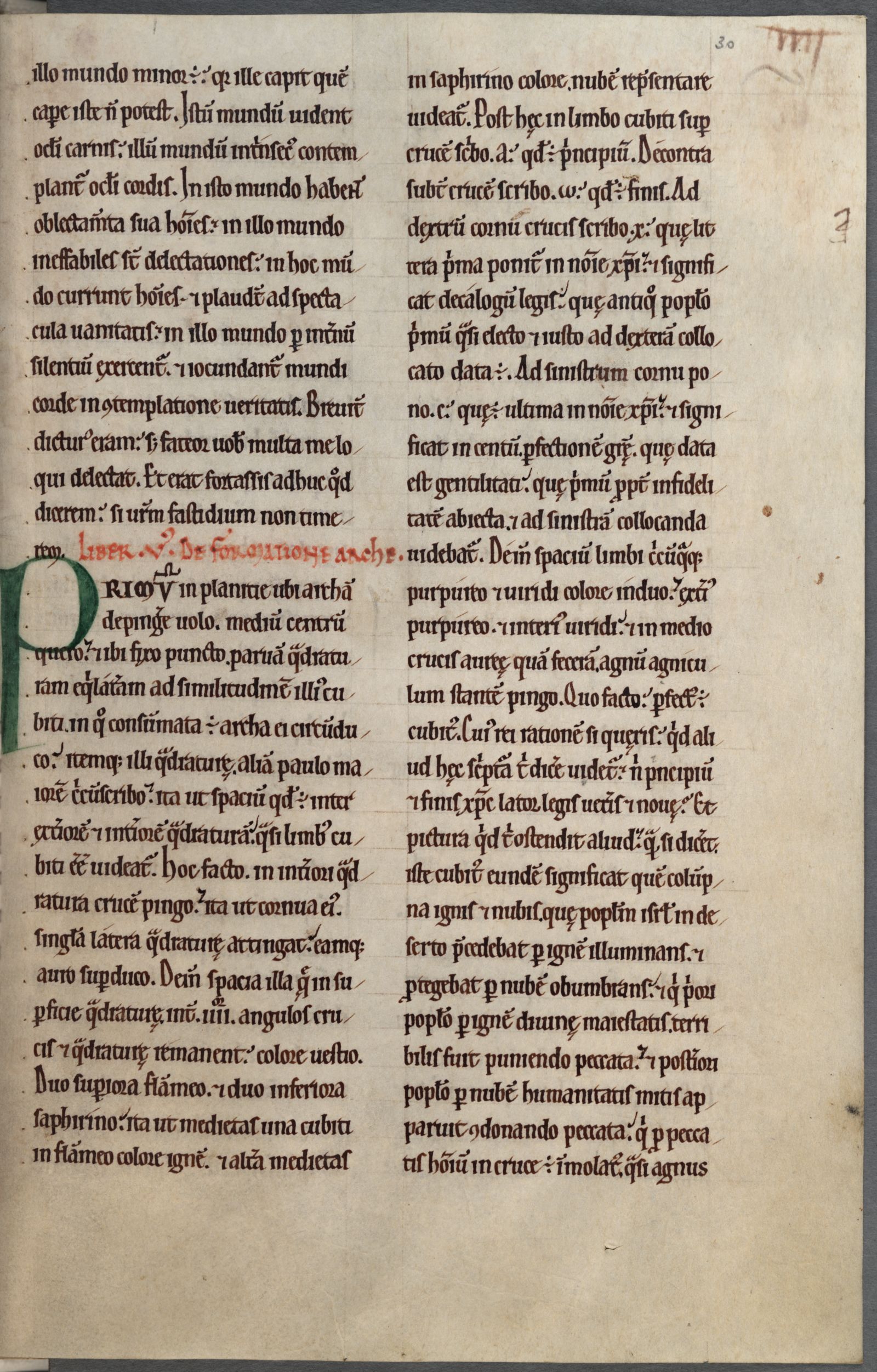
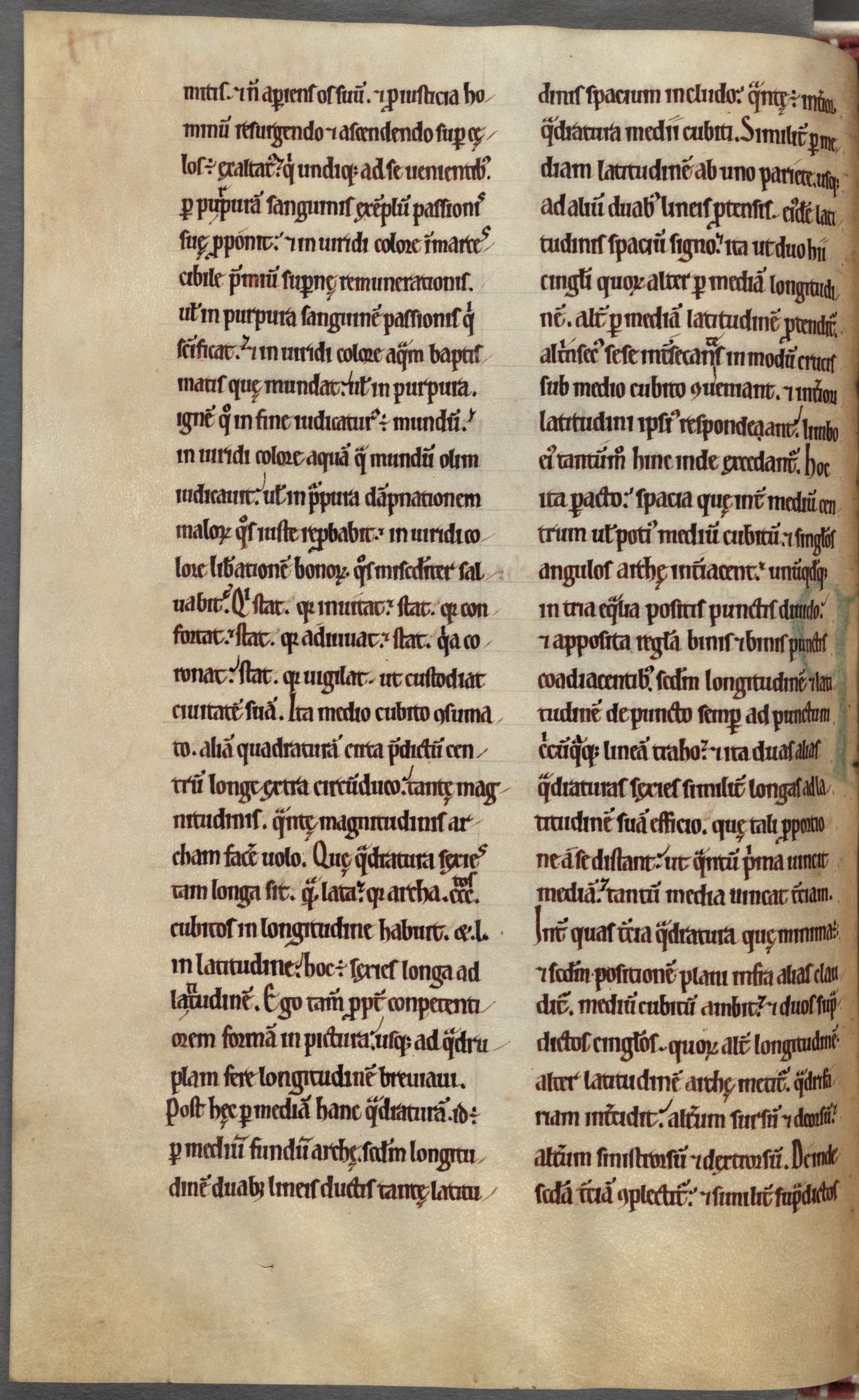
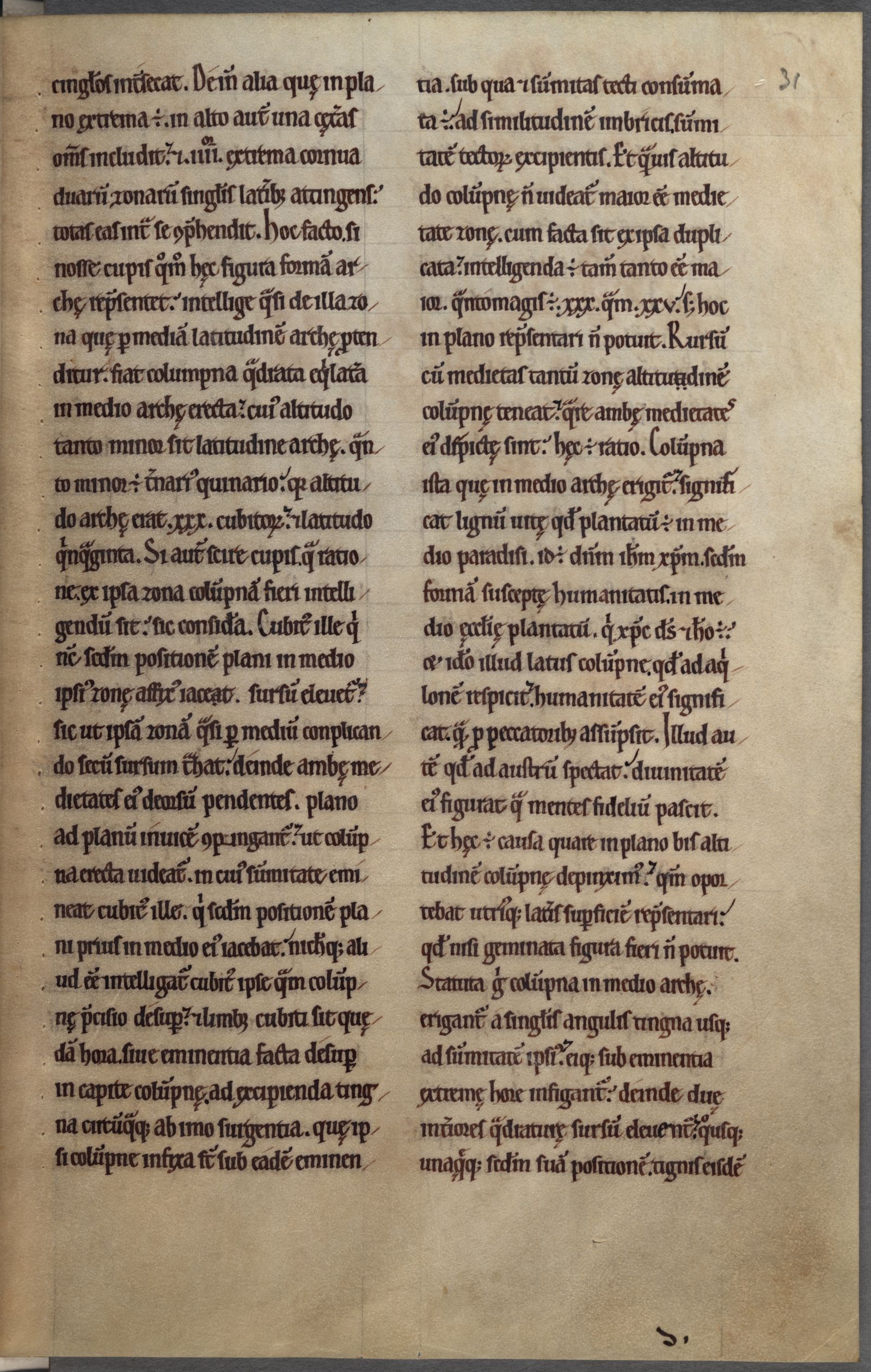
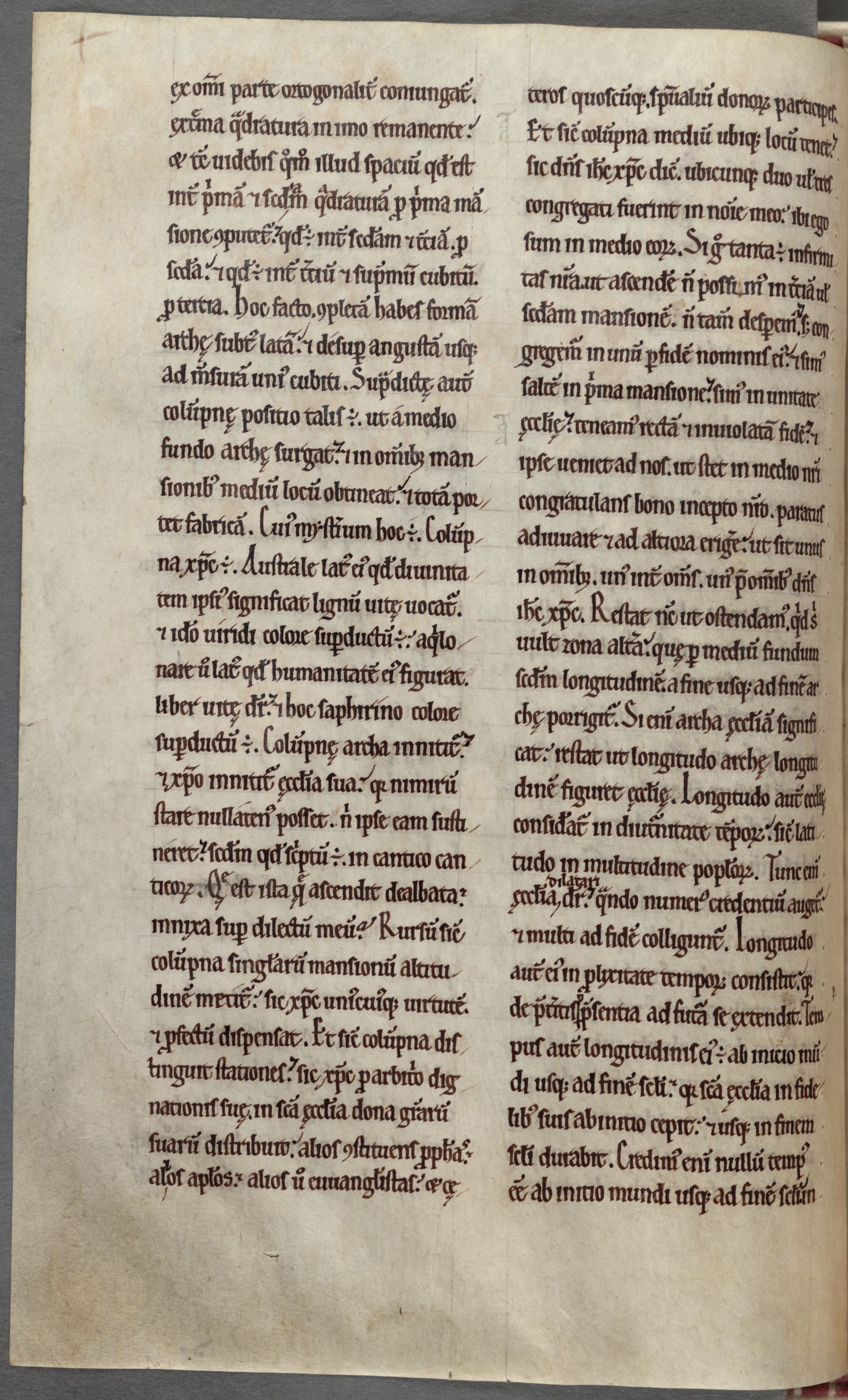
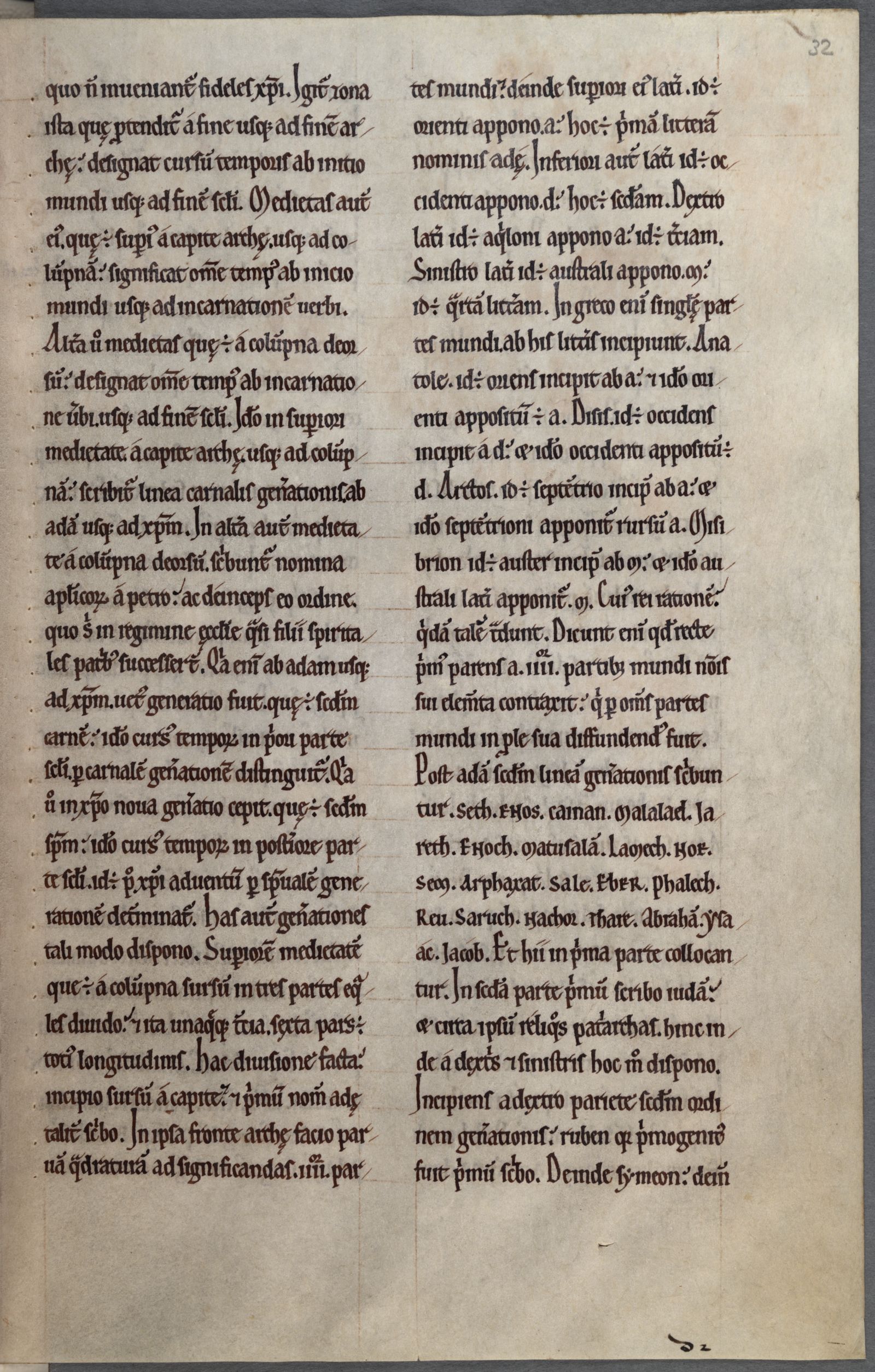
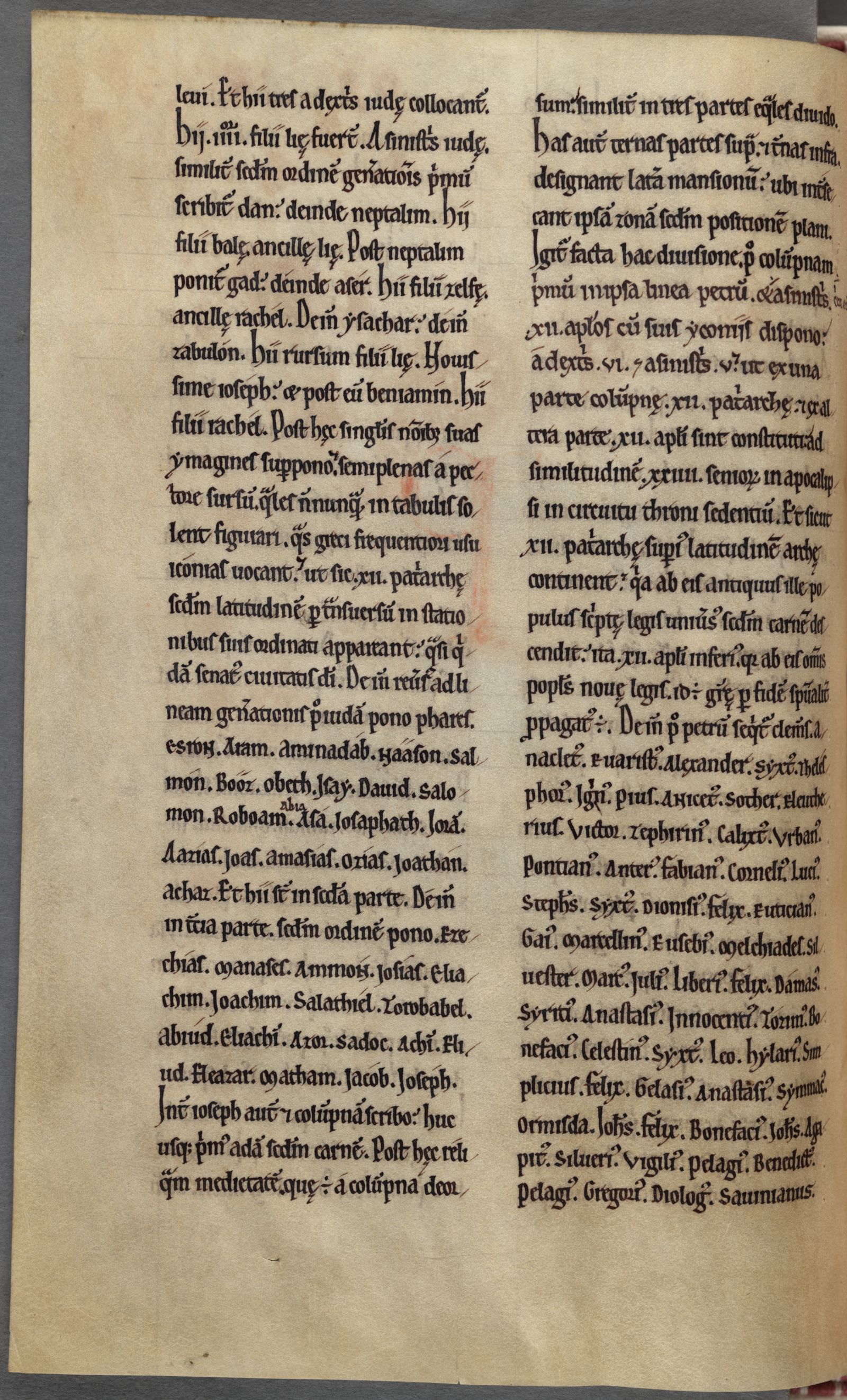
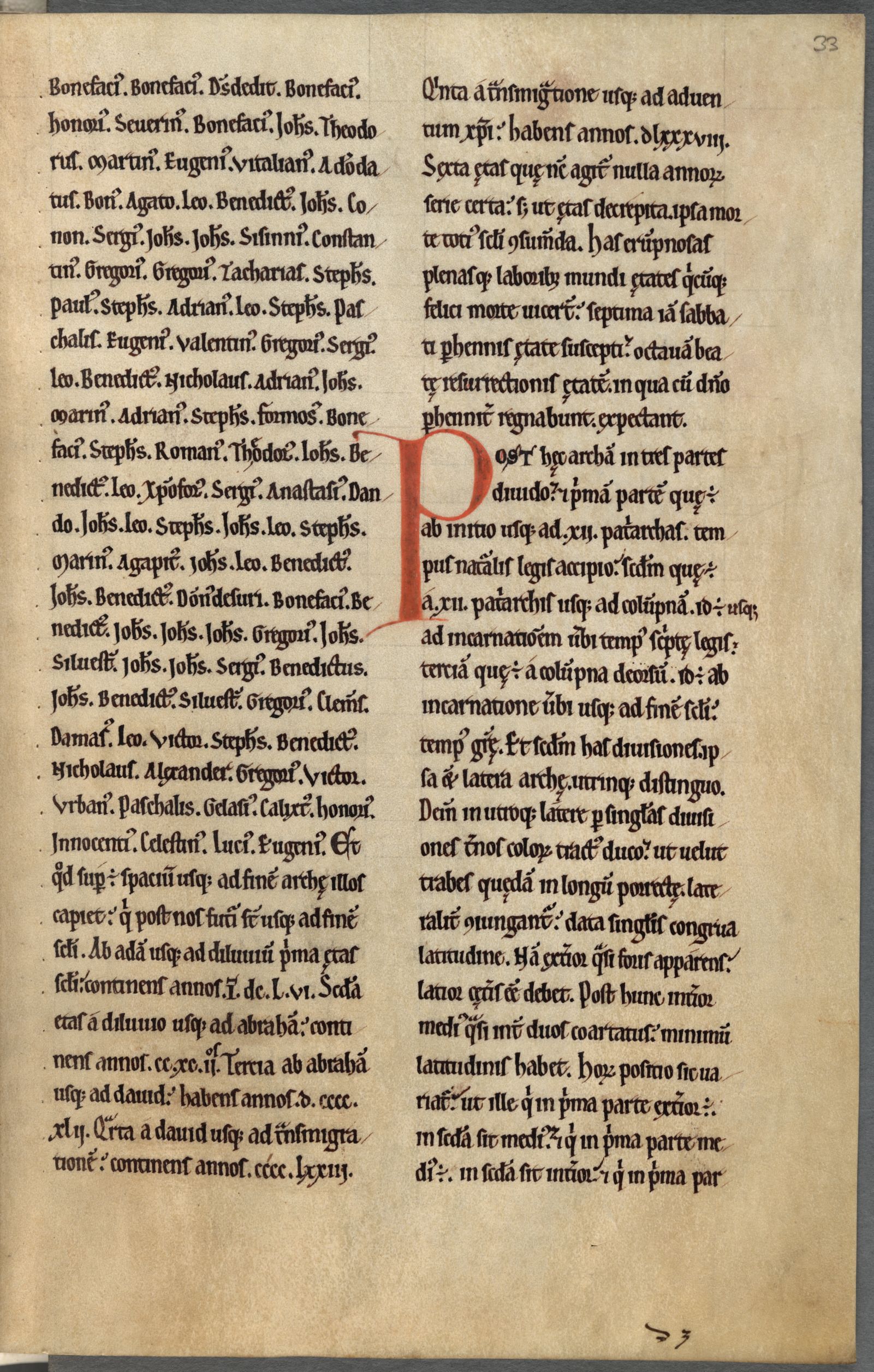
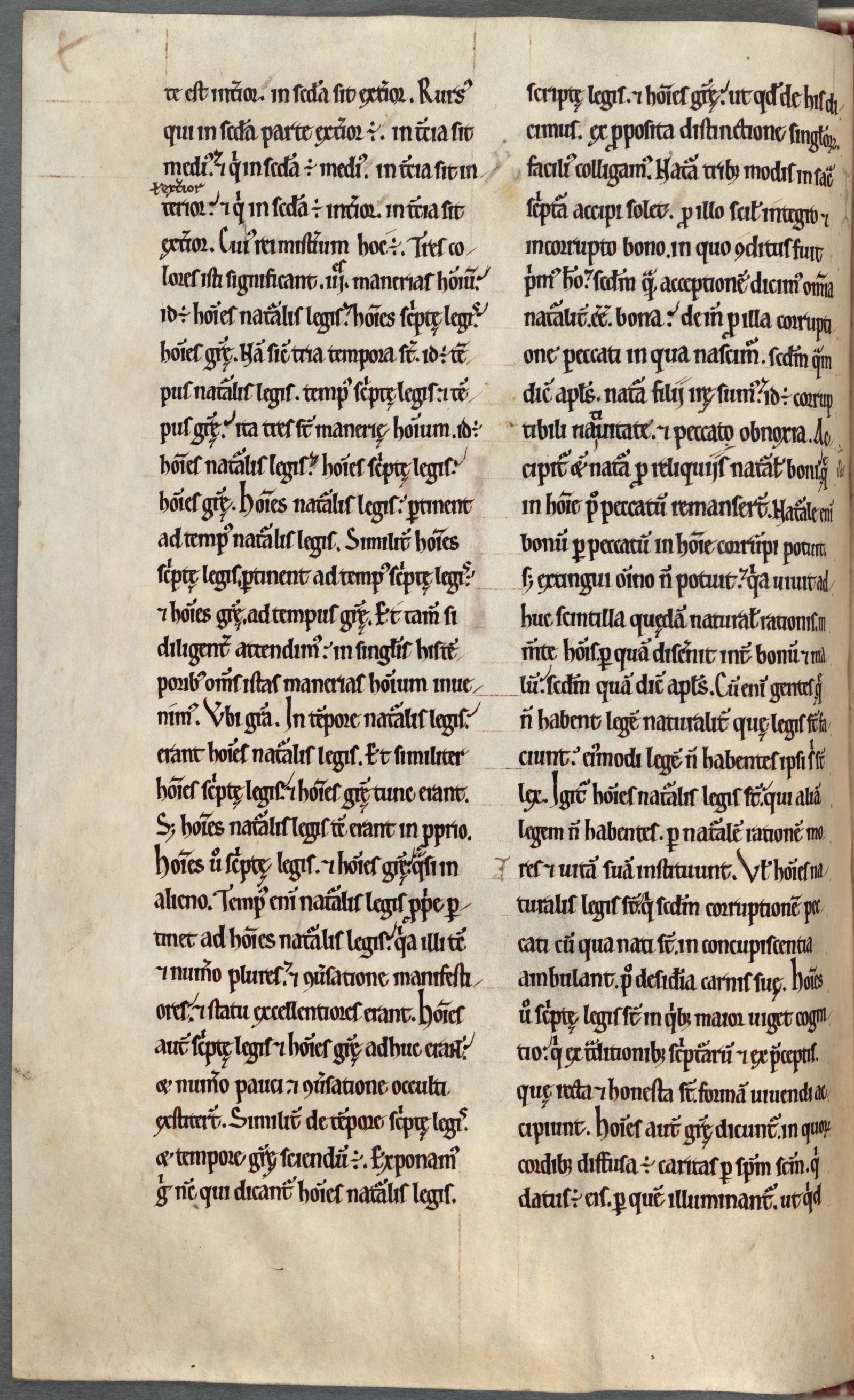
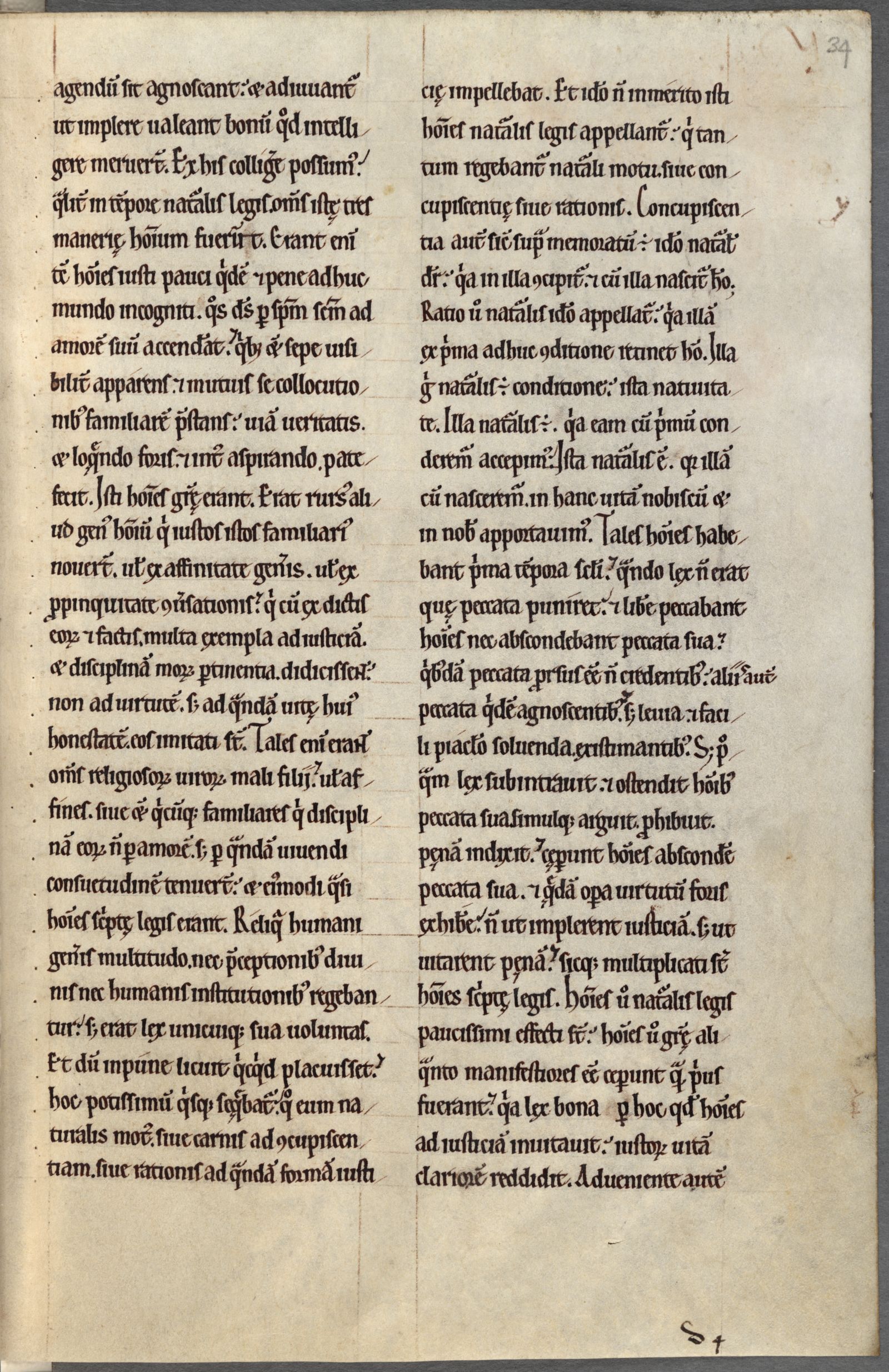
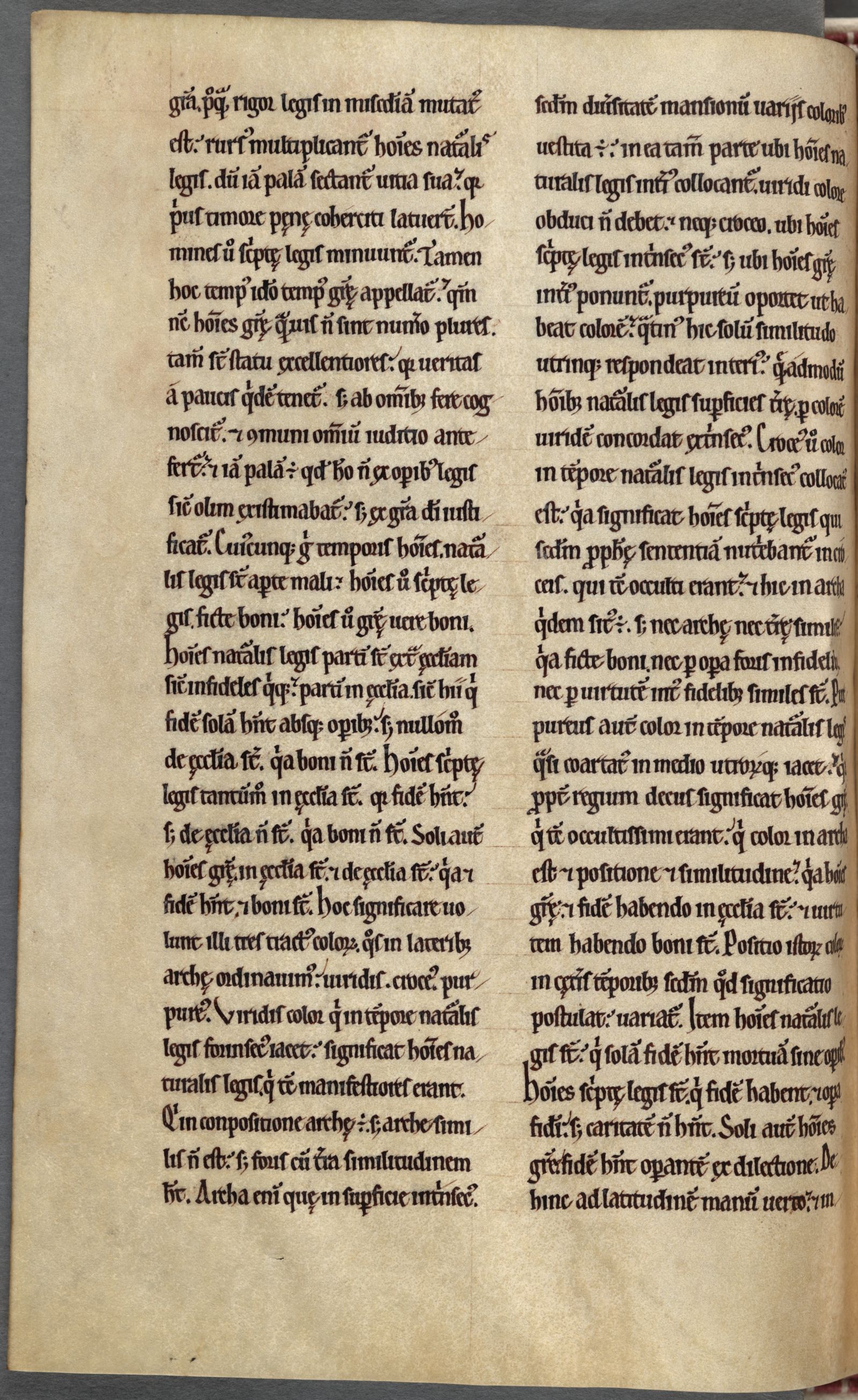
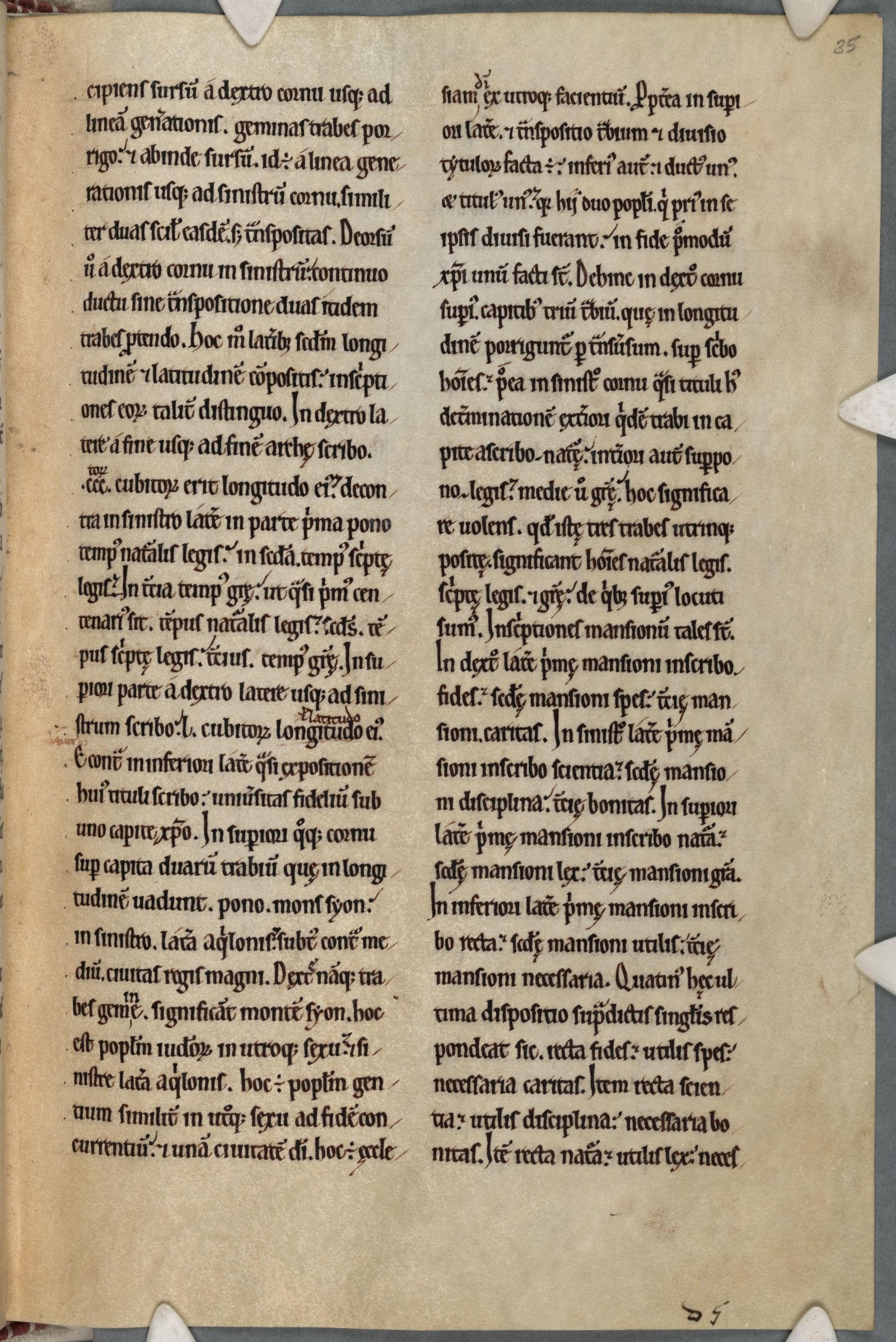
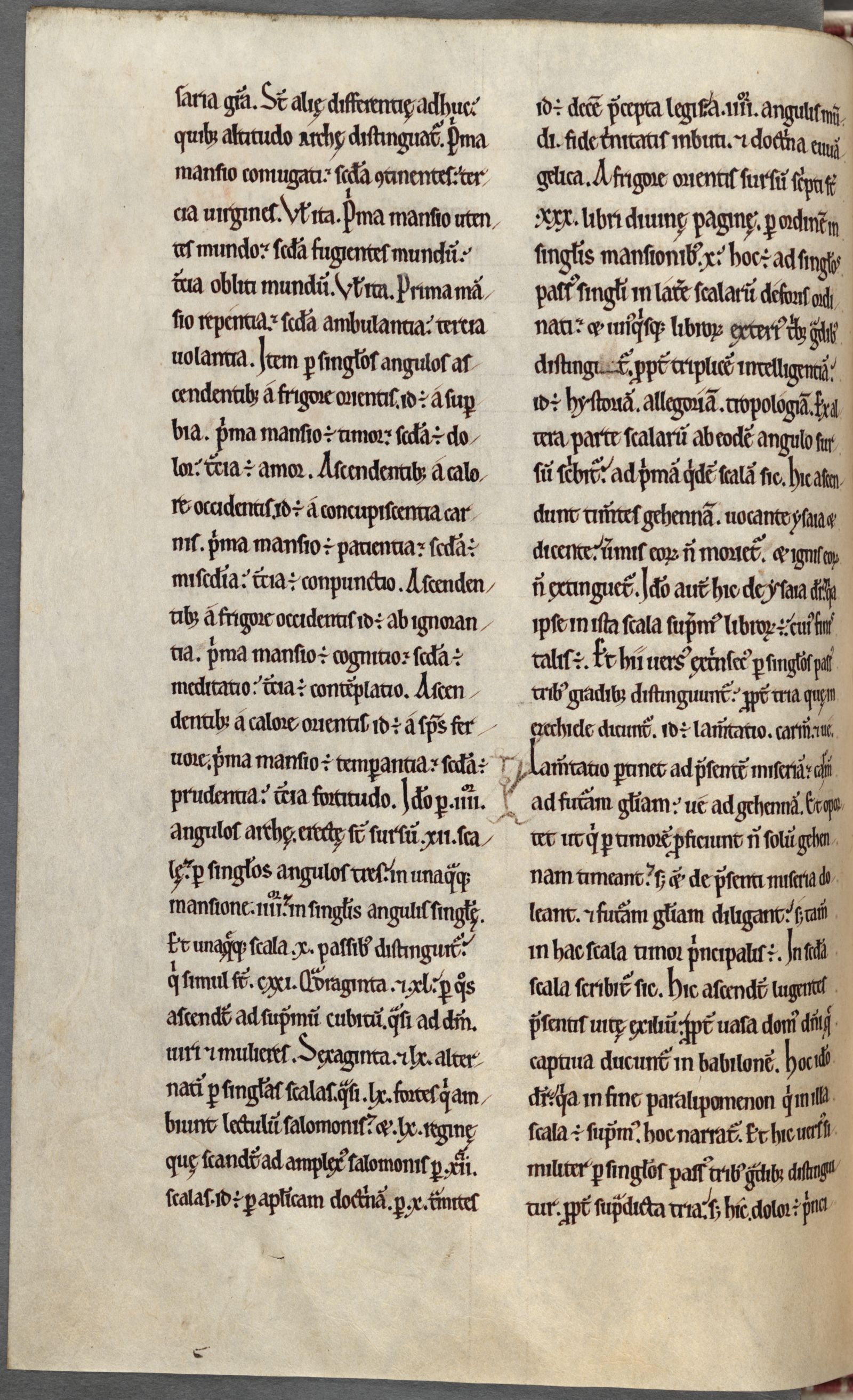
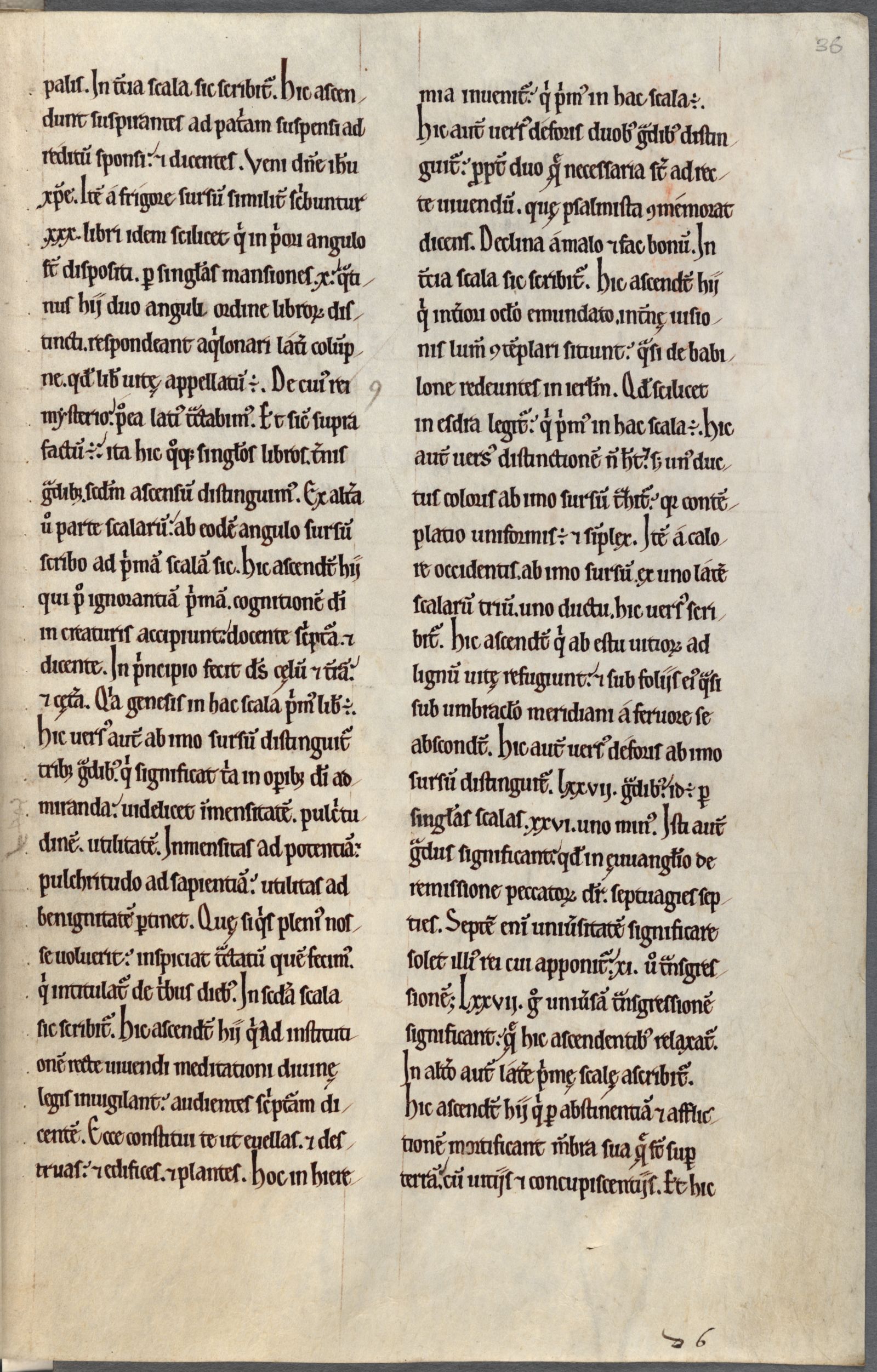
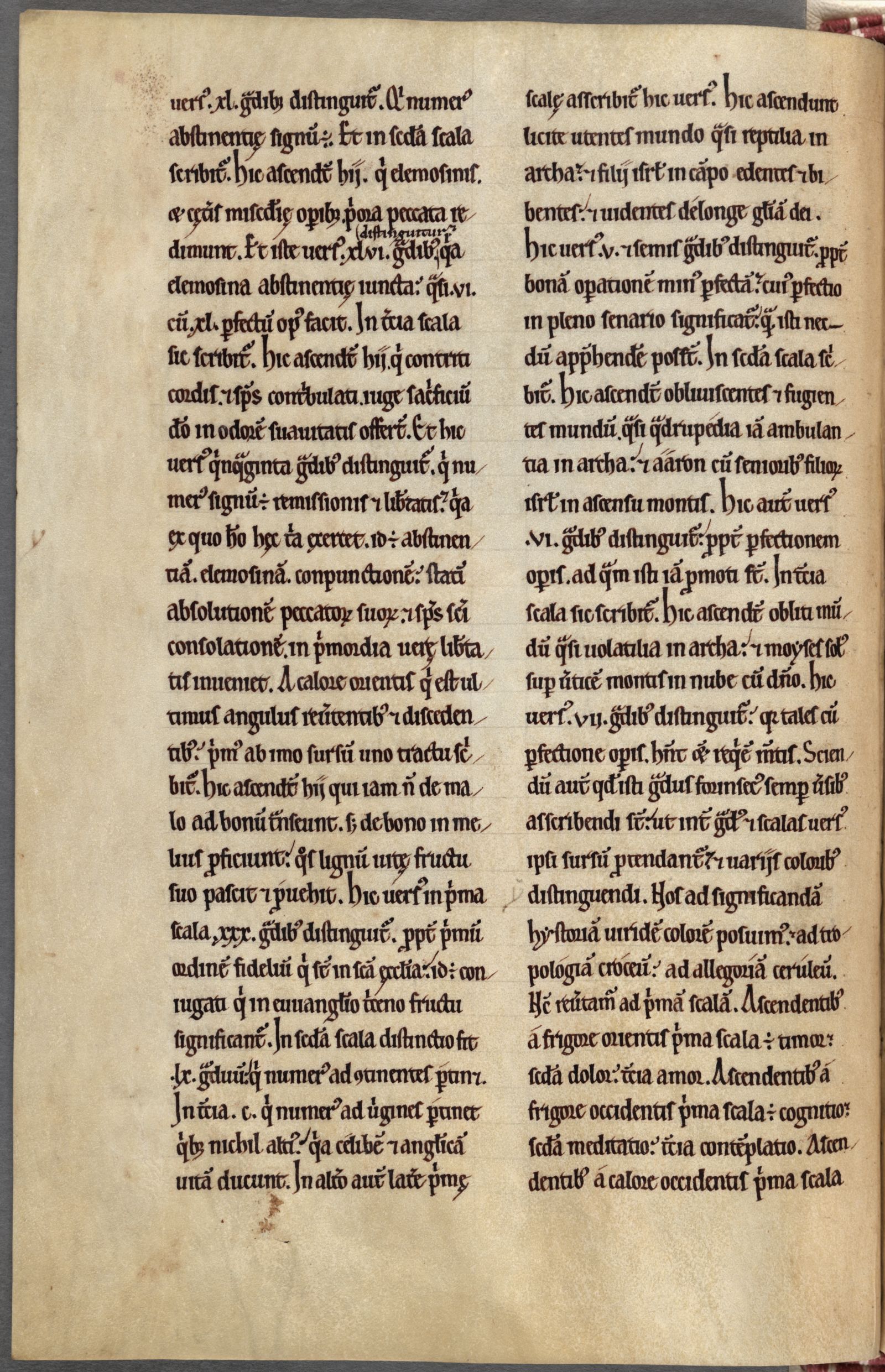
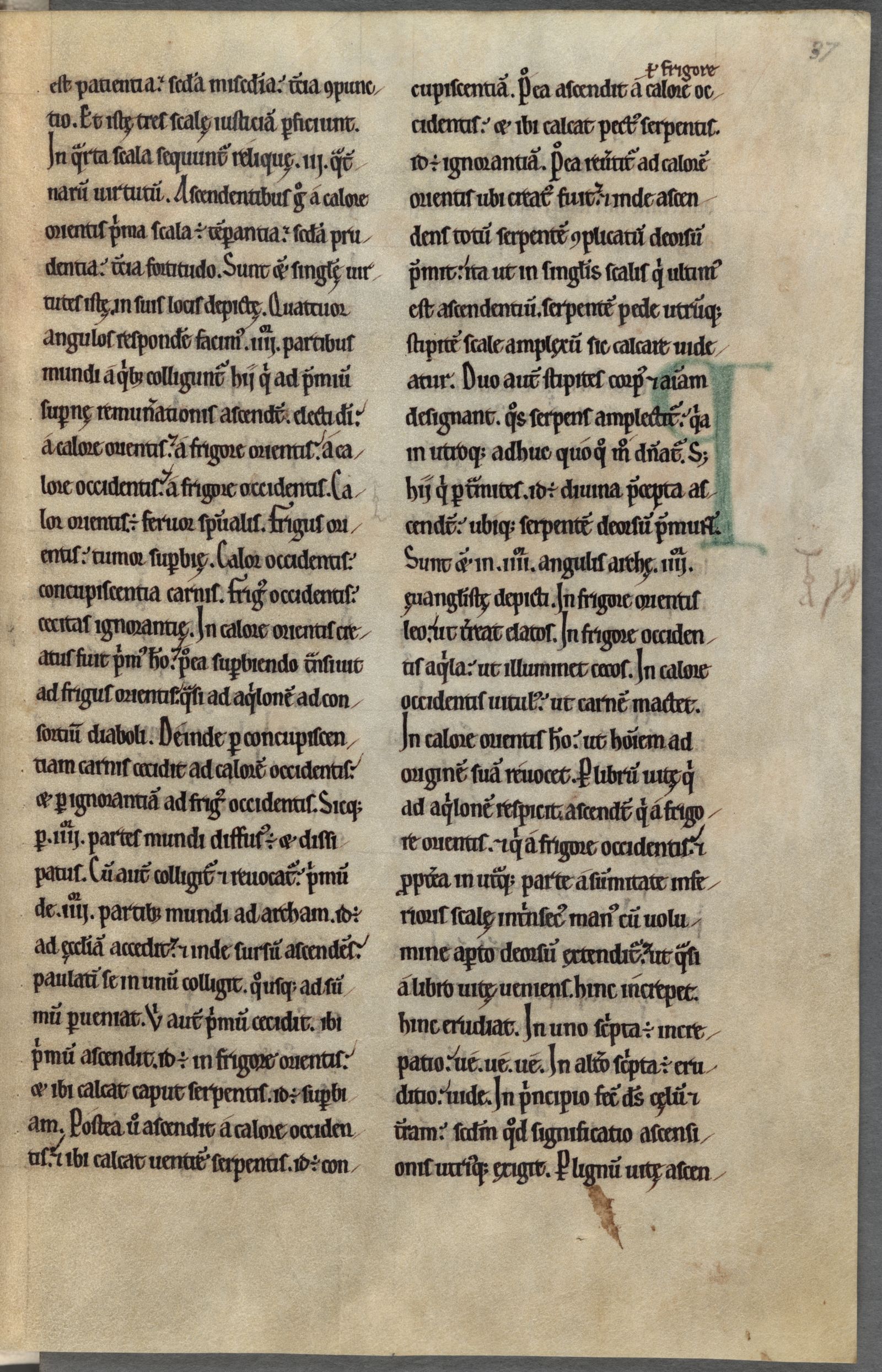
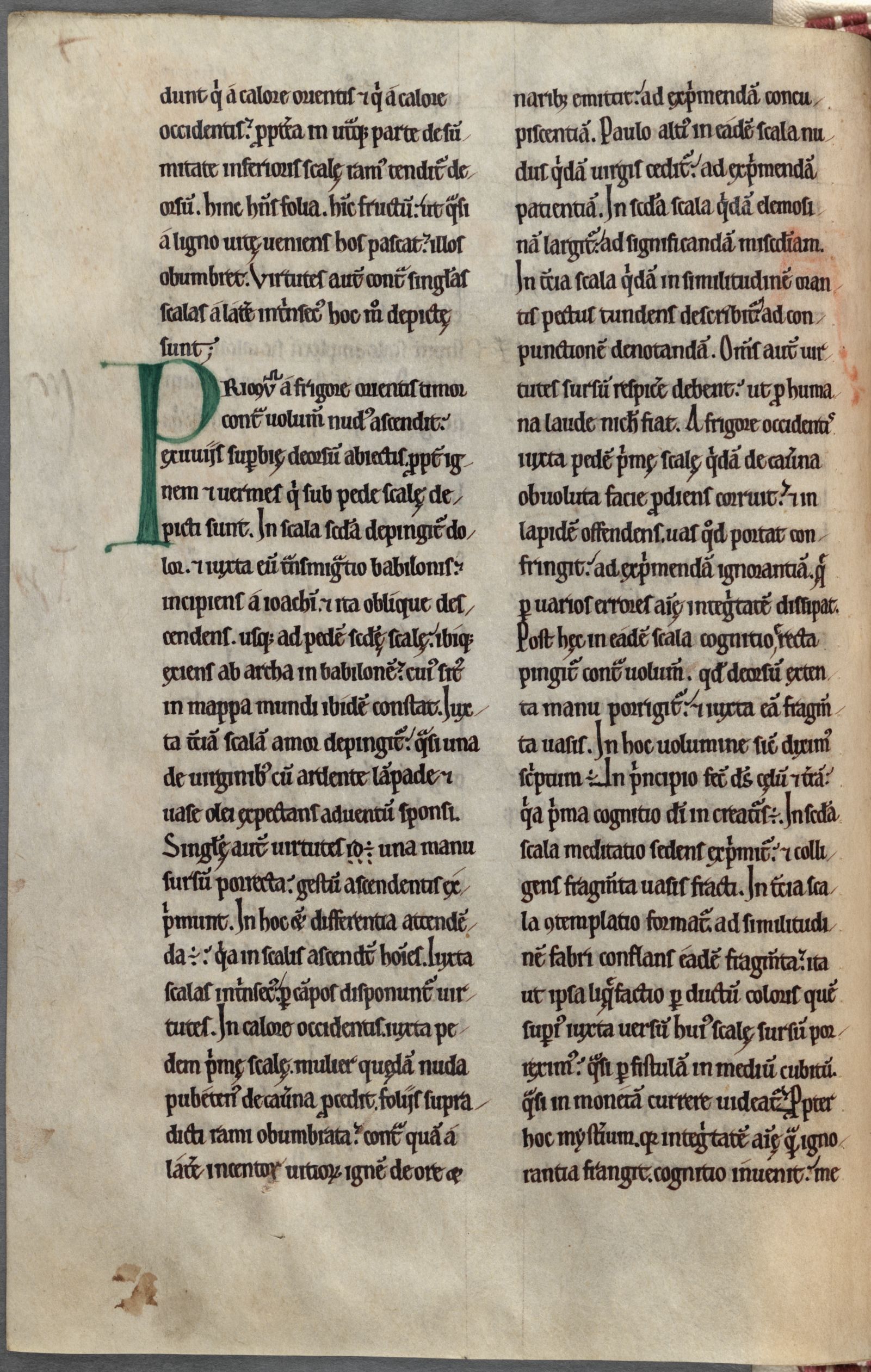
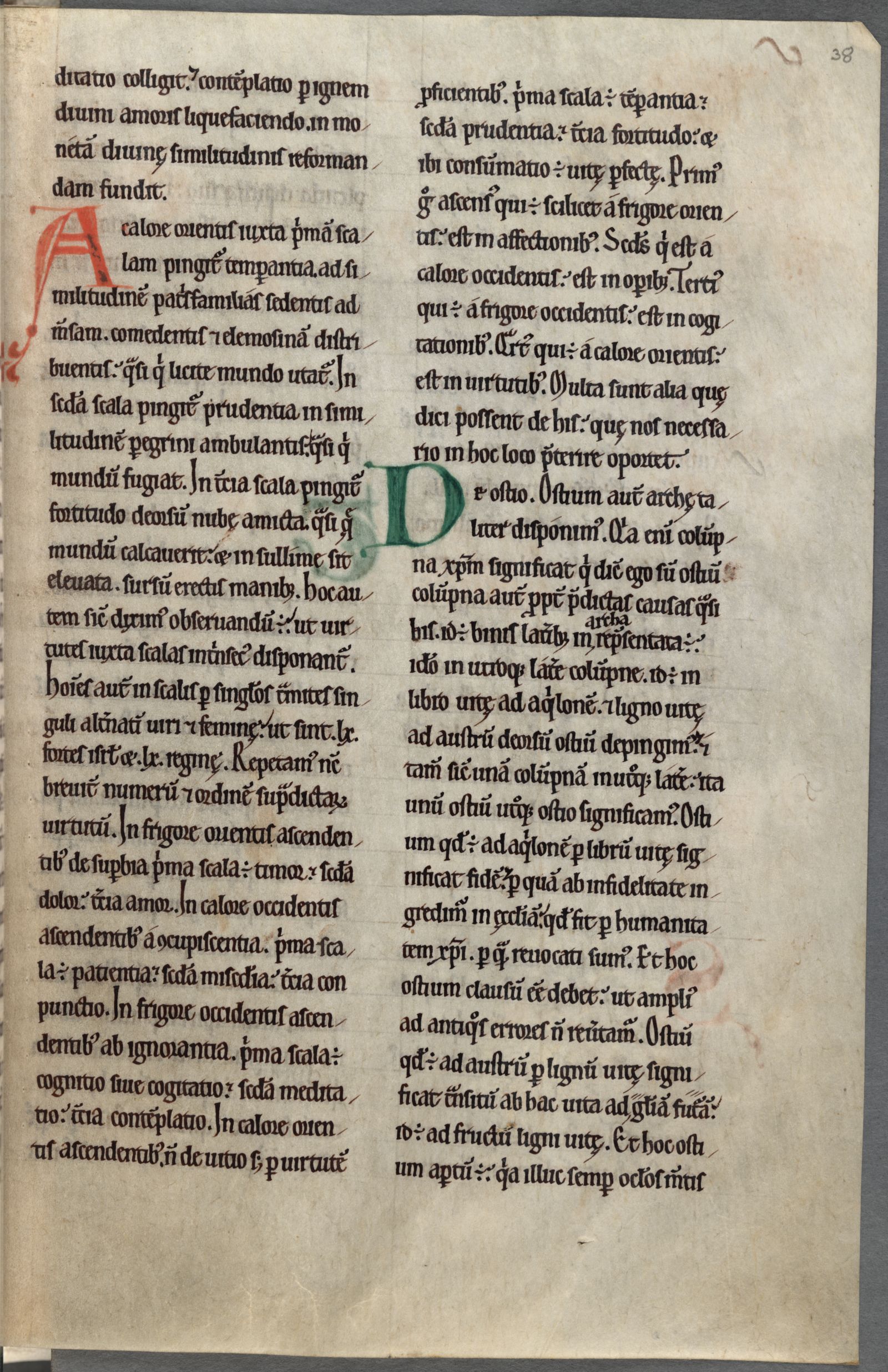
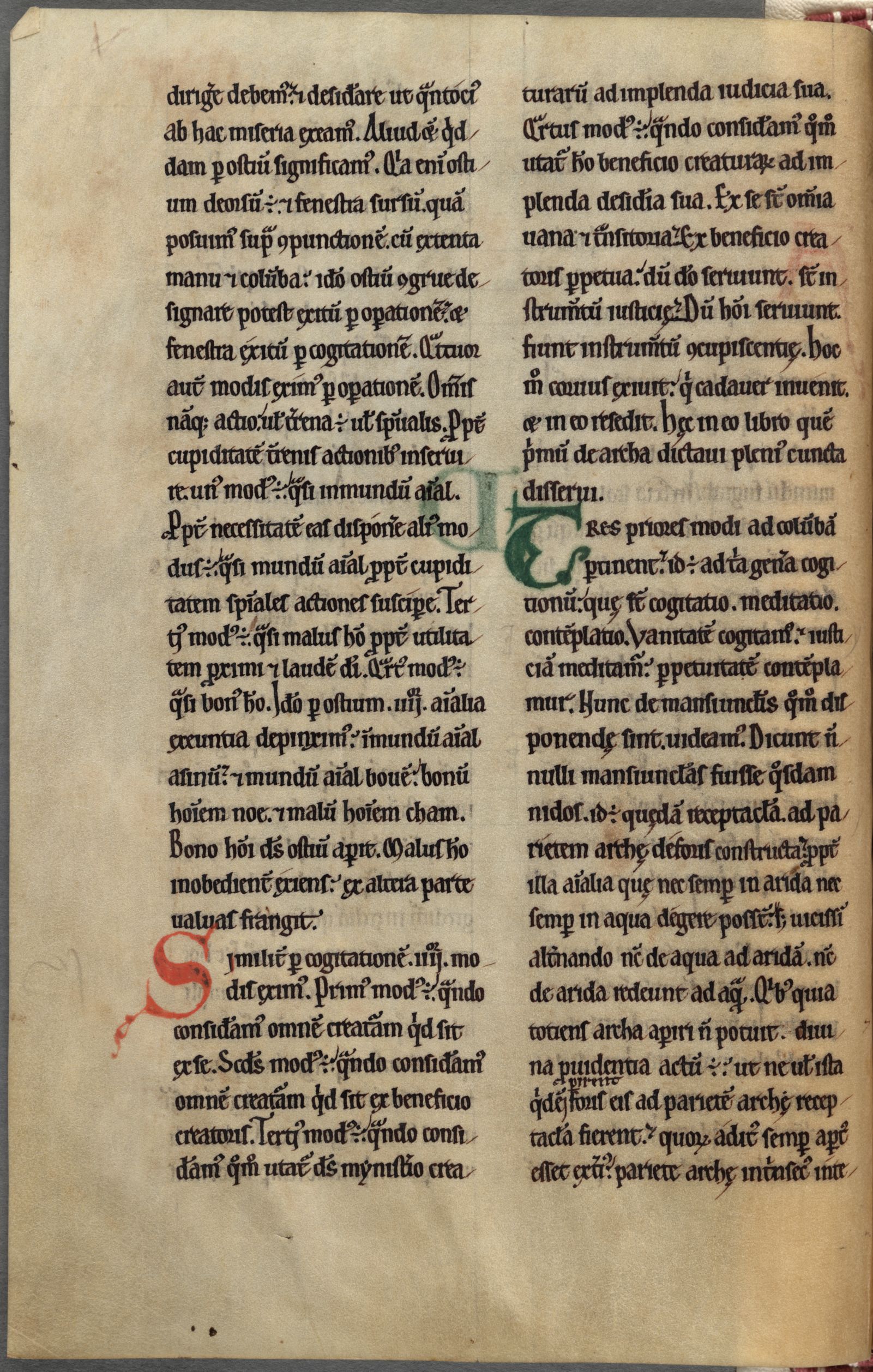
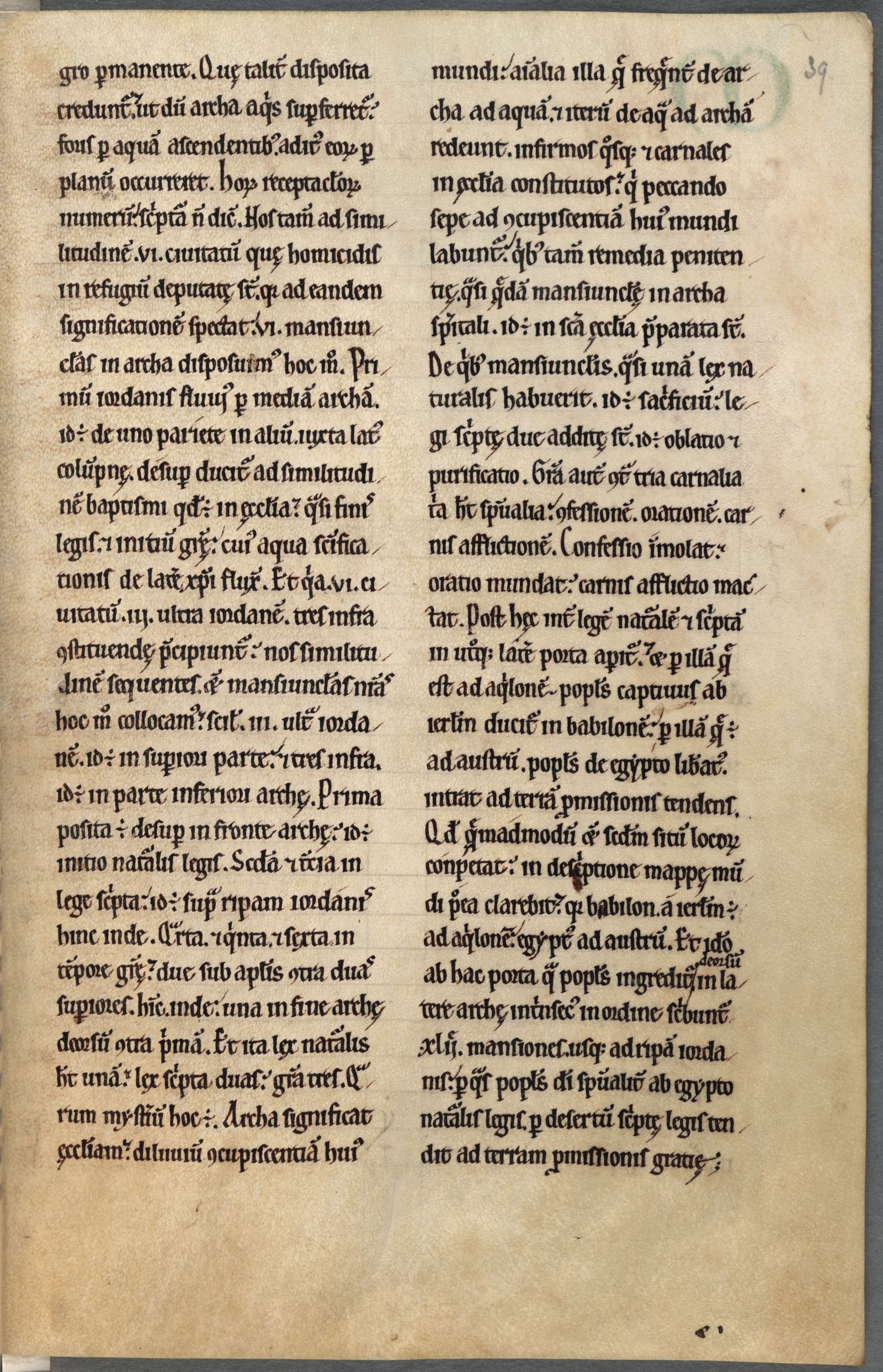
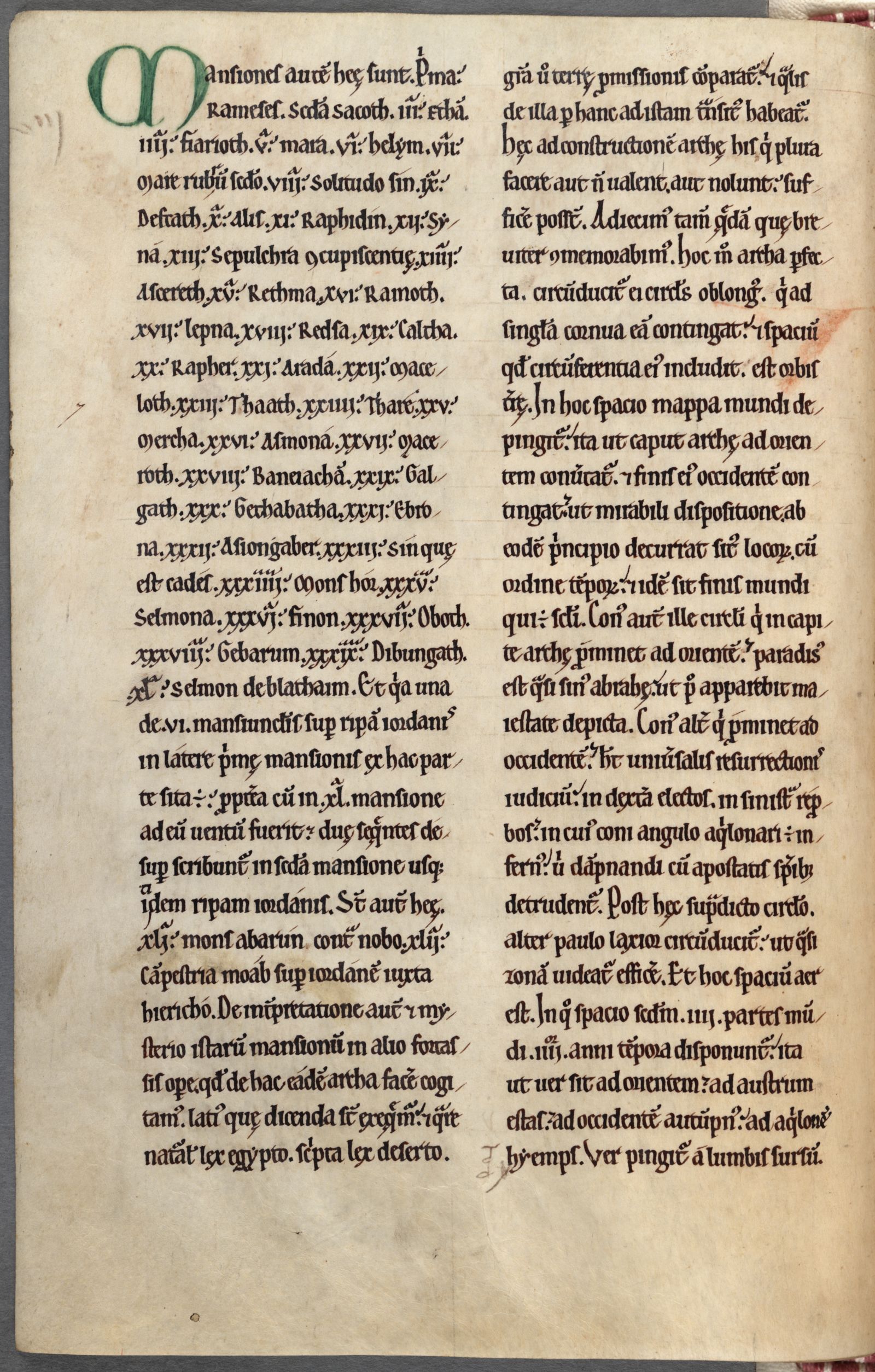
Images courtesy of The Parker Library, Corpus Christi College, Cambridge. CC BY-NC 4.0 (licence). IIIF manifest.
Paris, Bibliothèque Mazarine, Ms 717, fols. 1r and 8r
c. 1141–1150; Saint-Victor, Paris: a volume of the edition of Hugh's works made under Abbot Gilduin after Hugh's death; Sicard's Pm1. The control for the incipit and the explicit: the copy made in Hugh's own house within a decade of his death. Its images are small (about 1450 by 2000 pixels), so it is read here only at the two ends of the text.
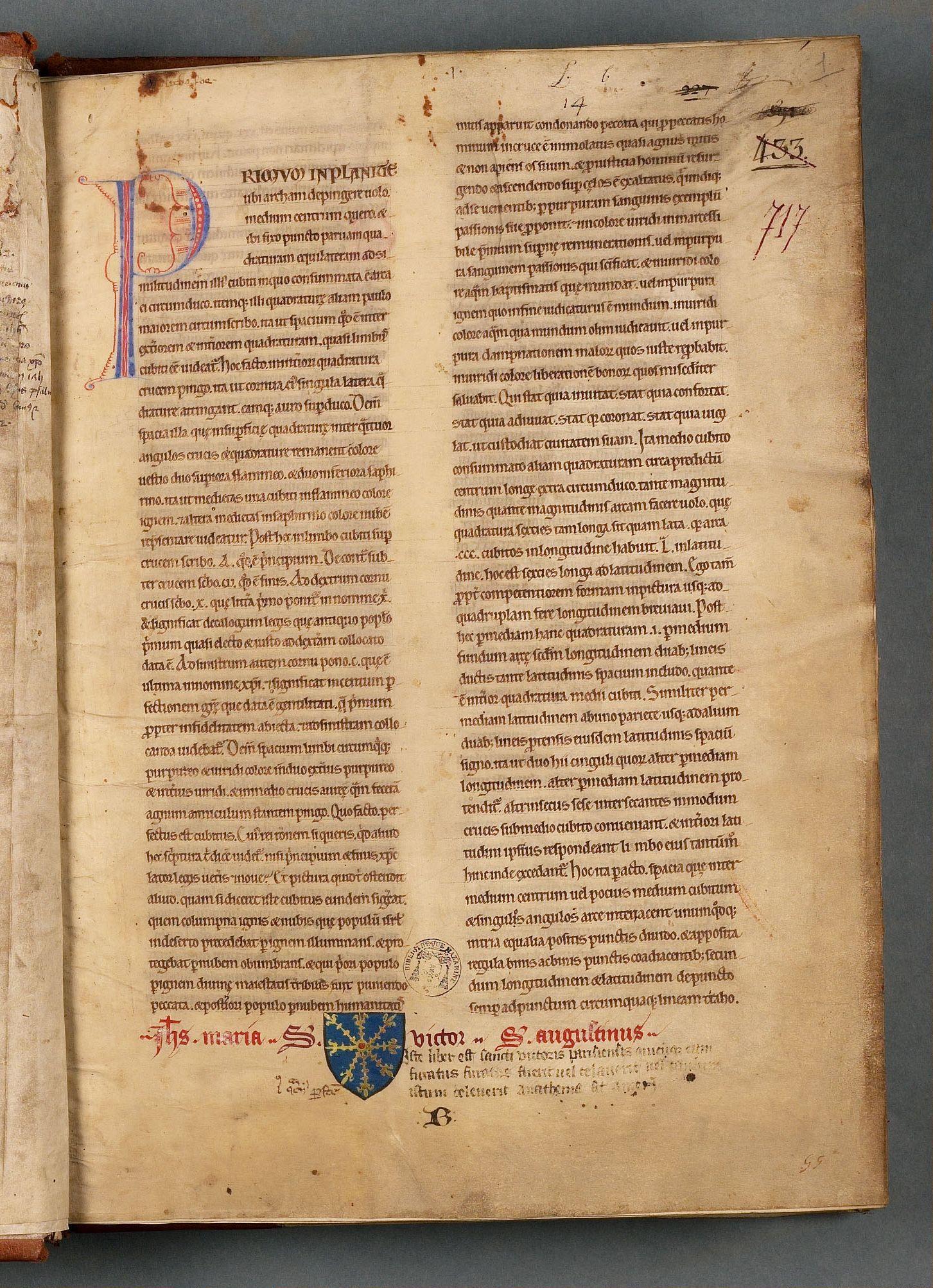
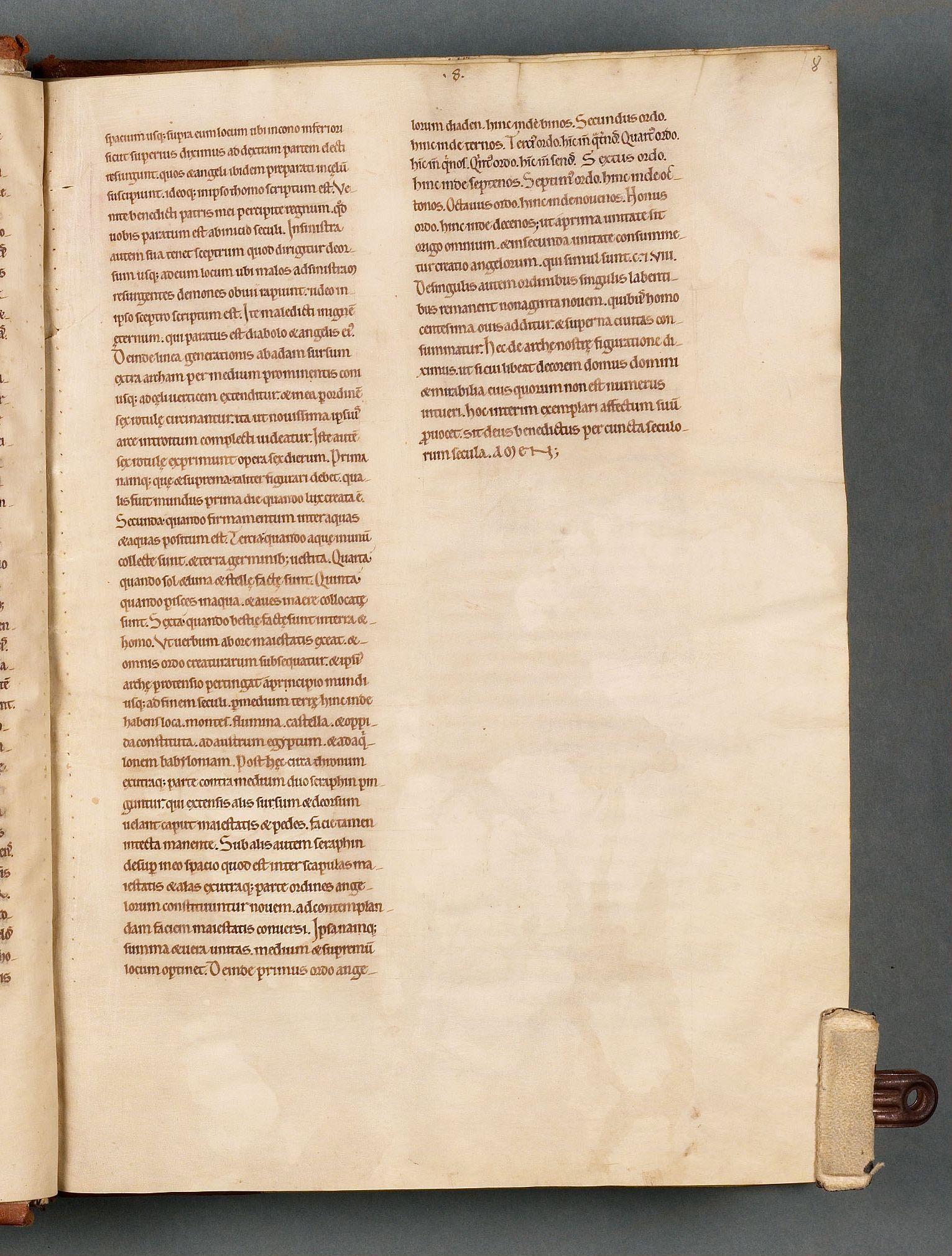
Bibliothèques numériques de l'Institut de France et des académies — Bibliothèque Mazarine, Ms 717. Public domain (Domaine public). IIIF manifest.
Bruges, Openbare Bibliotheek, Ms. 152, fol. 62v
c. 1151–1175; Cistercian abbey of Ten Duinen, Koksijde (Flanders); digitised by MMMonk. A twelfth-century reader drawing in answer to Hugh. Beside the sentence in which the storeys are joined to the rafters "orthogonaliter", a hand has boxed a gloss, "Orthogonium est figura quedam geometrica, triangularis plana, et dicitur orthogonium quasi recti angulum. Ita", and drawn the triangle beneath it, with the word split down its two sides. It is not the Ark; it is the only drawing we found made in reply to the text.
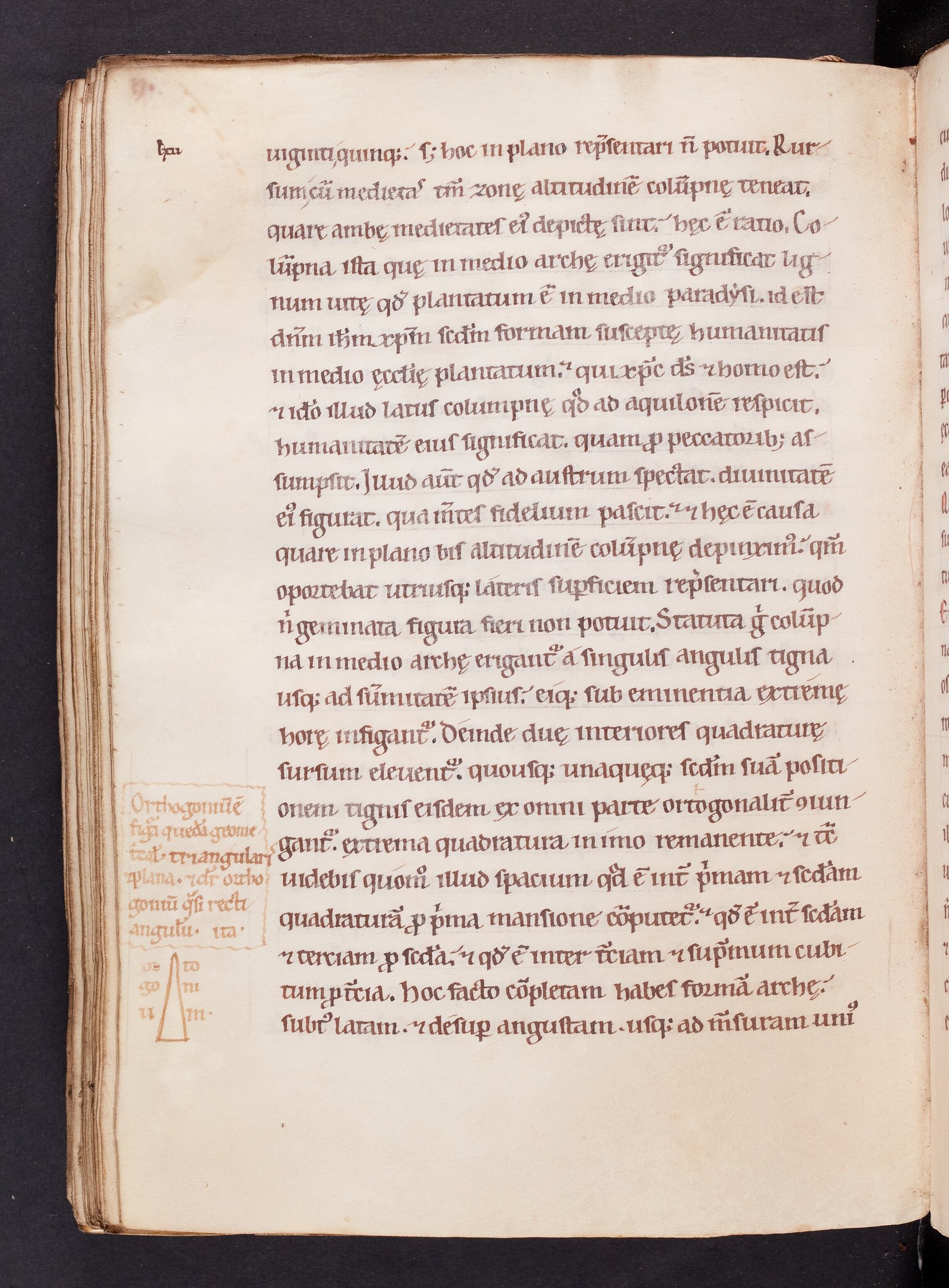
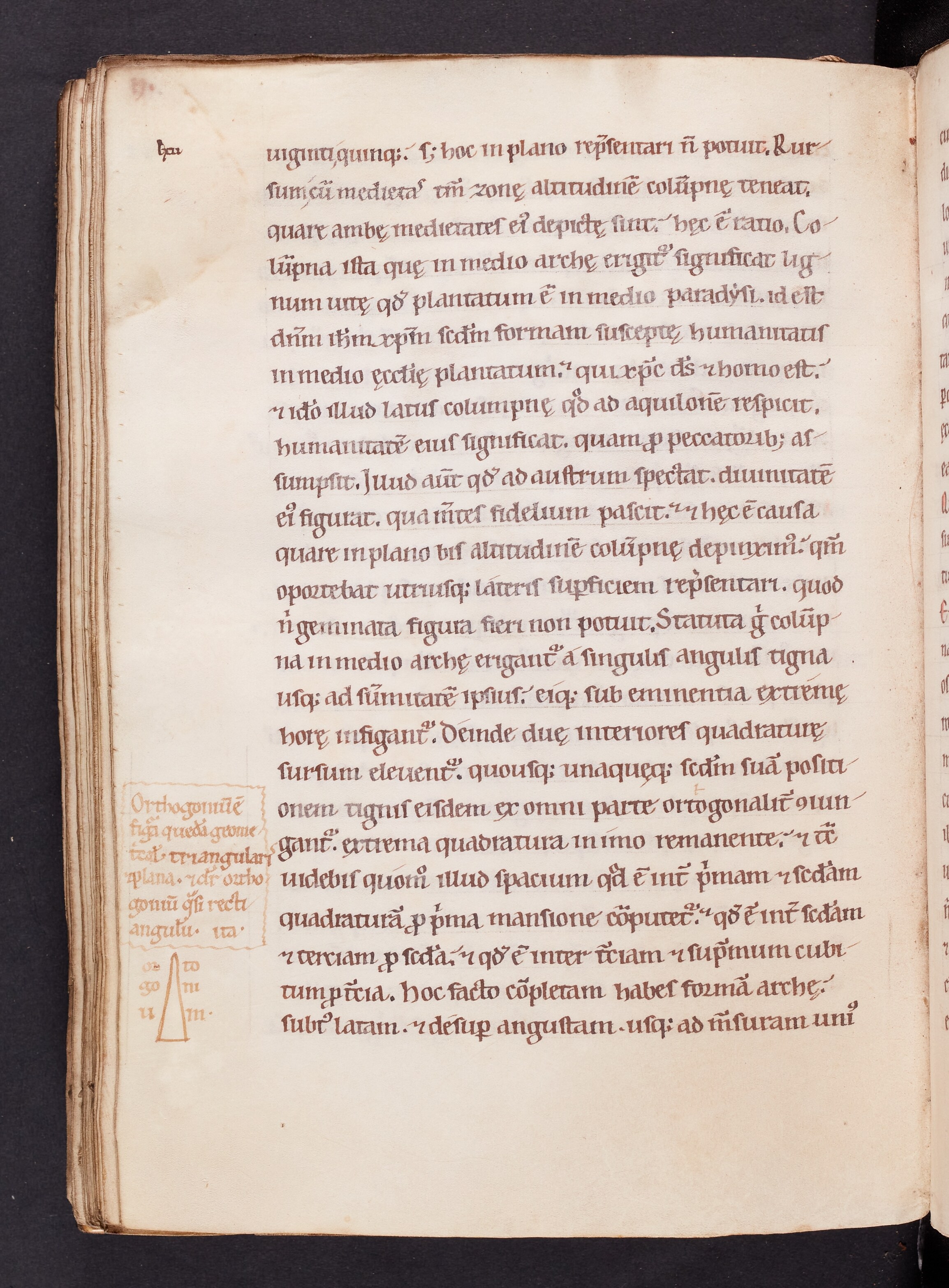
Provided by Bruges Public Library. CC BY-NC 4.0 (licence). IIIF manifest.
Sources and rights
-
Hugh of Saint Victor, De arca Noe mystica (Libellus de formatione arche), in J.-P. Migne, Patrologia Latina 176 (Paris, 1854), cols. 681–703 — the display text, read from the Documenta Catholica Omnia page scans and transcribed for this page.
-
Patrice Sicard, ed., Hugonis de Sancto Victore De archa Noe; Libellus de formatione arche, Corpus Christianorum Continuatio Mediaevalis 176 (Turnhout: Brepols, 2001) — the critical text. Not open access; not collated here, except where a step says otherwise.
-
Conrad Rudolph, The Mystic Ark: Hugh of Saint Victor, Art, and Thought in the Twelfth Century (Cambridge: Cambridge University Press, 2014) — the standard modern reconstruction of the painting, and one scholar's execution of these same instructions.
-
The Mystic Ark (Conrad Rudolph), University of California, Riverside — the reconstruction images. Licensed CC BY-NC-ND 4.0, which forbids adaptation; they are not reproduced, cropped or reduced here, and the link goes to the publisher's own copies.
-
Anya Burgon, “The Limits of the Present: Hugh of Saint-Victor's Pictura of Noah's Ark and Augustine's Distentio Animi”, Interfaces: A Journal of Medieval European Literatures 10 (2023), pp. 84–115 — open access; quotes the opening instruction from Migne and summarises the picture.
-
Jessica Weiss, trans., “Hugh of St Victor, A Little Book about Constructing Noah's Ark”, in Mary Carruthers and Jan M. Ziolkowski, eds., The Medieval Craft of Memory: An Anthology of Texts and Pictures (Philadelphia: University of Pennsylvania Press, 2002) — the standard English translation. Not open access; not copied. The English on this page is our own, made from Migne.
-
Cambridge, Corpus Christi College, MS 294 — Parker Library on the Web (Stanford Libraries). Images courtesy of The Parker Library, Corpus Christi College, Cambridge; CC BY-NC 4.0. Twenty-three pages copied locally for this page.
-
Paris, Bibliothèque Mazarine, Ms 717 — Bibliothèques numériques de l'Institut de France et des académies; public domain. Two leaves copied locally.
-
Bruges, Openbare Bibliotheek, Ms. 152 — MMMonk (Medieval Monastic Manuscripts, Flanders); provided by Bruges Public Library; CC BY-NC 4.0. One leaf and one detail copied locally.
-
Our reading of the text
The division of the work into 45 instructions, the choice of which words carry which lines, the English, and every grade and warrant on this page are the exhibition's own. They are a reading, and readings can be wrong; corrections are welcome. Not an edition.
The critical text (Sicard, CCCM 176) has not been collated. Where that matters to a drawing decision, the step says so rather than passing Migne off as settled.
-
The machine itself
The picture, the order of construction, the palette, the marking of the words, the mirror for the side rule, the zoom, the way the view follows each instruction, and the raised view — the parallel projection, the angles it opens at, and the fold that stands the band up — and the walk inside it — the eye at three and a half cubits, the pace, the flying — are the exhibition's design, not Hugh's. What Hugh supplies for the raised view is the instruction to lift the drawing and the measurements to lift it by; the six passages that do it, 40 to 45, carry their own verdicts and warrants like every other. What each of them rests on is set out in What have we added, and what it leaves out in What is not drawn.
The page runs entirely in the browser. It sets no cookie and keeps no record of any visit, and the only request it makes after loading is for the three-dimensional drawing library the walk needs (three.js, MIT licence, kept on this site), fetched when a visitor opens the walk and not before.