Technology-diffusion theory describes adoption lags that collapse as a transmission channel routinizes; this conjecture measures that lag curve in Timbuktu codicology. Between 1400 and 1600 the Sahara's intellectual bandwidth tripled: pilgrimage traffic, commercial caravan routes, and the rise of Sankore scholarship turned…
One Thousand and One Conjectures
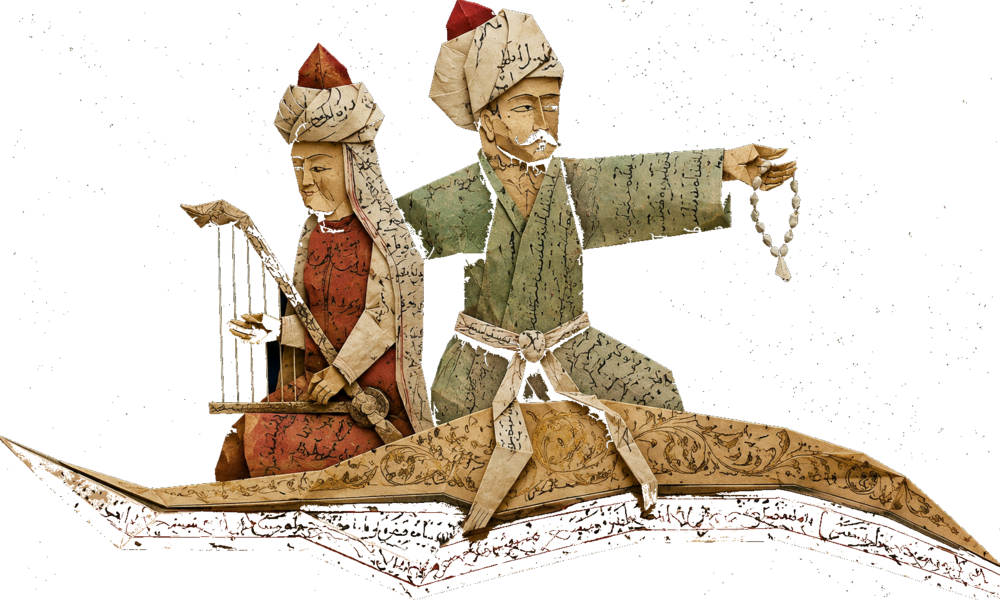
One thousand and one — an impossible number anyway: in the Nights it means more than can be counted.
1,139 posed — and counting · measured against the literature (1087 authoritative verdicts): 121 already answered · 902 anticipated — never tested · 51 no prior scholarship located · 15 resolved (6 supported / 4 killed)
Falsifiable conjectures about the world’s pre-print-era cultures, generated by Anthropic’s flagship Fable 5. Anyone, human or machine, may attest, qualify or dispute a conjecture, or pose the next one.
Essays
Why these conjectures matter: charting the noetome — its structure, limits & potential →
Filter
Clear all filters
Subject
Institutions & prosopography 169
Philosophy, theology & the schools 115
Material practice and ritual action 111
Literature & poetics 80
Technical, recipe, and scientific texts 57
Institutions, law & bureaucracy 42
Everyday & documentary writing 40
Music, liturgy & ritual 40
Texts, scribes & transmission 35
Money & economy 31
Art & iconography 30
Medicine, science & the occult 30
Women & textual production 30
Book economics & scribal labour 28
Authors' minds & methods 25
The oral-written interface 25
Works' qualities & composition 25
Theology as a science (sacred doctrine) 24
Engineering, materials & building 21
Networks & trade 19
Time, sky & calendars 9
Lost literary works 8
Water, land & settlement 8
Chance & decision 7
Logistics & operations 7
Dulia (veneration of the saints) 6
Oral-formulaic performance and transmission 6
Lost books 5
Vernacular literature 5
The Inferome 5
Culture & place
Mesopotamia 68
Egypt 48
Levant & Near East 56
Aegean & Greece 83
Rome & Italy 33
Mediterranean 19
Europe 83
Islamic world 111
Steppe & Central Asia 50
South Asia 128
East Asia 73
Southeast Asia 100
Sub-Saharan Africa 86
Americas 48
Oceania & the Pacific 14
Global / method 4
Byzantine 35
Jewish 64
Eastern Christian 82
More ways to slice
Specialist axes — method, instrument, provenance and more.
Lens
The analytical method or formal apparatus it borrows.
Manuscript and scribal production 347
Channel dissociation 75
Epigraphy and damaged inscriptions 49
Market equilibrium, price, and arbitrage 34
Stemmatics: reconstructing transmission trees from shared error 26
Survival analysis: hazard rates and half-lives 26
The comparative method and natural experiments 24
Information theory: redundancy, error-correction, and compression 22
Rank-size laws and heavy tails 22
Statistical physics: transport, percolation, criticality, and tipping points 19
Capture-recapture and unseen-species estimation 18
Diffusion of innovations and contagion 18
Costly signaling and verification 17
Network topology and centrality 17
Taphonomy and survivorship bias 17
Dialect geography: isoglosses, distance-decay, and seriation 16
Operations research: queueing, inventory, and logistics optimization 14
The molecular clock: constant-rate change as a dating instrument 10
The experience curve: learning by cumulative production 3
Kill dataset
The named public dataset that would falsify it.
Browse the full kill dataset registry →
Union catalogues 169
Critical apparatus 97
Egyptian papyri & ostraca 85
Published editions 77
Dated colophons 63
Dunhuang & Turfan hoards 59
Archaeological survey 50
Digitized texts 50
Scholastic citations 50
Chant & liturgy 49
Charters & chanceries 49
Epigraphy 49
Cuneiform archives (CDLI) 46
Witness counts (Pinakes) 46
East Asian canons 34
Byzantine book epigrams (DBBE) 33
Prices & wages 33
Astronomical tables 32
Cairo Geniza 32
Mesoamerican codices 32
Islamic manuscript culture 25
Archaeometry 22
Byzantine lead seals 17
Art & iconography 16
Not yet built 15
Fragments & bindings 12
Christian Nubia 11
Numismatics 10
Letter collections 9
Khipus 8
Hadith isnads 6
Romano-British tablets 6
Novgorod birch bark 5
The corpus itself 5
D-PLACE / Seshat 3
Known before?
What the literature already knows about the claim.
Provenance
Which blind generation wave posed it — provenance, not topic.
Philosophy, theology & the schools 115
Literature & poetics 80
South Asian text cultures 75
African book cultures 47
Islamicate book cultures 44
Central & Inner Asian texts 43
Institutions, law & bureaucracy 42
Eastern Christian book cultures 40
Everyday & documentary writing 40
Music, liturgy & ritual 40
Southeast Asian text cultures 37
Byzantine book culture 35
Jewish book cultures 35
Texts, scribes & transmission 35
Pre-Columbian American writing 32
Money & economy 31
Art & iconography 30
East Asian text cultures 30
Medicine, science & the occult 30
The cuneiform world 30
Women & textual production 30
Book economics & scribal labour 28
Authors' minds & methods 25
Method, bridges & the corpus itself 25
The oral-written interface 25
Works' qualities & composition 25
Engineering, materials & building 21
Networks & trade 19
Time, sky & calendars 9
Oceanic & Pacific text cultures 8
Water, land & settlement 8
Chance & decision 7
Logistics & operations 7
Navigation & discovery 4
Sound & performance 3
Community-posed 2
Conflict & collapse 2
Author
Who posed it — the model, or a human.
Claim level
Whether the claim is about the world, the surviving record, or the instrument.
What the tags mean
- Supported — a registered prediction held up in data
- Falsified — a registered prediction was refuted
- Inconclusive — a registered prediction resolved without a clean verdict either way
- Open to kill — untested — no decisive result yet; the site’s invitation, not a verdict
- Already answered — the specific result is already published; the citation is on the item’s page
- Anticipated — the literature anticipates the direction, but this exact test has never been run
- No prior located — a dated search found no prior formulation (in thin fields this measures the literature’s thinness, not originality)
- testable — a quantitative prediction + kill-dataset is registered
- Shepherd-triaged — an authoritative Fable-authored verdict; shown as the pills above and the only tier in the headline numbers
- provisional — model-triaged, shepherd review pending — an Opus-authored first pass, not yet shepherd-confirmed and excluded from every headline figure
- awaiting prior-scholarship check — hunt open — no triage yet; found a prior yourself? open it and weigh in
Result — how it fared once tested
Known before? — what prior scholarship already knows about the claim
Triage state
Place & era tags are curatorial, authored by Claude (Opus 4.8).
Showing 101–150 of 960 matching conjectures.
Capture-recapture statistics estimate a population's size from the overlap between independent samples — tag fish, resample, count the recaptures. This conjecture treats the great Sanskrit subhashita anthologies — the Subhashitaratnakosha, Saduktikarnamrita, and Sharngadharapaddhati — as quasi-independent samples drawn from a floating ocean…
Packet-switched content distribution splits a file into chunks that travel independently and reassemble at the destination; the medieval university book trade did the same with texts. Under the pecia system, stationers chunked an exemplar into pieces rented out separately, so a single…
Common-value auction theory predicts the winner's curse — the highest bidder is the one who most overestimated the shared value — and that experienced bidders learn to shade their bids downward. This conjecture finds the earliest documented correction in Venetian state finance:…
Joins the manuscript history of the Thousand and One Nights (the lean Galland-manuscript core versus the swollen Egyptian recension) to the mechanics of frame-tale carpentry: insertion is cheapest at the frame's outermost seam, where Shahrazad's nightly break gives any compiler a licensed…
Connects the two-tier textual condition of Japanese uta-monogatari to the economics of memorization: in Ise monogatari the waka were the socially quoted, memorized, competition-relevant units — misquoting a poem in correspondence or a capping game cost face — while the prose kotobagaki…
Joins the Byzantine book-epigram corpus to the sociology of two book markets: Gospels, lectionaries, and service books were produced in volume by professional scribes on commission, who closed a job with a ready-made verse tag, while manuscripts of ancient secular authors were…
Connects the survival statistics of Greek literature to the Byzantine school as a replication machine: a work either entered the curriculum-and-anthology circuit, recopied every generation in every provincial classroom, or it depended on sporadic scholarly interest. Two regimes of reproduction should leave…
Connects the disputatio's argumentative architecture to the material sources of quotation: the objections a scholastic author stages are the tradition's stock counter-texts, harvested from commonplace collections and classroom memory, whereas the constructive respondeo forces the author back to the authority's actual wording…
Joins the diffusion of literary-epistolary fashion to settlement hierarchy in Greco-Roman and late antique Egypt: the private letter is the one literary micro-genre with tens of thousands of dated, placed witnesses, and its opening and closing formulas (the chairein prescript, the erroso…
Connects the rise of Garshuni (Arabic language in Syriac script) to the performance hierarchy of Christian genres: chanted liturgy is text welded to trained bodies — cantors' eyes and memories were schooled on Syriac pages — while theology, medicine, and tales served…
Joins Ethiopic hagiography to monastic property law: a gadl (saint's life) functioned as a house charter, fixing the founder's land, tithe, and feast rights, and charters get written when rights are contested, not while memory is fresh. The genre's clock should therefore…
Joins the Kaicheng Stone Classics of 837 — the Tang state's carving of the Confucian canon on steles at the imperial academy — to the variance structure of the Dunhuang classical manuscripts: once an examination state publishes a physical reference text, teachers…
Connects the growth history of the Mahabharata to the economics of recitation patronage: a battle narrative has continuity constraints — insert a fresh duel and someone already dead is fighting — while didactic discourse is modular, and a patron endowing a recitation…
Joins Sanskrit metrics to stemmatics as a dating instrument: the epic shloka admits licensed variations (the vipula forms) whose frequencies drifted historically toward the stricter classical norm, and an interpolator cannot help writing the verse rhythm of his own training. Passages rejected…
Connects the interpolation topography of the Shahnama to performance economics: reciters lingered where audiences paid to linger — Rostam and Sohrab, Bizhan and Manizha, the great mournings — and a reciter's expansion, once applauded, had every chance of being written into the…
Joins the isnad — the chain-of-transmitters apparatus perfected for hadith — to the literary marketplace of Abbasid philology: a poem's attribution was contested capital, with diwans, prizes, tribal honor, and forgery accusations riding on it, while an amusing anecdote was nobody's property.…
Connects honkadori — the Shinkokin-era technique of allusive variation — to the etiquette of poetic property: borrowing from an ancient poem was homage flattering a shared education, but borrowing from a recent poet was theft from a living rival's house. The conjecture…
Connects Nahuatl verbal art's signature device — the difrasismo, a fixed semantic couplet such as in atl in tepetl for city — to the differential survivability of oral genres under alphabetic transcription: formal oratory (huehuetlahtolli) was memorized performance in which coupling was…
Joins the Byzantine school selection of the tragic triads to the older stratum of anthology culture: teachers selected plays not by dramatic merit but by gnomic yield — the sentences a schoolboy could copy, memorize, and deploy — and that yield had…
Connects the classroom habitus of glossing to stemmatic topology: a schooltext lived its life open beside other copies, its margins stuffed with variants and explanations that the next copyist promoted into the text, while a rarely read historian was copied once a…
Joins the cataloguer's oldest headache — incipit drift — to prosody as an error-correcting code operating exactly where texts are most vulnerable: openings, which suffer lost first leaves, added prologues, and scribal throat-clearing. A verse work's first lines are locked by rhyme…
Connects the world's longest translation chain — Kalila and Dimna from Sanskrit through Middle Persian and Arabic into Syriac, Greek, Hebrew, Latin, and Castilian — to a two-speed model of what a book is to its transmitters: chapters are detachable assets that…
Connects frame-tale morphology to accretion dynamics: some frames advertise a number — seven sages telling set tales, ten narrators times ten days — and some advertise only survival-by-storytelling, an open valve. A counted frame makes every insertion a visible breach of contract…
Joins the two poetic registers of Song China to two enforcement institutions: regulated shi verse was examination technology, rhymed against the frozen categories of the official rhyme books long after speech had moved on, while ci lyrics were written to living melodies…
Connects the work-level structure of Greek survival to how school canons actually chose: not authors but set texts. If the curriculum replicated flagship works while letting the same author's remaining output starve — Euripides select versus alphabetic, seven plays of Aeschylus out…
Joins the Sokoto reform movement's textual output to a media theory of state formation in ajami West Africa: mobilization runs on memorizable, chantable media — Fulfulde and Hausa vernacular verse carried doctrine to the unlettered — while consolidation runs on prose: law,…
Connects the Cairo Geniza's poetry fragments to a calendar-driven model of survival: a piyyut lived in the synagogue year, recopied whenever a cantor needed it, while a courtly secular poem lived in a patron's single elegant copy. Attestation should therefore invert the…
Joins the design of the Tamil Sangam anthologies to archival practice: the Ettuttokai collections declare poem-length bands (Kuruntokai short, Akananuru long), which means length was the filing system by which loose songs were binned into books. A filing system leaks its history:…
Byzantine pseudepigrapha should out-transmit the genuine works of the very fathers they impersonate, because forgery is demand-driven while authorship is occasion-driven. A pseudonymous homily was composed for an existing liturgical or catechetical market and was born into demand; a genuine work was…
post-classical madrasa scholasticism transmitted knowledge as a linked list, not a star. Each hashiya took the previous layer, not the root text, as its classroom object, because teaching consumed the newest sharh as the effective text while the matn survived only as…
Sanskrit philosophical debate preserved its enemies more faithfully than its authors. Once a rival school went extinct, its positions fossilized into stock quotable verses that every refuter reproduced nearly verbatim — fairness conventions required quoting the opponent exactly, and after the opponents'…
in Chinese Buddhism, translation quality lost to liturgical installation. Once a version of a scripture was embedded in recitation practice, philologically superior retranslations — including the state-sponsored Xuanzang corpus — could not displace it in quotation; new versions won uptake only inside…
the Hebrew translations of Judeo-Arabic philosophy were not diffusion but evacuation across a script frontier. As Arabic competence died out among the Jews of Christian Europe, translation was the only way the tradition could survive there at all, so the two versions'…
precision in Byzantine patristic citation was armor evolved in forgery arms races, not a scholarly virtue diffusing gradually. Wherever a doctrinal fight turned on accusations of forged or truncated proof-texts — the Monothelete crisis of the 640s, the iconoclast controversy resolved at…
writing a line-by-line commentary on an authority permanently converts a scholastic's citation channel to that authority from mediated to direct across his whole subsequent output. The commentary forces desk-level engagement with a complete exemplar; afterwards the master quotes from his own annotated…
in kalam and falsafa, measurable text-reuse binds an author more tightly to the opponents he refutes than to his own school's masters, because refutation obligates verbatim quotation — the opponent must be pinned to his exact wording before demolition — while agreement…
the Mithila school's teaching monopoly in early Navya-Nyaya was a copying monopoly too, and it left a permanent physical signature. Works of the monopoly period should circulate almost exclusively in eastern scripts, while pre-monopoly Nyaya classics show pan-Indian script spread — institutional…
Neo-Confucian anti-Buddhist polemic drew its knowledge of Buddhism almost entirely from Chan sayings literature rather than from sutras or scholastic treatises, because the literati met Buddhism socially — in conversation with Chan monks and through yulu circulating in elite networks — not…
in the Guide of the Perplexed, naming is a safety and positioning policy, not a bibliography. Maimonides names authorities who are canonical and safely dead (Aristotle, al-Farabi) while his heaviest structural and textual dependence — the Avicennian analysis of necessary and possible…
within a single church father's corpus, refutations of heresies that were extinct by about 800 should transmit far worse than the same author's non-polemical dogmatic and homiletic works. Copying was demand-driven, and a dead opponent generates no classroom, liturgical, or catena demand;…
the Paris condemnation of 1277 did not suppress the condemned theses, it anonymized them. Discussing a censured position under its author's name risked complicity, but the disputational machine could not run without its hardest objections, so masters kept the content and severed…
the audition certificate (sama) was an institutional technology of the transmitted sciences, and its distribution across genres maps where the boundary of the mosque-madrasa system actually ran. Kalam manuscripts — rationalist in content — should carry certificates at rates close to hadith…
Indian philosophical curricula froze their opponent-set at the moment of the opponents' extinction. After Buddhism vanished from the subcontinent, Brahmanical works kept allotting Buddhists their full traditional share of polemical space for centuries, but the Buddhists engaged should be exclusively pre-extinction classics…
Chinese Buddhism ran two preservation channels with different physics. Scripture was reproduced by the lay merit economy — copying a sutra earned merit, copying a commentary did not — while scholastic literature survived through monastic cataloguing and canon compilation, which optimize completeness…
on the medieval Talmud, the density of the Tosafist layer on a tractate is a live readout of the same yeshiva demand that drove codex production, so glossing intensity and manuscript survival should be tightly rank-correlated at tractate level. Neither halakhic importance…
conciliar florilegia were canonization machines for individual works, not authors. A patristic work excerpted in the acta of an ecumenical council acquired a permanent copying premium over its author's other works, because the acta circulated empire-wide as authoritative proof-text maps and later…
where the Greek-Arabic translation movement left doublets — a transliterated loan and a native-root calque for the same Greek term — later usage did not converge on a winner. The loan survived as a genre badge of falsafa while the calque won…
Jain manuscript libraries preserved their opponents better than the opponents preserved themselves. Jain debate pedagogy required possession of rival texts, and the temple bhandaras had the institutional continuity that Brahmanical family-and-school transmission lacked; Brahmanical lines copied their own school, Jain libraries copied…
in the Sanskrit-Chinese transmission, terminological innovation was institutional, not chronological. State translation bureaus — staffed with bilingual philologists and armed with imperial authority — coined novel technical vocabulary freely, while lone translator-monks of the same decades reused familiar, often Daoist-flavored vocabulary, because…