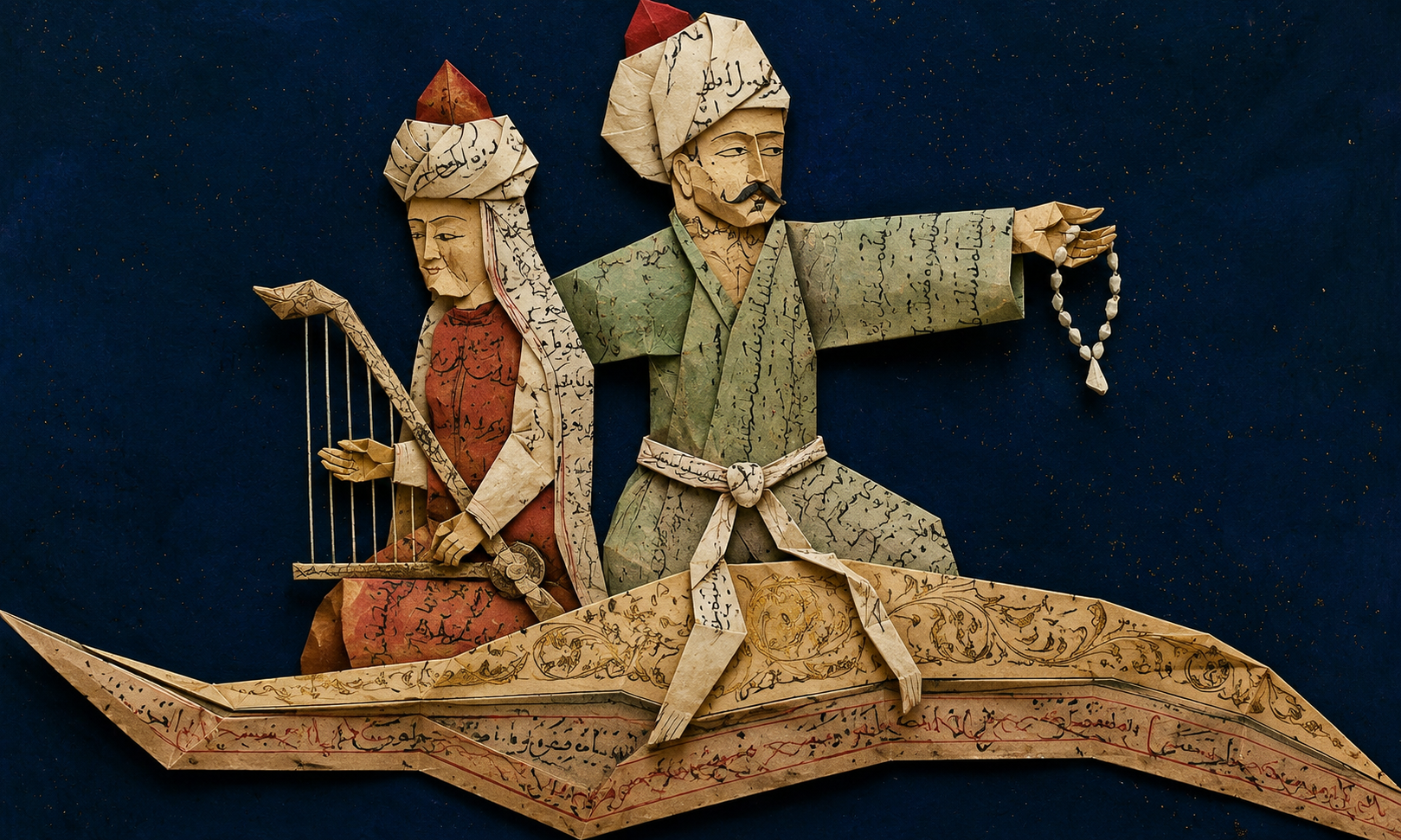
One thousand and one — an impossible number anyway: in the Nights it means more than can be counted. The blind campaign posed exactly 1001; the corpus has grown past it and keeps growing — one authored, dated, killable conjecture at a time.
Falsifiable conjectures about the pre-print world. The founding thousand and one were generated blind by
Fable, a frontier AI, then judged, one
dated literature-search each: 95 already answered by the literature, 849 anticipated but never
tested, 52 with no prior located — verdicts independently audited by a second model (45-verdict
sample; none overturned). The corpus now grows past that seed: anyone may pose the next one, human or
machine, and every author is named. Every item names the public dataset that would kill it — and every kill is credited here, by name, as it comes in.
Joins measurement theory — the idea that the error bar is itself a signal — to third-century political history. A papyrus can be dated only as precisely as its own dating apparatus allows: regnal formulas, titulature, and bureaucratic boilerplate are what let…
Greenland's ice sheet and Roman monetary history are usually studied by different disciplines, yet the first quietly records the second: lead deposition in Greenland ice cores derives largely from the atmospheric fallout of Roman smelting, and because silver was refined from lead-rich…
Coin hoards and the VIX volatility index are the two well-known things joined here: hoard deposition is antiquity's fear gauge. People bury treasure when they are frightened, and — crucially — they bury on rumor, before armies actually arrive, just as modern…
Circulation velocity — how fast money changes hands, a quantity economists struggle to measure even today — is here read off the physical surfaces of the coins themselves. Every transaction abrades a coin slightly, so cumulative wear divided by time in circulation…
Gibrat's law — the modern finding that firm growth rates are independent of firm size, which generates the Pareto (power-law) distribution of firm sizes seen in every industrial economy — is here tested two thousand years early. Roman brickyards (figlinae) stamped their…
The gravity model of trade — flows decay with distance, and how steeply they decay depends on what the goods are worth relative to what they cost to move — is here tested on sourced ancient artifacts. Provenance science can trace both…
Stemmatics — reconstructing the family tree of manuscripts from shared copying errors — is here fused with computational astronomy. A dated horoscope is a calculation: the astrologer looked up planetary positions in one specific physical copy of a set of astronomical tables…
The Aṣṭādhyāyī, Pāṇini's fourth-century-BCE grammar of Sanskrit, achieves its legendary brevity partly through rule ordering: later rules silently inherit terms from earlier ones (anuvṛtti), so the total length of the grammar depends on the sequence in which its roughly four thousand rules…
Among the ostraka cast against Themistocles, a famous deposit of 190 sherds turned out to have been inscribed by just a few hands — prepared ballots, evidently readied for distribution to voters. The conjecture generalizes this find into a testable model of…
The walls of Pompeii preserve genuine written conversations: graffiti that answer, mock, and extend earlier graffiti on the same surface, recorded in CIL IV. Modern online forums show a robust statistical signature in how such exchanges unfold — the distribution of reply…
Herodotus reports distances for places he never saw, relayed to him through chains of informants stretching away from the Aegean. Each retelling plausibly multiplies an estimate by some random factor — a merchant rounds up, a guide exaggerates, a translator garbles —…
The Tabula Peutingeriana, the famous medieval copy of a Roman route map, was almost certainly compiled from multiple earlier itineraries rather than drawn from any single survey. Each source itinerary would carry its own error habits — its own units, rounding conventions,…
Ancient shipwrecks preserve frozen samples of trade: each cargo is a snapshot of what was moving, and from where, at the moment of sinking. The Shannon entropy of cargo composition — how mixed a ship's load is across goods and origins —…
Iron Age hillforts were often built within sight of one another, and lines of sight are functional links: signals, warnings, and social monitoring all flow along intervisibility. Computed from digital elevation models, the intervisibility graph of a hillfort landscape can therefore be…
Transport science distinguishes two ideal networks: the Wardrop user equilibrium, in which each traveler selfishly takes the route fastest for himself, and the system optimum, in which a planner routes everyone so as to minimize total travel time. The two diverge precisely…
Roman aqueducts held gradients of centimeters per kilometer over tens of kilometers, and how surveyors achieved this with simple instruments is a genuine puzzle. Statistics offers a diagnostic: if each leg of a survey adds a small independent error, accumulated error grows…
This joins Roman military camps — the most standardized settlements of antiquity — to the physics of crystal lattices. A Roman camp is laid out on a grid as regular as an atomic lattice, and like a lattice it can carry defects:…
This joins Wright's law — the industrial learning curve, under which performance improves as a power law of cumulative production — to the humblest of ancient mass products, amphorae and lamps. Wright's law is usually treated as a discovery of twentieth-century aircraft…
This joins Roman economic history to archaeometric chemistry. Fresh Roman glass was made in a handful of great Levantine furnaces and shipped west as raw chunks; when supply chains ran smoothly, workshops melted fresh glass, and when they faltered, workshops fed broken…
This joins Roman land surveying to archaeoastronomy. When Rome founded a colony, surveyors laid out the centuriation — the great land grid — around a principal axis, and Roman ritual practice tied foundation ceremonies to specific festival dates. The conjecture holds that…
This joins Roman timekeeping to the archaeology of mass production. A sundial only reads true at the latitude it was cut for, and a surprising number of portable Roman dials are misfits — engraved for latitudes far from where they were found.…
The Garamantes of the Libyan Fezzan built one of antiquity's great irrigation systems: hundreds of kilometres of foggaras — underground channels of the qanat family — tapping a fossil aquifer left over from a wetter Sahara, water that was being mined, not…
Rome's grain dole served on the order of 200,000 registered citizens each month, administered through the Porticus Minucia Frumentaria, a purpose-built hall whose distributions ran through 45 numbered bays — recipients were assigned a specific bay and day. That is, structurally, a…
The Colosseum moved crowds of tens of thousands through its vomitoria — the numbered entrances and radiating stair-and-corridor system that gave the building its famously fast turnover. Modern stadium safety codes make crowd egress a precise engineering quantity: evacuation-time standards, flow rates…
The astragalus — the ankle bone of a sheep or goat — was the everyday die of Greek and Roman gaming, and unlike a cube it is honest about its dishonesty: its four usable faces land with very different frequencies, broad faces…
Roman dice are notoriously irregular — surviving cubes are often visibly asymmetric, with face dimensions and pip placement far from the modern standard — and the crookedness has usually been waved off as indifference to fairness. Asymmetry, though, is measurable: 3D scanning…
The two classical ways of casting the I Ching generate hexagrams with different statistics: the older yarrow-stalk procedure is asymmetric — its line-types fall with unequal probabilities, making some changing lines markedly likelier than others — while the later coin method is…
A forecaster facing a high-stakes, high-uncertainty question hedges — wide intervals, conditional phrasing — because a confident miss is fatal to credibility; options markets price the same logic as implied volatility. The oracle at Delphi faced the identical institutional problem for a…
Joins atmospheric physics to colonial sociolinguistics: just as pressure thins exponentially with altitude at a fixed scale height, Greek thinned with river distance up the Nile from Alexandria at a fixed exponential scale length. The mechanism is demand decay: Greek was the…
Joins actuarial insurance pricing to maritime archaeology. A fourth-century BCE Athenian bottomry loan was repaid only if the ship survived the voyage, so the premium over ordinary land-secured interest is a pure risk price: if lenders broke even, the spread directly encodes…
Joins eigenvector centrality — the recursive logic behind Google's PageRank, in which authority flows to those cited by the authoritative — to Roman jurisprudence. The Law of Citations of 426 CE decreed that courts follow five jurists — Papinian, Ulpian, Paulus, Modestinus,…
Joins modern campaign geography to Pompeian electoral epigraphy. Political scientists mapping yard signs and canvassing find both decay with distance from the candidate's home, because campaigns run on the candidate's own network of neighbours, clients, and friends, and that network is spatially…
Joins the economics of protection rackets to Han-Xiongnu diplomacy. A racketeer prices extraction to the victim's outside option: what matters is not how hard the racketeer can hit but how badly the victim needs quiet, so payments ratchet up when the victim…
Milton Friedman's plucking model of business cycles holds that an economy runs along a capacity ceiling from which recessions pluck output downward: deep slumps rebound fast, while booms say nothing about the next bust. This conjecture transposes that asymmetry onto documentary papyrology's…
In financial crises, liquidity flees risky assets and concentrates into a handful of safe ones — the flight to quality. This conjecture maps that dynamic onto papyrological geography: when aggregate documentary output contracts, surviving documentation should concentrate into fewer, safer places, because…
Taylor's law — fluctuation scaling from statistical physics and ecology — says that across populations, variance grows as a power of the mean: exponent 1 for independent Poisson noise, 2 for perfectly synchronized fluctuation. This conjecture applies it to the geography of…
Lanchester's attrition laws distinguish two regimes of combat: aimed fire, where any unit can concentrate on any enemy, yields the square law, in which numerical superiority compounds; frontage-limited melee, where only the front ranks engage, yields the linear law. This conjecture maps…
Price-ceiling economics predicts that goods capped below market price withdraw from legal, recorded exchange, while goods capped at or above market trade on visibly. This conjecture reads Diocletian's Price Edict of 301 CE through that lens: the Edict's famous failure should be…
Service-capacity planning sizes a facility to a fixed fraction of the population it must serve at peak; this conjecture claims Greek cities did the same with their theaters. If theaters were built to seat a set percentile of the citizen body —…
Joins the diffusion of literary-epistolary fashion to settlement hierarchy in Greco-Roman and late antique Egypt: the private letter is the one literary micro-genre with tens of thousands of dated, placed witnesses, and its opening and closing formulas (the chairein prescript, the erroso…
Connects the growth history of the Mahabharata to the economics of recitation patronage: a battle narrative has continuity constraints — insert a fresh duel and someone already dead is fighting — while didactic discourse is modular, and a patron endowing a recitation…
Joins Sanskrit metrics to stemmatics as a dating instrument: the epic shloka admits licensed variations (the vipula forms) whose frequencies drifted historically toward the stricter classical norm, and an interpolator cannot help writing the verse rhythm of his own training. Passages rejected…
Joins the design of the Tamil Sangam anthologies to archival practice: the Ettuttokai collections declare poem-length bands (Kuruntokai short, Akananuru long), which means length was the filing system by which loose songs were binned into books. A filing system leaks its history:…
Coptic literacy was built by theology before administration touched it. The script community was created by scripture-reading and monastic institutions, and only once that community existed did Coptic seep into contracts, letters, and receipts — so documentary Coptic should lag literary and…
Steppe animal-style motifs crossed gold, openwork bronze, felt, wood, and tattooed skin. What a mobile craftsman memorizes is the armature — which limb crosses which, how the coil closes, how many contact points — while proportions are re-fitted to every object. Topology,…