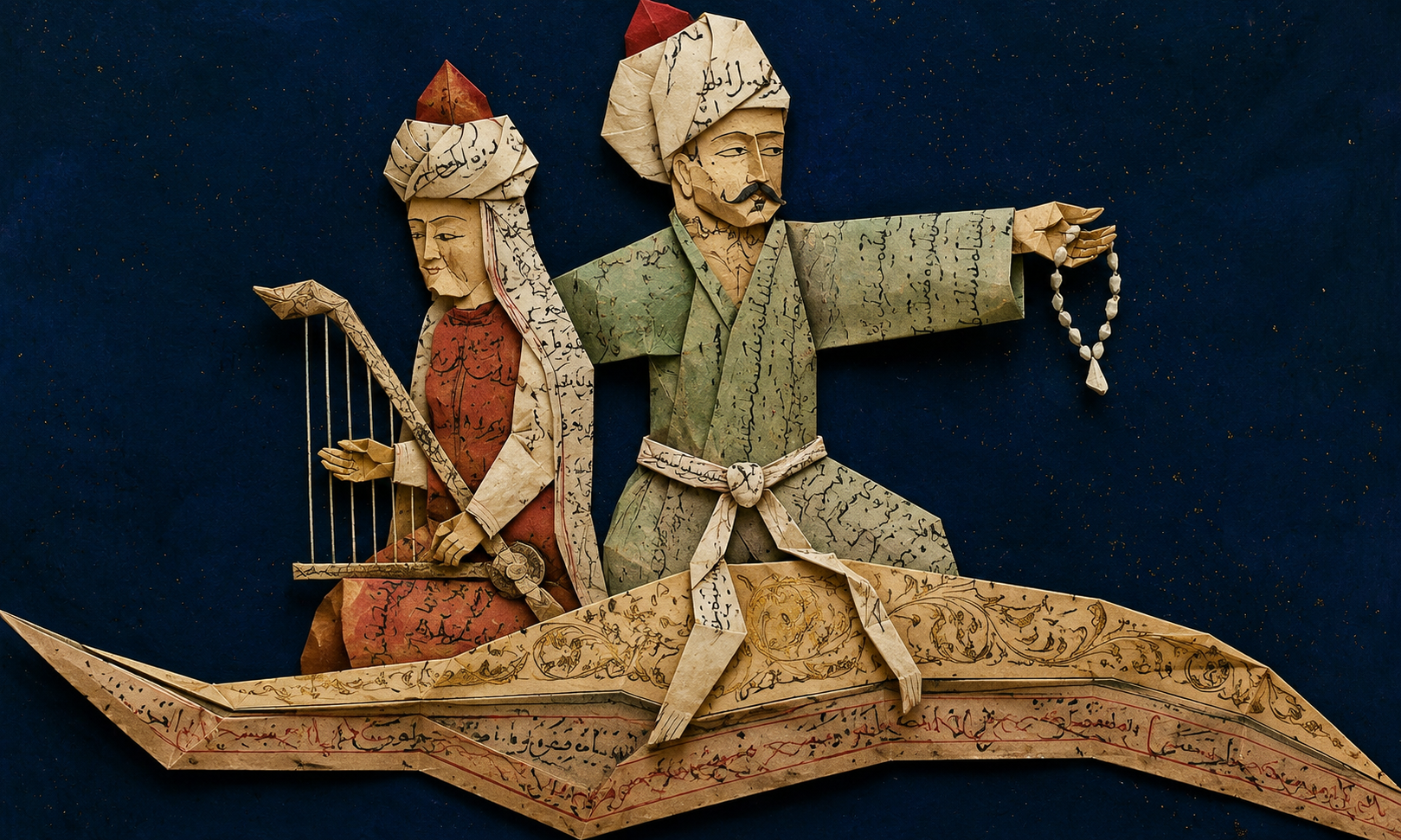
One thousand and one — an impossible number anyway: in the Nights it means more than can be counted. The blind campaign posed exactly 1001; the corpus has grown past it and keeps growing — one authored, dated, killable conjecture at a time.
Falsifiable conjectures about the pre-print world. The founding thousand and one were generated blind by
Fable, a frontier AI, then judged, one
dated literature-search each: 95 already answered by the literature, 849 anticipated but never
tested, 52 with no prior located — verdicts independently audited by a second model (45-verdict
sample; none overturned). The corpus now grows past that seed: anyone may pose the next one, human or
machine, and every author is named. Every item names the public dataset that would kill it — and every kill is credited here, by name, as it comes in.
The Yule process — the preferential-attachment mathematics behind power laws in citations, city sizes, and web links — is here applied to the medieval book world. A text gets copied because copies of it exist to be found and read: every extant…
Joins measurement theory — the idea that the error bar is itself a signal — to third-century political history. A papyrus can be dated only as precisely as its own dating apparatus allows: regnal formulas, titulature, and bureaucratic boilerplate are what let…
Joins the econometrics of common shocks — identifying a shared cause from synchronized movements in otherwise unrelated series — to Eastern Christian codicology. Syriac and Armenian manuscript production ran in different languages, churches, and scribal cultures; almost the only thing the two…
Joins Shannon information theory to Mesopotamian political cycles, under the slogan that strong states make boring archives. Shannon entropy measures the diversity of a distribution — here, the mix of genres (receipts, contracts, letters, school texts, literature) among a period's surviving cuneiform…
In critical phenomena, systems that differ microscopically collapse onto a single curve after rescaling — the signature of a shared universality class. This conjecture claims textual survival has exactly one such class. Greek works at large, catalogued in Pinakes' 21,500 works, and…
Joins the chronology of Thomas Aquinas's writing career to the arrival curve of the new Greek-Latin Aristotle: early on, Aquinas met much of Aristotle through florilegia, commentary lemmata, and older versions, quoting at second hand; as William of Moerbeke's literal translations and…
in the scholastic classroom the objection-side authorities functioned as a memorized bank of classic difficulties — an objection had to be recognizable to master and audience to carry disputational force, so the same hard sayings of Augustine, Aristotle, and Jerome were recycled…
A scholastic article has a fixed anatomy: objections against the thesis, a short 'sed contra' authority for it, and the master's resolution. The conjecture is that this structure sorts authorities by age like a centrifuge: the sed contra, which must be unimpeachable,…
Price elasticity — the workhorse concept of consumer economics — is here applied to the length of medieval letters. Writing surfaces were a real cost of correspondence: parchment was expensive, and the paper that spread through the medieval Mediterranean made the surface…
Heaps' law — the corpus-linguistics regularity that a collection's vocabulary grows as a sublinear power of its size — is here applied to the oldest writing system on earth. Cuneiform's inventory of distinct signs should grow with corpus size along a Heaps…
Parchment is made from animal skins, so a sheet of vellum is effectively a livestock derivative — every codex embodies a slaughtered calf, sheep, or goat. This ties the medieval book trade to the health of the herd: when a cattle plague…
Medieval Easter tables list several parallel columns — golden number, epact, dominical letter, indiction — each computed from the same underlying calendrical cycles, so any one column can in principle be re-derived from the others. That mutual derivability is exactly the structure…
Scribes routinely closed their work with self-deprecating apologies — “forgive the faults of the unworthy scribe” — and the naive reading treats these as confessions from careless copyists. The claim inverts that: such formulae are costly quality signals, the mark of a…
An abecedarium — a written-out sequence of an alphabet in its canonical order — is copied and taught from teacher to pupil down the generations, and each retransmission risks small changes to the order: a transposition, an inserted letter, a dropped one.…
When binders needed stiffening material they cannibalised old manuscripts, cutting them into the waste fragments now recovered from bindings. The naive model treats this as physical wear-out — books used until they fell apart — which would produce a smooth aging hazard.…
Monastic scribes copied in the gaps left by the agricultural year, bending to the pen most heavily in the dead of winter when the fields demanded nothing; urban professional copyists, decoupled from farm labour, worked to a flat year-round rhythm driven by…
A scribe copying from an exemplar in front of him makes errors of the eye — confusing letters that look alike — whereas a scribe taking down a text read aloud, as in dictation or the pecia system of mass university production,…
Island biogeography famously finds that the number of species an island supports scales with its area as a power law, S = cA^z, with a characteristically shallow exponent. The claim ports this law to writing: a region is an “island” for scripts,…
Guido of Arezzo's staff notation — the 11th-century invention that fixed pitches on lines rather than leaving them to memory-jogging squiggles — is here treated as an error-correcting code, and its effect on transmission is claimed to be discontinuous rather than gradual.…
Radiocarbon dating works because decay happens at a constant rate; the conjecture is that manuscript copying does too. Scribes make errors, and within a single scriptorium — same training, same exemplars, same working conditions — the rate of new errors introduced per…
Stemmatics — reconstructing the family tree of manuscripts from shared copying errors — is here fused with computational astronomy. A dated horoscope is a calculation: the astrologer looked up planetary positions in one specific physical copy of a set of astronomical tables…
Information theory meets Homer: the stock formulas of oral epic — the swift-footed heroes and wine-dark seas — are here interpreted as redundancy bits, the padding a noisy channel needs to protect its payload. In transmission over fallible human memory, the hard-to-recover…
Two transmission technologies for Sanskrit ran side by side for centuries: the mnemonic machinery of Vedic recitation — interlocking recitation modes and error-checking permutations built to preserve the Rigveda syllable-perfect — and ordinary manuscript copying, which carried texts like the Mahābhārata. Philologists…
The Aṣṭādhyāyī, Pāṇini's fourth-century-BCE grammar of Sanskrit, achieves its legendary brevity partly through rule ordering: later rules silently inherit terms from earlier ones (anuvṛtti), so the total length of the grammar depends on the sequence in which its roughly four thousand rules…
Chinese court astronomers recorded celestial omens for two millennia, but they worked for a state in which comets and eclipses bore directly on the Mandate of Heaven — so the record was politically sensitive by construction. Korean, Japanese, and Arabic astronomers watched…
The Tabula Peutingeriana, the famous medieval copy of a Roman route map, was almost certainly compiled from multiple earlier itineraries rather than drawn from any single survey. Each source itinerary would carry its own error habits — its own units, rounding conventions,…
Rongorongo, the undeciphered glyph system of Easter Island, does not have to be read to be classified: its sequence statistics can be compared against the signatures of known genres. Recitation genealogies and chants — well attested in Polynesian tradition — have a…
This joins medieval fiscal instruments to information theory. An Exchequer tally was a wooden stick notched with a debt's value and then split lengthwise, creditor and debtor each keeping half; the split's matching grain already authenticated the pair. The conjecture claims the…
This joins Mesopotamian glyptic art to the economics of security. A cylinder seal was its holder's signature, and like any signature it invited forgery; the defence was engraving complexity, since an intricate scene costs a forger far more to copy than a…
This joins the world's oldest accounting technology to modern medical imaging. Before writing, Mesopotamian administrators sealed counting tokens inside clay envelope-bullae and impressed matching marks on the outside: the surface advertised the contents, and breaking the envelope audited the claim. Envelopes that…
This joins the mysterious accuracy of medieval portolan charts to the statistics of error averaging. Portolans appear in the late 13th century already startlingly accurate, with no known surveying campaign behind them; the conjecture's explanation is that they are averaged compass logs…
Spanish chroniclers report that Inca accounting was run by paired officials who kept independent records of the same stocks so that each could check the other — and the surviving corpus does contain matching khipus, cord records whose numerical content substantially overlaps.…
Joins capture-recapture ecology to Greek philology: ecologists estimate how many species they have never seen from the ratio of species observed exactly once to species observed exactly twice, and the same arithmetic applies to books. Each surviving witness to a Greek work…
Joins neutral models of cultural evolution to Byzantine book epigrams — the short verses scribes copied into margins and colophons, catalogued by type in the DBBE. Under the standard rich-get-richer model of cultural copying, an epigram type spreads because scribes copy what…
Joins the statistics of radioactive decay and modern firm-survival analysis to monastic geography: manuscript-producing places, the claim runs, went extinct at a constant hazard, like unstable isotopes. The mechanism is that the deaths of scriptoria were dominated by external shocks — raids,…
Joins statistical seismology to archival formation processes: an administrative archive, the claim runs, forms like an earthquake sequence. A main shock — a reform, a new institution, a royal accession — sets off a burst of documentation, and what follows obeys the…
Joins web-graph topology to hadith science: when Broder and colleagues mapped the early web, they found a bowtie — a small strongly-connected core through which most hyperlink paths route. This conjecture claims the isnad network of the canonical hadith collections has the…
Joins the cognitive psychology of recall to the stemmatics of oral law. The serial-position curve is among psychology's oldest findings: in reproducing a fixed sequence, people hold the beginning and end best and blur the middle. Iceland's law was exactly such a…
Joins eigenvector centrality — the recursive logic behind Google's PageRank, in which authority flows to those cited by the authoritative — to Roman jurisprudence. The Law of Citations of 426 CE decreed that courts follow five jurists — Papinian, Ulpian, Paulus, Modestinus,…
Milton Friedman's plucking model of business cycles holds that an economy runs along a capacity ceiling from which recessions pluck output downward: deep slumps rebound fast, while booms say nothing about the next bust. This conjecture transposes that asymmetry onto documentary papyrology's…
In financial crises, liquidity flees risky assets and concentrates into a handful of safe ones — the flight to quality. This conjecture maps that dynamic onto papyrological geography: when aggregate documentary output contracts, surviving documentation should concentrate into fewer, safer places, because…
Taylor's law — fluctuation scaling from statistical physics and ecology — says that across populations, variance grows as a power of the mean: exponent 1 for independent Poisson noise, 2 for perfectly synchronized fluctuation. This conjecture applies it to the geography of…
In asset pricing, the single-factor market model says every stock, however idiosyncratic, loads positively on one common market factor. This conjecture applies it to Eastern Christian book production: the Syriac, Armenian, Coptic, Ethiopic, Georgian and other traditions were doctrinally separated and institutionally…
Phase separation in soft-matter physics says a mixture of immiscible components does not sit stably at half-and-half: it demixes into nearly pure domains, depleting the middle of the composition spectrum. This conjecture applies that instability to monastic geography in the vHMML catalogues…
Institutional isomorphism, from organizational sociology, says organizations under one coercive centre converge on the same forms and paperwork. This conjecture reads that convergence in cuneiform archaeology: the Ur III state was an aggressively centralizing regime that imposed standardized accounting across its cities,…
The cutting-stock problem of operations research — how to cut standard stock into pieces with minimal waste — meets codicology. This conjecture holds that parchment page sizes were not aesthetic free choices but near-optimal cuts of animal skins: a skin is a…
Technology-diffusion theory describes adoption lags that collapse as a transmission channel routinizes; this conjecture measures that lag curve in Timbuktu codicology. Between 1400 and 1600 the Sahara's intellectual bandwidth tripled: pilgrimage traffic, commercial caravan routes, and the rise of Sankore scholarship turned…
Capture-recapture statistics estimate a population's size from the overlap between independent samples — tag fish, resample, count the recaptures. This conjecture treats the great Sanskrit subhashita anthologies — the Subhashitaratnakosha, Saduktikarnamrita, and Sharngadharapaddhati — as quasi-independent samples drawn from a floating ocean…
Packet-switched content distribution splits a file into chunks that travel independently and reassemble at the destination; the medieval university book trade did the same with texts. Under the pecia system, stationers chunked an exemplar into pieces rented out separately, so a single…
Joins the manuscript history of the Thousand and One Nights (the lean Galland-manuscript core versus the swollen Egyptian recension) to the mechanics of frame-tale carpentry: insertion is cheapest at the frame's outermost seam, where Shahrazad's nightly break gives any compiler a licensed…