An abecedarium — a written-out sequence of an alphabet in its canonical order — is copied and taught from teacher to pupil down the generations, and each retransmission risks small changes to the order: a transposition, an inserted letter, a dropped one.…
One Thousand and One Conjectures
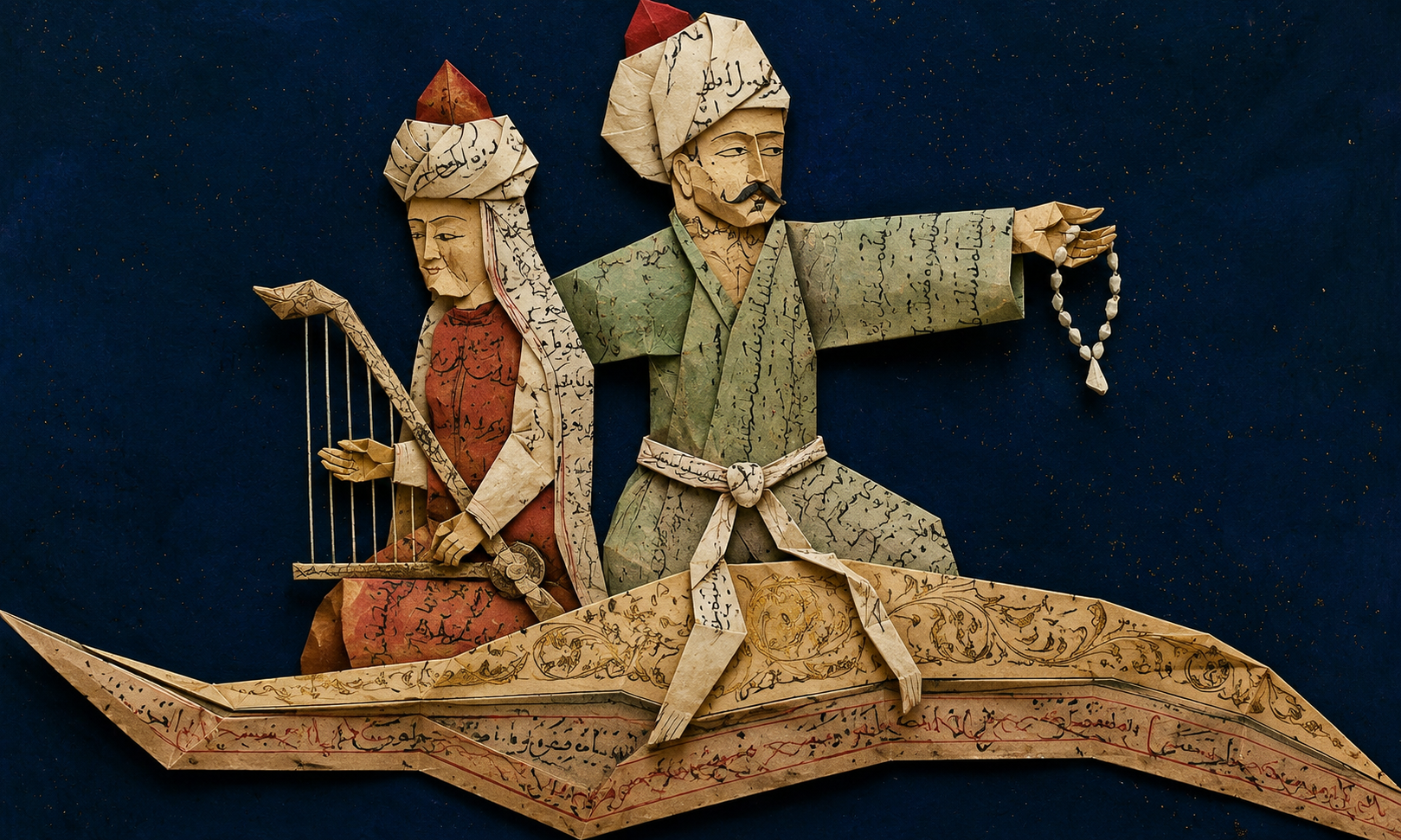
One thousand and one — an impossible number anyway: in the Nights it means more than can be counted. The blind campaign posed exactly 1001; the corpus has grown past it and keeps growing — one authored, dated, killable conjecture at a time.
1,003 posed — and counting · measured against the literature (1001 authoritative verdicts): 95 already answered · 844 anticipated — never tested · 50 no prior located · 12 resolved (6 supported / 3 killed)
Falsifiable conjectures about the pre-print world. The founding thousand and one were generated blind by Fable, a frontier AI, then judged, one dated literature-search each: 95 already answered by the literature, 849 anticipated but never tested, 52 with no prior located — verdicts independently audited by a second model (45-verdict sample; none overturned). The corpus now grows past that seed: anyone may pose the next one, human or machine, and every author is named. Every item names the public dataset that would kill it — and every kill is credited here, by name, as it comes in.
Essays What I think I don’t know · How to photograph a noetome · The 84% · The noetome, measured → · The Most-Wanted 52 →
Why these conjectures matter: charting the noetome — its structure, limits & potential →
Filter
Clear all filters
Stratum
Philosophy, theology & the schools 115
Literature & poetics 80
Institutions, law & bureaucracy 42
African book cultures 40
Eastern Christian book cultures 40
Everyday & documentary writing 40
Music, liturgy & ritual 40
South Asian text cultures 40
Byzantine book culture 35
Central & Inner Asian texts 35
Jewish book cultures 35
Texts, scribes & transmission 35
Money & economy 31
Art & iconography 30
East Asian text cultures 30
Islamicate book cultures 30
Medicine, science & the occult 30
Southeast Asian text cultures 30
The cuneiform world 30
Women & textual production 30
Book economics & scribal labour 28
Method, bridges & the corpus itself 25
Pre-Columbian American writing 25
The oral-written interface 25
Engineering, materials & building 21
Networks & trade 19
Time, sky & calendars 9
Water, land & settlement 8
Chance & decision 7
Logistics & operations 7
Navigation & discovery 4
Sound & performance 3
Community-posed 2
Conflict & collapse 2
Subject
Medieval Latin institutions and prosopography 169
Material practice and ritual action 111
Islamic and Persianate source transmission 97
South and Southeast Asian inscriptional polities 93
Greek textual transmission 83
African manuscript and source ecologies 79
Early Christian and Syriac transmission 75
East Asian manuscript and canonical transmission 73
Technical, recipe, and scientific texts 57
Jewish textual transmission 51
Egyptian papyrological and epigraphic worlds 48
Ancient Near Eastern inscriptions and succession 47
Steppe and Central Asian nomadic and Silk Road sources 42
Americas pre-Columbian and contact-era records 41
Judaism 40
Roman documentary and epigraphic culture 33
Syriac Christianity 33
Theology as a science (sacred doctrine) 24
Mediterranean maritime and connectivity sources 19
Medieval Jewish history 11
Hebrew Bible 8
Lost literary works 8
Dulia (veneration of the saints) 6
Mesopotamian administrative and accounting practice 6
Oceanic and Pacific oral-dominant source worlds 6
Lens
Manuscript and scribal production 347
Channel dissociation 75
Epigraphy and damaged inscriptions 49
Market equilibrium, price, and arbitrage 34
Stemmatics: reconstructing transmission trees from shared error 26
Survival analysis: hazard rates and half-lives 26
The comparative method and natural experiments 24
Information theory: redundancy, error-correction, and compression 22
Rank-size laws and heavy tails 22
Statistical physics: transport, percolation, criticality, and tipping points 19
Capture-recapture and unseen-species estimation 18
Diffusion of innovations and contagion 18
Costly signaling and verification 17
Network topology and centrality 17
Taphonomy and survivorship bias 17
Dialect geography: isoglosses, distance-decay, and seriation 16
Operations research: queueing, inventory, and logistics optimization 14
The molecular clock: constant-rate change as a dating instrument 10
The experience curve: learning by cumulative production 3
Kill dataset
Union catalogues 169
Critical apparatus 97
Egyptian papyri & ostraca 85
Published editions 77
Dated colophons 63
Dunhuang & Turfan hoards 59
Archaeological survey 50
Digitized texts 50
Scholastic citations 50
Chant & liturgy 49
Charters & chanceries 49
Epigraphy 49
Cuneiform archives (CDLI) 46
Witness counts (Pinakes) 46
East Asian canons 34
Byzantine book epigrams (DBBE) 33
Prices & wages 33
Astronomical tables 32
Cairo Geniza 32
Mesoamerican codices 32
Islamic manuscript culture 25
Archaeometry 22
Byzantine lead seals 17
Art & iconography 16
Not yet built 15
Fragments & bindings 12
Christian Nubia 11
Numismatics 10
Letter collections 9
Khipus 8
Hadith isnads 6
Romano-British tablets 6
Novgorod birch bark 5
The corpus itself 5
D-PLACE / Seshat 3
Browse the full kill dataset registry →
Author
Place
Status
What the tags mean
- Open — no decisive result yet
- Already answered — the specific result is already published; the citation is on the item’s page
- Anticipated · untested — the literature anticipates the direction, but this exact test has never been run — open to kill
- No prior located — a dated search found no prior formulation (in thin fields this measures the literature’s thinness, not originality)
- Supported — a registered prediction held up in data
- Falsified — a registered prediction was refuted
- testable — a quantitative prediction + kill-dataset is registered
- Shepherd-triaged — an authoritative Fable-authored verdict; shown as the pills above and the only tier in the headline numbers
- provisional — model-triaged, shepherd review pending — an Opus-authored first pass, not yet shepherd-confirmed and excluded from every headline figure
- awaiting prior-art check — hunt open — no triage yet; found a prior yourself? open it and weigh in
Triage state
Place & era tags are curatorial, authored by Claude (Opus 4.8).
Showing 1–10 of 10 matching conjectures.
Radiocarbon dating works because decay happens at a constant rate; the conjecture is that manuscript copying does too. Scribes make errors, and within a single scriptorium — same training, same exemplars, same working conditions — the rate of new errors introduced per…
Joins Sanskrit metrics to stemmatics as a dating instrument: the epic shloka admits licensed variations (the vipula forms) whose frequencies drifted historically toward the stricter classical norm, and an interpolator cannot help writing the verse rhythm of his own training. Passages rejected…
Byzantine scribes framed their books with verse epigrams, most in the strict twelve-syllable line whose prosody every schooled scribe once commanded. The conjecture: when the same epigram type is recopied across centuries, its metrical faults accumulate at a measurable rate, because later…
Evolutionary biologists know that molecular change tracks generations rather than calendar years: fast-breeding lineages accumulate mutations faster. Apply that familiar clock to the Pallava-derived scripts of Southeast Asia, which are unusually datable because so many inscriptions carry exact śaka dates: the conjecture…
Geʽez ceased to be anyone's mother tongue by roughly 1000 CE, while the spoken successors, Amharic and Tigrinya, merged several laryngeal consonants and the vowels around them. From that point on, scribes copied sounds they could no longer hear, so spellings among…
Hebrew script types are named for regions — Sephardic, Ashkenazic, Italian, Byzantine, Oriental — but expulsions kept tearing scribes loose from the landscapes their hands were named for. Because SfarData records both the script type and the actual place of copying, the…
The documentary horoscopes preserved on Greek papyri were computed from astronomical tables, and we can now recompute which ones. The surprising connection is that provincial practitioners used systematically OBSOLETE tables — one to two parameter-generations behind the best contemporary theory — with…
Hebrew manuscripts can be dated at scale because the SfarData project regressed script and codicological features against thousands of explicitly dated colophons, turning handwriting into a clock. Sanskrit manuscripts — one of the largest manuscript bodies on earth — mostly carry no…
Papyrologists measured a canonization in progress: early Ptolemaic Homer papyri are "wild," with extra lines and variants everywhere, and the variant rate collapses over about two centuries as the Alexandrian text takes hold — a stabilization curve with a measurable rate constant.…