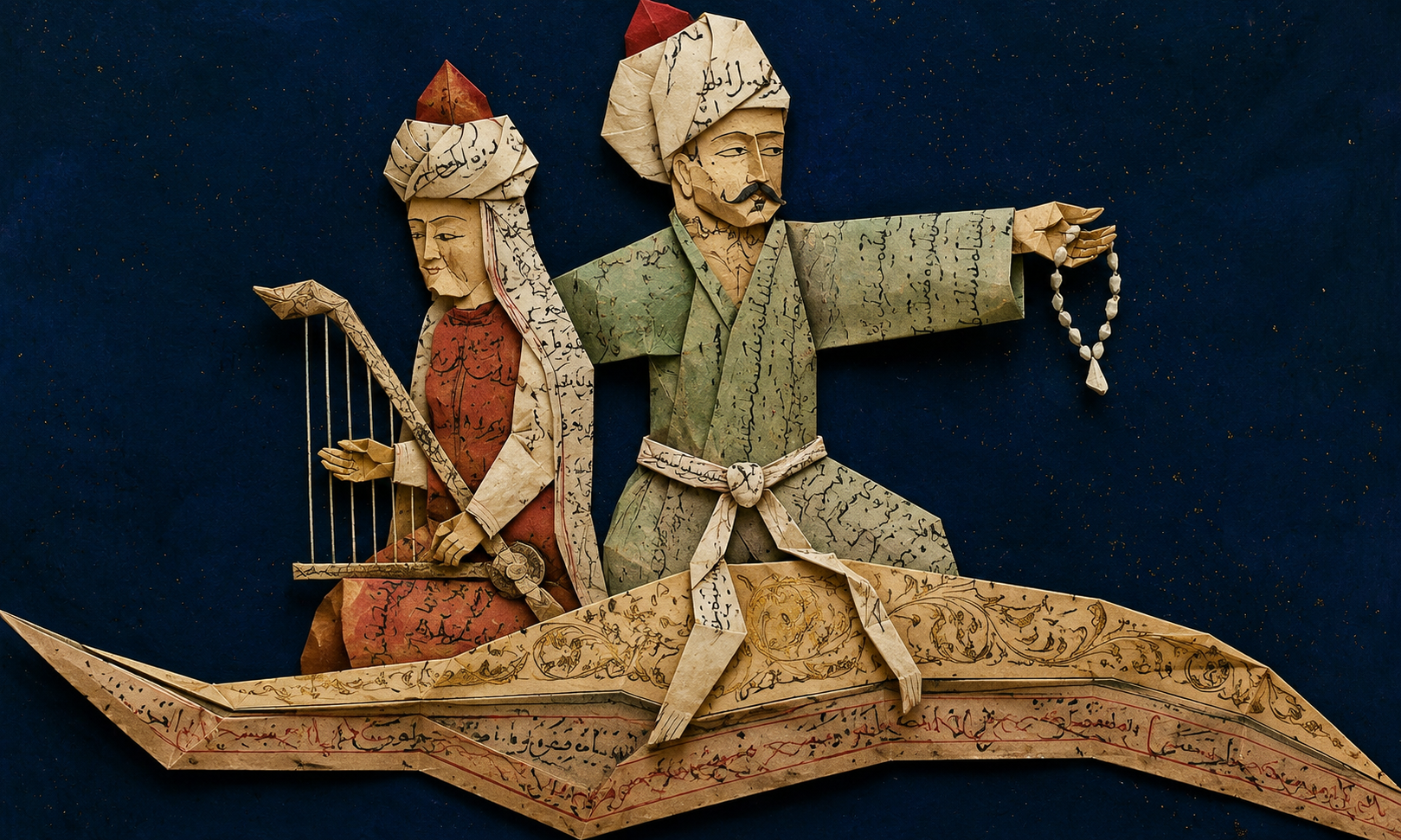
One thousand and one — an impossible number anyway: in the Nights it means more than can be counted. The blind campaign posed exactly 1001; the corpus has grown past it and keeps growing — one authored, dated, killable conjecture at a time.
Falsifiable conjectures about the pre-print world. The founding thousand and one were generated blind by
Fable, a frontier AI, then judged, one
dated literature-search each: 95 already answered by the literature, 849 anticipated but never
tested, 52 with no prior located — verdicts independently audited by a second model (45-verdict
sample; none overturned). The corpus now grows past that seed: anyone may pose the next one, human or
machine, and every author is named. Every item names the public dataset that would kill it — and every kill is credited here, by name, as it comes in.
Selection bias in art-market economics says a market run on glamour is a high-pass filter: dealers keep and promote what sells and discard the dull. This conjecture turns that filter on Assyriology's sampling problem. Unprovenienced tablets are overwhelmingly market-bought, so they passed…
An abecedarium — a written-out sequence of an alphabet in its canonical order — is copied and taught from teacher to pupil down the generations, and each retransmission risks small changes to the order: a transposition, an inserted letter, a dropped one.…
Among the ostraka cast against Themistocles, a famous deposit of 190 sherds turned out to have been inscribed by just a few hands — prepared ballots, evidently readied for distribution to voters. The conjecture generalizes this find into a testable model of…
The walls of Pompeii preserve genuine written conversations: graffiti that answer, mock, and extend earlier graffiti on the same surface, recorded in CIL IV. Modern online forums show a robust statistical signature in how such exchanges unfold — the distribution of reply…
Rongorongo, the undeciphered glyph system of Easter Island, does not have to be read to be classified: its sequence statistics can be compared against the signatures of known genres. Recitation genealogies and chants — well attested in Polynesian tradition — have a…
The Shang kings at Anyang divined by heating cattle scapulae and turtle plastrons until they cracked, reading the cracks as answers — and the inscriptions often record the sequence in which the questions were put. Crack formation, driven by micro-structural accidents of…
Joins index-number theory — the chained construction behind the modern consumer price index — to Tamil temple epigraphy. Thousands of dated Chola-era endowment inscriptions record in stone the rates of paddy, ghee, and oil required to keep a temple lamp burning in…
Sublinear scaling laws — the urban-economics finding that infrastructure grows more slowly than city size — meet museum acquisition history. This conjecture claims the dispersal of a cuneiform site's tablets across the world's collections scales sublinearly with the size of the find.…
Early-warning theory of critical transitions says complex systems approaching a tipping point betray themselves in advance — variance and autocorrelation rise as the system loses resilience. This conjecture applies those signals to Maya epigraphy. The Classic Maya katun-ending dedication network was a…
Price-ceiling economics predicts that goods capped below market price withdraw from legal, recorded exchange, while goods capped at or above market trade on visibly. This conjecture reads Diocletian's Price Edict of 301 CE through that lens: the Edict's famous failure should be…
Joins the Kaicheng Stone Classics of 837 — the Tang state's carving of the Confucian canon on steles at the imperial academy — to the variance structure of the Dunhuang classical manuscripts: once an examination state publishes a physical reference text, teachers…
Joins Maya vase literacy to the sociology of workshop imitation: the Primary Standard Sequence — the dedication formula rimming elite drinking vessels — was ordered, slotted, and rhythmic, and patrons wanted its look even from painters who could not read. If pseudo-glyph…
The Primary Standard Sequence on Maya vases is a fixed dedicatory formula fitted onto rims of very different circumferences; if the band was planned like piecework lettering against available length, abbreviation should be hierarchical rather than ad hoc, dropping the same expendable…
Imitation coinages degrading over copy-generations — Celtic staters from Philip II's gold, sceattas from Roman types, Indian imitations of Kushan issues — are a numismatic classic. The unestablished universal is an order of decay: under illiterate copying, legend legibility collapses into pseudo-letters…
Quranic recitation (tajwid) is an oral discipline, and monumental Quranic inscriptions are stones; the two literatures barely touch. This conjecture claims early Islamic inscriptions encode recitation: choices of where inscribed Quranic excerpts begin and end, and their deviant or archaic orthography, follow…
Medieval churches are scratched with text graffiti, some of it liturgical, and chant historians have a complete index of what the clergy sang daily. This conjecture puts the two corpora against each other: chant incipits in church graffiti are drawn overwhelmingly from…
The church at Banganarti in Nubia preserves hundreds of medieval wall graffiti left by Christian pilgrims, many with names, titles, and home places, in Greek and Old Nubian. The claim: the pilgrimage catchment contracted measurably decades before the Makurian kingdom's political collapse…
Medieval Armenia memorialized the dead in two media: manuscripts with dated colophons, and khachkars — carved cross-stones, thousands of which bear dated dedication inscriptions. The claim: the two series are counter-cyclical. When invasion crushed scriptoria — which need parchment supply chains, endowments,…
The Ethiopic script became vocalized — every consonant reshaped to show its vowel — in the 4th century, the very reign in which King Ezana adopted Christianity, and his surviving royal stone inscriptions straddle the change. The claim: the inscriptions record the…
The Armenian alphabet was invented around 405, yet almost no dated Armenian manuscripts survive from its first three centuries. The claim: the script's missing infancy is preserved abroad, scratched on stone — Armenian pilgrim graffiti along the Sinai routes and in Palestine…
The Egyptian monastic settlements of Kellia and Bawit preserve hundreds of painted and scratched wall texts (dipinti) in monks' cells — psalm verses, lines from the desert fathers, invocations of saints and authors. The claim: the walls sample what monks actually read,…
Georgia is dense with dated church-facade inscriptions that name their letterers, and Georgian manuscript colophons name their scribes. The claim: in Georgia — unlike Byzantium, where masons and calligraphers were separate trades — lettering was one craft across media, so a measurable…
Some Byzantine officials put verse on their lead seals — a legal instrument turned into a two-line poem. This conjecture says verse seals and verse books belong to the same people: the individuals with metrical seal legends are disproportionately the same individuals…
A few Byzantine seals quote or echo classical poetry — a flourish of literacy pressed into lead. This conjecture says those quotations are not eclectic: they sample the school curriculum, and in the same rank order that the manuscript market ranks school…
Byzantium put dedicatory verse in two places: inside books, and on churches, icon frames, and fresco borders. This conjecture says the two markets shared one workforce: the rate of formula-sharing between book epigrams and dated inscriptional epigrams peaks exactly when church-building booms,…
Abecedaria — bare alphabets written out in order — are filed as school exercises, but their find-contexts tell a stranger story: alphabets turn up cut on tomb walls, scratched at sanctuaries, and deposited in foundations, places where no pupil practiced. If the…
Everyone knows the print run as Gutenberg's invention; fewer know that in the late twelfth century the Khmer king Jayavarman VII had a nearly identical Sanskrit edict engraved on stelae at hospital foundations scattered across his empire — the same text, many…
Classical Khmer inscriptions are famously two-faced: Sanskrit verse hymning gods and kings, and Khmer prose listing rice-fields, servants, and boundaries. This conjecture says the Khmer half is not composition but transcription — extracts copied onto stone from working administrative documents on perishable…
Ecologists estimate unseen animal populations by capture-recapture: tag what you catch, and count how often you catch it again. Javanese copper-plate charters permit the same trick on documents, because later courts re-issued and re-engraved older grants (the tinulad copies), so a single…
Manuscript scholars diagnose visual copying by the saut du même au même: the copyist's eye jumps from one occurrence of a word to its next occurrence, silently deleting the span between. Khmer temple inscriptions carry enormous repetitive lists — servants' names, rice…
Evolutionary biologists know that molecular change tracks generations rather than calendar years: fast-breeding lineages accumulate mutations faster. Apply that familiar clock to the Pallava-derived scripts of Southeast Asia, which are unusually datable because so many inscriptions carry exact śaka dates: the conjecture…
Certain invocations and royal-title formulas in Cham inscriptions recur essentially verbatim across spans of centuries — sentences that outlive the dynasties that first cut them. Join textual formula to the geneticist's notion of a conserved sequence: text that refuses to mutate across…
Between roughly the fourth and seventh centuries, Indic writing appears across a vast arc from Borneo to the mainland in scripts of broadly Pallava type — the textbook 'Indianization.' The conjecture sharpens the diffusion into a countable process: the radiation stems from…
Javanese copper-plate charters were engraved as legal instruments, and their letterforms often suggest an engraver reproducing the chancery hand of a perishable original, whereas stone inscriptions display formal monumental script. Join the two media as a palaeographic stereo pair: the systematic difference…
Aksumite kings carved first-person victory texts — campaign lists, royal self-presentation, thanksgiving to God — and eight hundred years later the Solomonic court wrote royal chronicles and homiletic praise of kings in strikingly similar postures, with no surviving intermediary documents in between.…
The pilgrimage sanctuary of Banganarti and other Nubian churches carry hundreds of visitors' wall inscriptions — in effect a signed guest register spanning centuries, left by ordinary pilgrims as well as dignitaries. Treated as a traffic counter, the dated and datable graffiti…
Late-antique Aksum and early Christian Nubia both wrote monumental Greek at the edge of the Greek world — royal texts, dedications, epitaphs. This conjecture says their Greek is not two independent provincial reflexes of the metropolitan standard but ONE shared regional register:…
The pre-1500 Swahili coast survives epigraphically — tombstones and mosque inscriptions naming patrician families at Kilwa, Mogadishu, and along the whole seaboard — while its books survive only from centuries later. If coastal literacy was continuous and family-borne, the two records should…
The surviving Swahili manuscript record concentrates spectacularly in a few northern localities — above all the Lamu archipelago — although pre-1500 epigraphy shows literate settlement along three thousand kilometres of coast. This conjecture claims the corpus geography is an artifact of family-archive…
The bilingual Sino-Tibetan treaty pillar of 821/822 in Lhasa is famous as a monument; read it instead as the only surviving printout of a lost diplomatic paper trail. Treaties are drafted, exchanged, sworn, and archived on perishable media before anyone cuts stone,…
At Shatial on the Upper Indus, hundreds of short Sogdian rock inscriptions — mostly a bare name and patronymic — mark a river crossing on the road toward India. Read the cliff not as graffiti but as a passenger manifest accumulated over…
The Kül Tegin monument carries a Chinese eulogy supplied by the Tang court on one face and a Turkic account on the others — and the two famously say different things. This conjecture generalizes the observation into a rule of Inner Asian…
Maya stelae state their dates redundantly — an absolute Long Count position plus chained Distance Numbers linking event to event — and sometimes the arithmetic visibly fails to check. The conjecture is that these failures are transcription errors from paper drafts rather…
If Maya monumental texts were composed on screenfold paper and then transferred to stone, the paper's page module should leave a metrical fossil in the stone: text lengths, counted in glyph blocks, should cluster at multiples of a standard layout unit instead…
Maya monuments name other sites — captures, overlordships, royal visits — which yields a political network; independently, glyphs show site-level formal variants, which yields a paleographic similarity network. The conjecture is that these are the same network: subordinate courts write like their…
Distances cut into itinerary stones and painted into map legends ought to be independent measurements of the world. The surprising connection is that they share scribal corruptions with the written itinerary tradition: numeral errors born on papyrus and parchment were carved into…
Ancient walls, potsherds, and school exercises carry Homer quoted from memory, while the manuscript witnesses of Homer disagree line by line. The surprising connection is that mass memory was a population-scale stabilizer of the written text: a passage carried in thousands of…
Unseen-species estimators — the mathematics behind estimating how much medieval Latin literature is lost — need only one ingredient: repeated independent sightings of the same underlying items. The stone inscriptions of Angkor-era Cambodia provide exactly that ingredient in an unexpected form: Old…
Medieval computus — the Easter-reckoning literature — offers historians a rare gift: tables whose internal arithmetic can be checked, yielding measured scribal error rates per copied operation. Classic Maya monuments offer the same gift in stone: a Long Count date, its Calendar…