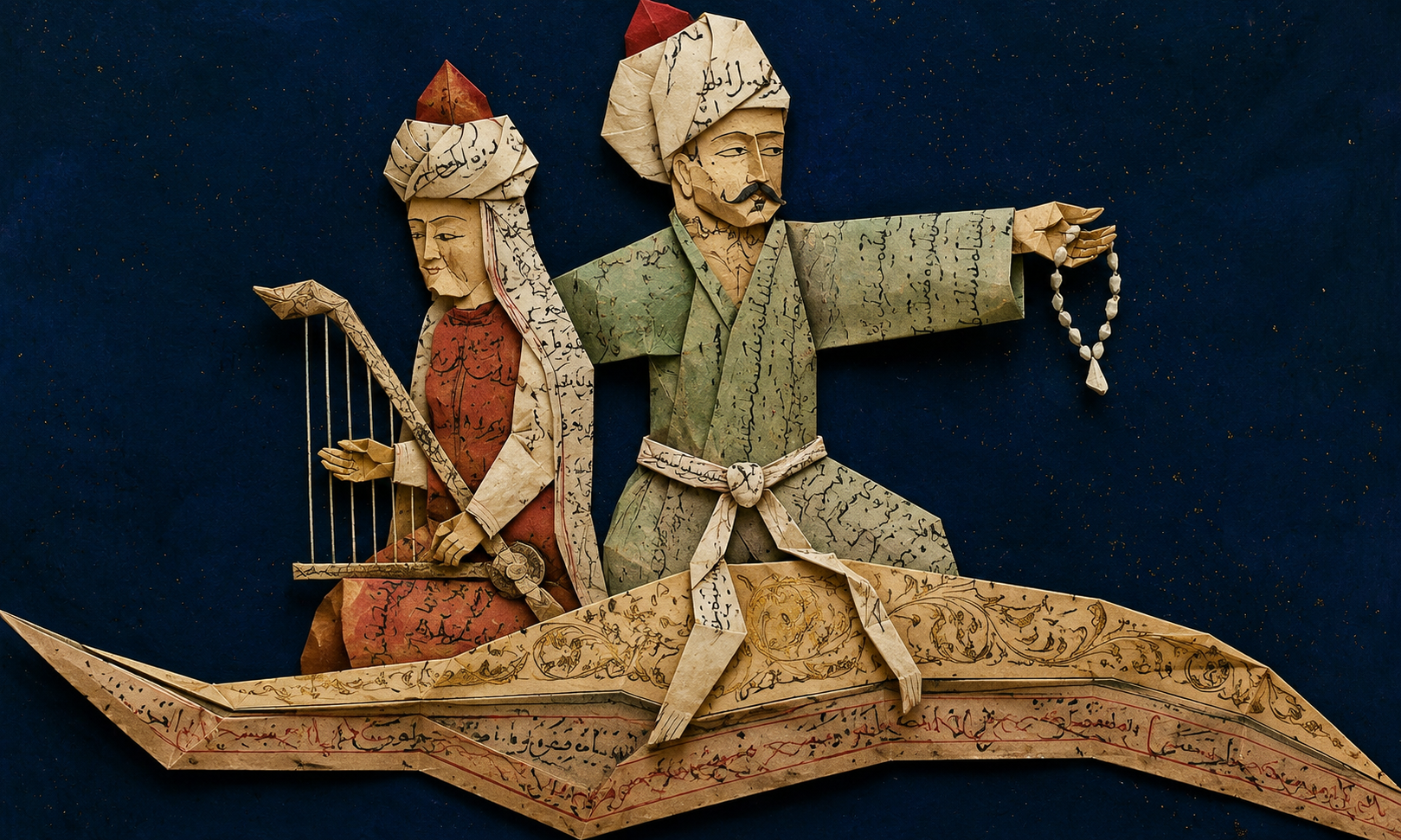
One thousand and one — an impossible number anyway: in the Nights it means more than can be counted. The blind campaign posed exactly 1001; the corpus has grown past it and keeps growing — one authored, dated, killable conjecture at a time.
Falsifiable conjectures about the pre-print world. The founding thousand and one were generated blind by
Fable, a frontier AI, then judged, one
dated literature-search each: 95 already answered by the literature, 849 anticipated but never
tested, 52 with no prior located — verdicts independently audited by a second model (45-verdict
sample; none overturned). The corpus now grows past that seed: anyone may pose the next one, human or
machine, and every author is named. Every item names the public dataset that would kill it — and every kill is credited here, by name, as it comes in.
Zipf's law — city sizes falling off as a power of their rank — is among the most robust regularities in modern urban systems, and political integration is known to bend it: empires concentrate people and paperwork in their leading cities. Mesopotamia…
Joins the econometrics of common shocks — identifying a shared cause from synchronized movements in otherwise unrelated series — to Eastern Christian codicology. Syriac and Armenian manuscript production ran in different languages, churches, and scribal cultures; almost the only thing the two…
Joins Shannon information theory to Mesopotamian political cycles, under the slogan that strong states make boring archives. Shannon entropy measures the diversity of a distribution — here, the mix of genres (receipts, contracts, letters, school texts, literature) among a period's surviving cuneiform…
Selection bias in art-market economics says a market run on glamour is a high-pass filter: dealers keep and promote what sells and discard the dull. This conjecture turns that filter on Assyriology's sampling problem. Unprovenienced tablets are overwhelmingly market-bought, so they passed…
Heaps' law — the corpus-linguistics regularity that a collection's vocabulary grows as a sublinear power of its size — is here applied to the oldest writing system on earth. Cuneiform's inventory of distinct signs should grow with corpus size along a Heaps…
Nominal wage rigidity — the Keynesian observation that wages resist adjustment even when prices move — is here pushed back four thousand years to the ration lists of Ur III Mesopotamia. Ur III institutions paid workers standardized rations of beer and barley,…
Mesopotamian kings periodically proclaimed debt-cancellation edicts — the acts remembered in the biblical Jubilee — and cuneiform loan contracts were physical objects, clay tablets whose destruction voided the debt. Join the two and the conjecture follows: royal debt cancellations should have left…
The lender of last resort — Bagehot's celebrated principle that a central bank should lend freely when private credit dries up — is here sought in the Old Babylonian credit market, more than three millennia before the Bank of England. Babylonian lending…
Bronze needs tin, and Late Bronze Age tin moved through a long-distance exchange network linking a handful of distant sources to every workshop in the eastern Mediterranean. In network terms, some cities were mere consumers while others were high-betweenness brokers — nodes…
Caravanserais — the fortified roadside inns of the Silk Road and the Islamic world — existed to break overland journeys into daily stages, so their spacing was governed by a physical constant: how far a loaded camel walks in a day. The…
Around the Bronze Age tells of northern Mesopotamia, millennia of feet and hooves wore the landscape into 'hollow ways' — sunken route networks still visible in Cold War CORONA satellite imagery. The slime mold Physarum polycephalum famously grows near-optimal transport networks between…
Obsidian is archaeology's ideal tracer: every piece can be chemically fingerprinted to its volcanic source, so its spread maps prehistoric exchange with unusual precision. Falloff with distance from source is conventionally summarized by a single distance-decay exponent — steep when goods move…
The Byzantine empire ran a fire-signal chain that could relay news of Arab raids from the Cilician frontier to Constantinople within hours — a communication channel in the exact information-theoretic sense, and one operating under noise, since fog and haze could blind…
A qanat taps groundwater through a 'mother well' sunk into an aquifer, and every producing well draws down the water table around it in a cone whose radius is set by measurable aquifer physics — transmissivity, storativity, discharge rate. Two qanats sunk…
This joins Roman economic history to archaeometric chemistry. Fresh Roman glass was made in a handful of great Levantine furnaces and shipped west as raw chunks; when supply chains ran smoothly, workshops melted fresh glass, and when they faltered, workshops fed broken…
This joins Mesopotamian glyptic art to the economics of security. A cylinder seal was its holder's signature, and like any signature it invited forgery; the defence was engraving complexity, since an intricate scene costs a forger far more to copy than a…
This joins the world's oldest accounting technology to modern medical imaging. Before writing, Mesopotamian administrators sealed counting tokens inside clay envelope-bullae and impressed matching marks on the outside: the surface advertised the contents, and breaking the envelope audited the claim. Envelopes that…
This joins calendrics to political economy. Before the 19-year cycle fossilized Babylonian practice, Mesopotamian leap months were declared ad hoc, by royal or priestly decision, ostensibly to keep the lunar calendar aligned with the seasons. But an extra month is also an…
Joins statistical seismology to archival formation processes: an administrative archive, the claim runs, forms like an earthquake sequence. A main shock — a reform, a new institution, a royal accession — sets off a burst of documentation, and what follows obeys the…
In asset pricing, the single-factor market model says every stock, however idiosyncratic, loads positively on one common market factor. This conjecture applies it to Eastern Christian book production: the Syriac, Armenian, Coptic, Ethiopic, Georgian and other traditions were doctrinally separated and institutionally…
Phase separation in soft-matter physics says a mixture of immiscible components does not sit stably at half-and-half: it demixes into nearly pure domains, depleting the middle of the composition spectrum. This conjecture applies that instability to monastic geography in the vHMML catalogues…
Institutional isomorphism, from organizational sociology, says organizations under one coercive centre converge on the same forms and paperwork. This conjecture reads that convergence in cuneiform archaeology: the Ur III state was an aggressively centralizing regime that imposed standardized accounting across its cities,…
Sublinear scaling laws — the urban-economics finding that infrastructure grows more slowly than city size — meet museum acquisition history. This conjecture claims the dispersal of a cuneiform site's tablets across the world's collections scales sublinearly with the size of the find.…
The term structure of interest rates — the yield curve — normally slopes upward, because lenders demand compensation for longer exposure to risk. This conjecture says Old Assyrian merchant finance in the Kanesh trade refused that logic: interest in the Kultepe loan…
Joins the manuscript history of the Thousand and One Nights (the lean Galland-manuscript core versus the swollen Egyptian recension) to the mechanics of frame-tale carpentry: insertion is cheapest at the frame's outermost seam, where Shahrazad's nightly break gives any compiler a licensed…
Connects the rise of Garshuni (Arabic language in Syriac script) to the performance hierarchy of Christian genres: chanted liturgy is text welded to trained bodies — cantors' eyes and memories were schooled on Syriac pages — while theology, medicine, and tales served…
Connects frame-tale morphology to accretion dynamics: some frames advertise a number — seven sages telling set tales, ten narrators times ten days — and some advertise only survival-by-storytelling, an open valve. A counted frame makes every insertion a visible breach of contract…
Connects the Cairo Geniza's poetry fragments to a calendar-driven model of survival: a piyyut lived in the synagogue year, recopied whenever a cantor needed it, while a courtly secular poem lived in a patron's single elegant copy. Attestation should therefore invert the…
in the Syriac schools, logic was not a discipline but a fixed propaedeutic block welded to theological training, so it was copied as a single curricular object for over a millennium. Porphyry's Eisagoge, the Categories, and De interpretatione should move together; the…
This connects the diplomatics of multi-session audition certificates (samaʿat) with the incentive structure of certification. A samaʿ record for a long book lists who attended which sessions, and the legal and spiritual payoff was concentrated at the end: transmission rights vested at…
This connects the market for isnad elevation (ʿuluww) with the demography of audition sessions. Families brought small children to auditions to mint transmitters whose chains would be enviably short seventy years later; that custom is known. The sharpening: child-bringing was priced arbitrage,…
This connects the one substantially surviving medieval Arabic institutional library catalogue with household book culture. An endowed library and a scholar's home solved different problems: the home held the curriculum, the matns, the working copies a man taught from and annotated; the…
This connects market law with the division of epistemic labor in the book trade. The hisba manuals regulate bakers' loaves and druggists' compounds, and they also cover the warraqs. The conjecture: their copyist clauses police only the material object, fading ink, badly…
This connects the known takeover of the Islamic paper market by European mills with a datable moving boundary in the codicological record. Watermarked Italian paper displaced Oriental laid paper, but not everywhere at once: it should have swept as a front, arriving…
This connects book provenance with demographic catastrophe. Every owner's death sends a book to the estate division and often to the market; mass mortality is therefore legible as accelerated turnover on flyleaves. The Black Death and its recurrences in the Mamluk lands…
This connects script choice with information control in a shared-language world. Garshuni, Arabic language in Syriac script, is usually explained as scribal habit or identity display. The conjecture: it also functioned as a soft access-control layer, keeping community texts in the common…
This connects the palimpsest census with the communal boundaries of the paper economy. Once paper was cheap, scraping parchment stopped paying for anyone who bought materials on the open market, and the Muslim urban book trade lived on that market. Monastic communities…
This connects library ecology with the age structure of surviving copies. In high-churn metropolitan book markets, old copies were superseded, sold off, and scrapped: replacement, not catastrophe, is the great killer of early exemplars. Yemen's Zaydi libraries sat in a low-churn ecology,…
The Standard Professions List is one of the oldest texts on earth, copied nearly sign-for-sign from Uruk around 3200 BCE deep into the Early Dynastic period, and its ordering — beginning with what look like the highest officials — is usually treated…
Archaeologists distinguish archives that were deliberately closed from archives killed by catastrophe using burn layers and collapsed walls — evidence that looting and old excavations have often destroyed. But bureaux lived by the fiscal calendar: accounts were balanced and files culled at…
Old Babylonian contracts were often sealed inside clay envelopes that repeated the whole text — an expensive tamper-proofing device familiar to every museum visitor. Transaction-cost economics holds that costly verification is bought when trust is scarce: strangers get notarized, neighbours get a…
Babylonian years were named after royal deeds — Year in which Hammurabi dug the canal — and the formula was copied onto every dated tablet in the realm, making the year-name the cheapest mass medium ever operated: an annual broadcast written by…
The stabilization of texts like Gilgamesh into fixed first-millennium versions is traditionally credited to editors — named redactors imposing a canonical text. Error-correction theory says something different: copies proofread against multiple circulating exemplars converge automatically, and convergence speed rises with exemplar density.…
The cylinder seal was Mesopotamia's signature: a carved stone rolled on clay to bind its named owner. Historians therefore use sealings as biographical evidence — this man was present, alive, in office. Durable-goods statistics suggest a trap: valuable durables outlive their first…
Survival analysis distinguishes institutions by the shape of their exit curves: fixed terms produce peaked tenure distributions, seniority protection produces falling hazards, and service at pleasure — where dismissal strikes like lightning — produces the memoryless exponential. Ur III prosopography supplies thousands…
Modern legal systems set value thresholds for formality: above a statutory amount, contracts require notarization or extra witnesses. Old Babylonian contracts vary conspicuously in their formality — sealed or unsealed, three witnesses or ten — and the variation is usually attributed to…
Forensic accountants catch motivated bookkeeping not by finding errors but by finding directional errors: honest mistakes are symmetric, interested ones lean. Ur III balanced accounts are recomputable — the tablets show the arithmetic, and modern readers can redo the sums — and…