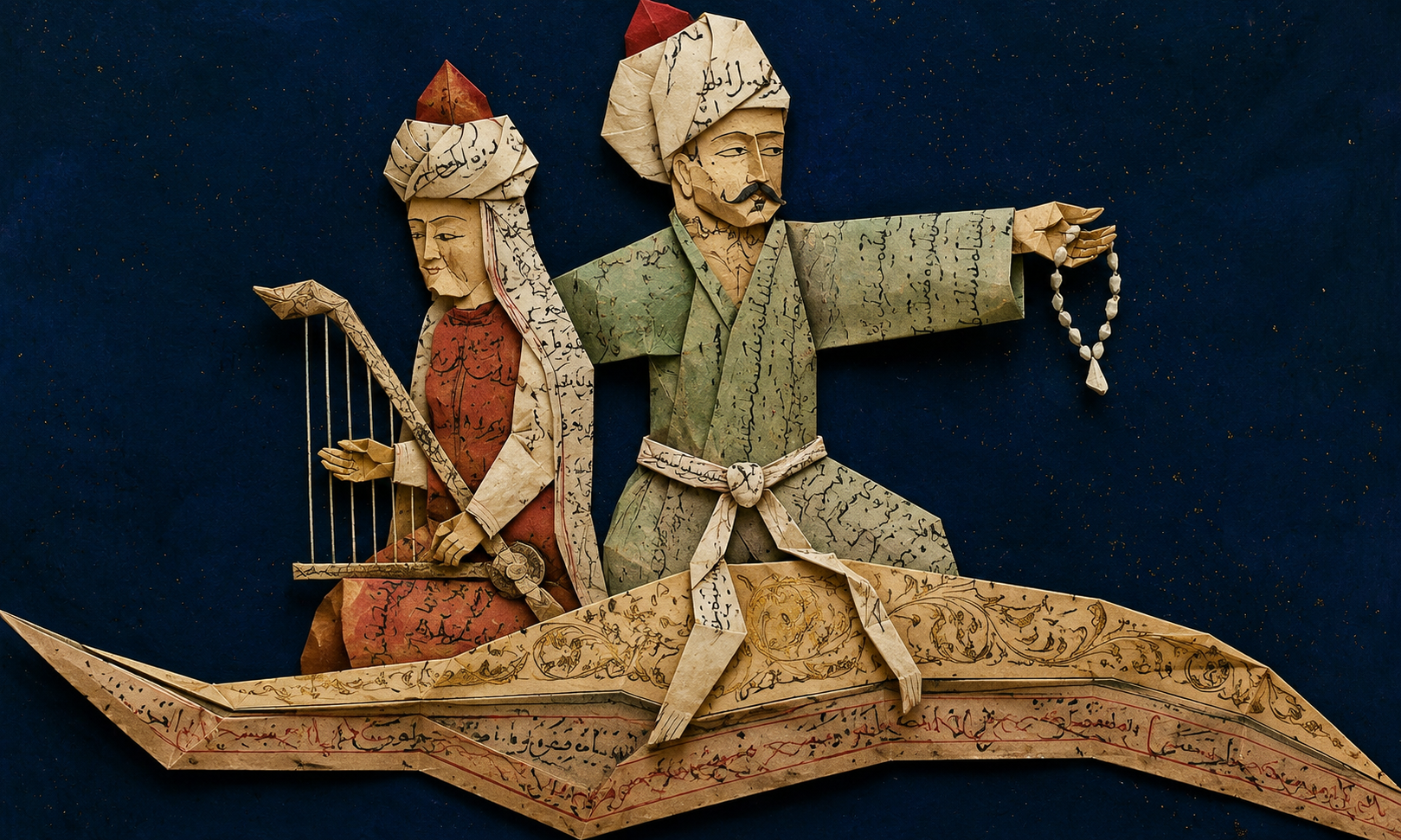
One thousand and one — an impossible number anyway: in the Nights it means more than can be counted. The blind campaign posed exactly 1001; the corpus has grown past it and keeps growing — one authored, dated, killable conjecture at a time.
Falsifiable conjectures about the pre-print world. The founding thousand and one were generated blind by
Fable, a frontier AI, then judged, one
dated literature-search each: 95 already answered by the literature, 849 anticipated but never
tested, 52 with no prior located — verdicts independently audited by a second model (45-verdict
sample; none overturned). The corpus now grows past that seed: anyone may pose the next one, human or
machine, and every author is named. Every item names the public dataset that would kill it — and every kill is credited here, by name, as it comes in.
Joins measurement theory — the idea that the error bar is itself a signal — to third-century political history. A papyrus can be dated only as precisely as its own dating apparatus allows: regnal formulas, titulature, and bureaucratic boilerplate are what let…
Greenland's ice sheet and Roman monetary history are usually studied by different disciplines, yet the first quietly records the second: lead deposition in Greenland ice cores derives largely from the atmospheric fallout of Roman smelting, and because silver was refined from lead-rich…
The Wadi al-Jarf papyri preserve the logbook of Merer, a boat-crew overseer under Khufu, recording day by day his gang's deliveries of Tura limestone to the Giza works — effectively a shipping ledger for the Great Pyramid. Independent arrivals at a facility,…
Joins autocatalytic reaction kinetics to the sociolinguistics of conquest: in Egypt's dated documentary papyri, the replacement of Greek and Coptic by Arabic behaved like a chemical substitution running with a nearly universal rate constant. The mechanism is autocatalytic — every office and…
Joins atmospheric physics to colonial sociolinguistics: just as pressure thins exponentially with altitude at a fixed scale height, Greek thinned with river distance up the Nile from Alexandria at a fixed exponential scale length. The mechanism is demand decay: Greek was the…
Joins the economics of crime — Gary Becker's principle that offenses rise when their returns rise and legitimate wages fall — to the Deir el-Medina archives of the royal tomb-builders. The workmen were paid in grain, and the ostraca record their ration…
Milton Friedman's plucking model of business cycles holds that an economy runs along a capacity ceiling from which recessions pluck output downward: deep slumps rebound fast, while booms say nothing about the next bust. This conjecture transposes that asymmetry onto documentary papyrology's…
In financial crises, liquidity flees risky assets and concentrates into a handful of safe ones — the flight to quality. This conjecture maps that dynamic onto papyrological geography: when aggregate documentary output contracts, surviving documentation should concentrate into fewer, safer places, because…
Taylor's law — fluctuation scaling from statistical physics and ecology — says that across populations, variance grows as a power of the mean: exponent 1 for independent Poisson noise, 2 for perfectly synchronized fluctuation. This conjecture applies it to the geography of…
Price-ceiling economics predicts that goods capped below market price withdraw from legal, recorded exchange, while goods capped at or above market trade on visibly. This conjecture reads Diocletian's Price Edict of 301 CE through that lens: the Edict's famous failure should be…
Absenteeism econometrics has two robust modern findings: absence hazard spikes on workdays adjacent to rest days, as workers manufacture long weekends, and total absence is dominated by a small cadre of chronic absentees. This conjecture claims the pharaoh's own tomb-builders behaved identically…
Joins the diffusion of literary-epistolary fashion to settlement hierarchy in Greco-Roman and late antique Egypt: the private letter is the one literary micro-genre with tens of thousands of dated, placed witnesses, and its opening and closing formulas (the chairein prescript, the erroso…
Coptic literacy was built by theology before administration touched it. The script community was created by scripture-reading and monastic institutions, and only once that community existed did Coptic seep into contracts, letters, and receipts — so documentary Coptic should lag literary and…
This connects selective diacritical pointing in early Arabic documents with the sociology of correspondence. Pointing cost time and scribes applied it selectively; the question is what governed the selection. The conjecture: pointing density tracks social distance between writer and recipient. Between intimates,…
Byzantine saints' lives love to embed documents — petitions, imperial rescripts, letters — and critics treat these as free invention. This conjecture claims the hagiographers were forgers of the careful kind: the documents embedded in lives set in late antiquity reproduce the…
The nomina sacra — the contracted sacred names like a barred theta-sigma for 'God' — are the most distinctive habit of Christian book hands; ordinary papyrus letters and contracts are the humblest layer of ancient writing. The conjecture is that in everyday…
Excavations in western Thebes recovered thousands of ostraca — potsherd letters — from 6th-8th century Coptic monks, including the archive of the monk Frange, who ceaselessly borrowed, lent, copied, and bound books from his hermit's cell in a pharaonic tomb. The claim:…
A huge share of surviving Sahidic Coptic literature comes from a single library, Shenoute's White Monastery near Sohag. The lazy reading is preservation bias: one lucky building. The claim instead: the White Monastery was a publisher of record whose selection caused survival…
The village of Touton in the Fayyum ran a celebrated 9th-10th century Coptic scriptorium whose colophons name scribes, patrons, and — crucially — the patrons' home villages and the destination churches of the books. The claim: Touton was a commercial long-distance producer,…
Coptic everyday writing on potsherds flourished around western Thebes until the mid-8th century, then stopped. The claim: documentary literacy died with its landlord, not with its language — ostraca production at each site terminates within a generation of the archaeological abandonment of…
The Egyptian monastic settlements of Kellia and Bawit preserve hundreds of painted and scratched wall texts (dipinti) in monks' cells — psalm verses, lines from the desert fathers, invocations of saints and authors. The claim: the walls sample what monks actually read,…
Around the 11th century Coptic literature switched literary dialect, Bohairic — the dialect of the delta and the Wadi Natrun monasteries — replacing Sahidic, the classical literary standard. The claim: this dialect shift inverted the usual conservatism rule — it was led…
Nearly everything quantitative about ordinary pre-print writing comes from three preservation flukes — the dry rubbish mounds of Oxyrhynchus, the waterlogged fort at Vindolanda, and the anaerobic clay under Novgorod's streets. These are different climates, centuries, empires, and languages, so if everyday…
A rubbish mound is not a random sample of a town's writing; it is a sample of what the town decided was finished. Roman-Egyptian documents had legal lifetimes — a loan receipt mattered until repayment plus a dispute window, a lease until…
Ptolemaic papyri largely survive because dead documents were recycled into mummy casings — which means the Ptolemaic documentary record was filtered through the funerary industry's paper procurement, not through history. Cartonnage workshops bought discarded office paper in bulk lots decades after writing,…
The choice between a potsherd and a papyrus sheet is usually told as a story about poverty, but it is better modeled as freight economics: papyrus was manufactured in the Nile valley and Delta, and its effective price rose with every desert…
Egyptian contracts routinely end with a hypographeus — a man who signs on behalf of a party who does not know letters. If signing-for-others was casual neighborly help, signers should be scattered across the population; if it was a semi-professional brokerage, a…
The stock notarial phrase 'because he does not know letters' is the single most-quoted statistic-generator in ancient literacy studies, yet it records an office workflow, not a diagnosis. A party in a hurry, a man whose hand was slow, or a woman…
Between the fluent and the letterless, the papyri record men who subscribe 'writing slowly' (bradeos graphon) — a competence just sufficient for a name and a formula. Slow writing was costly to display, so it should be spent where an autograph carried…
Many papyrus letters are baffling stubs — 'send the cloak; I wrote to you before' — unless the sheet was only the durable half of a delivery whose real payload was the carrier's mouth. Where a trusted, named carrier went, detail could…
When a household reused an obsolete document's back for a new text, it timestamped its own wastepaper basket: the interval between a dated recto and a dated verso measures how long ordinary people kept dead paper before recycling it. This retention time…
A petition was drafted at home, submitted to an office, and often returned or retained in copies, so identical petition texts can survive at both ends of the administrative pipeline. Which end survives is a preservation question with teeth: village house contexts…
Documentary papyri carry day-and-month dates, so the entire dated corpus is a calendar of when ordinary writing happened — and different genres should obey different clocks. Contracts and receipts should spike with the agrarian-fiscal cycle of harvest, tax deadlines, and sowing leases,…
Phonetic misspellings — iotacisms, dropped finals — are the audible fingerprints of ordinary Greek, and the Duke Databank encodes tens of thousands of them as editorial regularizations. A private letter preserves its writer's noise; a petition by the same person was usually…
A potsherd is a fixed, curved, often small writing surface, and that geometry should discipline the text written on it: line lengths truncated at sherd width, and — the sharper effect — abbreviation and symbol rates rising to squeeze standard formulas into…
The village notary office of Tebtunis left day-by-day registers of every document it drew up — the closest thing antiquity offers to a notarial cash register. Demand for documents should breathe with the agrarian year: leases before sowing, loans in the hungry…
A Theban taxpayer paid the same capitation taxes year after year, and each payment generated an ostracon receipt naming him — so a payer who appears once should often appear twice, and the multiplicity distribution of names across receipt series is a…
Tax receipts were signed by their issuing clerks, and long dated series from single Theban banks and granaries make those signatures a personnel register nobody kept on purpose. Clerk tenures, turnover, and succession can be read as first-attestation-to-last-attestation spans, giving measured career…
The outside of a folded papyrus letter carried its routing: sometimes a bare name, sometimes a full delivery instruction naming the town, the quarter, and the house. Routing verbosity should be a function of the delivery channel — a letter handed to…
Women appear as senders in a solid minority of papyrus letters, and those letters have geography. If women's correspondence was primarily kin-maintenance across household splits — daughters writing to mothers, wives to traveling husbands — their letters should span shorter distances and…
A rubbish dump preserves the letters a household received and threw away; a collapsed or abandoned house preserves the whole desk — incoming mail, retained drafts, and file copies of outgoing text. The Kellis houses in the Dakhla oasis exemplify the house…
The map of documented connectivity in Ptolemaic and Roman Egypt is dominated by a few giant private archives — Zenon's roughly two thousand texts alone can make third-century BCE Philadelphia look like the hub of the eastern Mediterranean. If the apparent place-network…
The genre profile of 'the papyri' is quoted as if it described ancient writing, but it is a mixture of at least three sampling machines: town dumps, village house collapses, and mummy cartonnage. Each machine selects differently — dumps favor high-turnover ephemera,…
The standard chronology of Egypt's documentary language shift — Demotic yielding to Greek across the Ptolemaic and early Roman periods — is built from a corpus in which Demotic disproportionately survives via temple-linked contexts and priestly families, while Greek rode the dump-and-cartonnage…
On Egypt's Eastern Desert ostraca, soldiers and contractors wrote in both Greek and Latin, and the conventional guess ties language choice to the writer's origin. The institutional alternative is starker: Latin was the army's paperwork register, so its share should track the…
The desert fort of Krokodilo filed daily report ostraca — a dated administrative pulse that should tick every day the system worked. The gaps in the recovered day-sequence are therefore diagnostic: if losses are pure preservation noise, missing days should scatter like…
At Mons Claudianus, water was rationed by written chits — small ostraca tying named individuals to daily allowances in a desert quarry where every drop was accounted. A rationing system generates paperwork proportional to headcount, so the chit corpus is a demographic…
Abecedaria — bare alphabets written out in order — are filed as school exercises, but their find-contexts tell a stranger story: alphabets turn up cut on tomb walls, scratched at sanctuaries, and deposited in foundations, places where no pupil practiced. If the…
The little wooden tags tied to mummies — often the only written object a poor family ever commissioned — did logistics before they did piety: they routed a body from the place of death to a distant family necropolis through professional carriers.…
The documentary horoscopes preserved on Greek papyri were computed from astronomical tables, and we can now recompute which ones. The surprising connection is that provincial practitioners used systematically OBSOLETE tables — one to two parameter-generations behind the best contemporary theory — with…