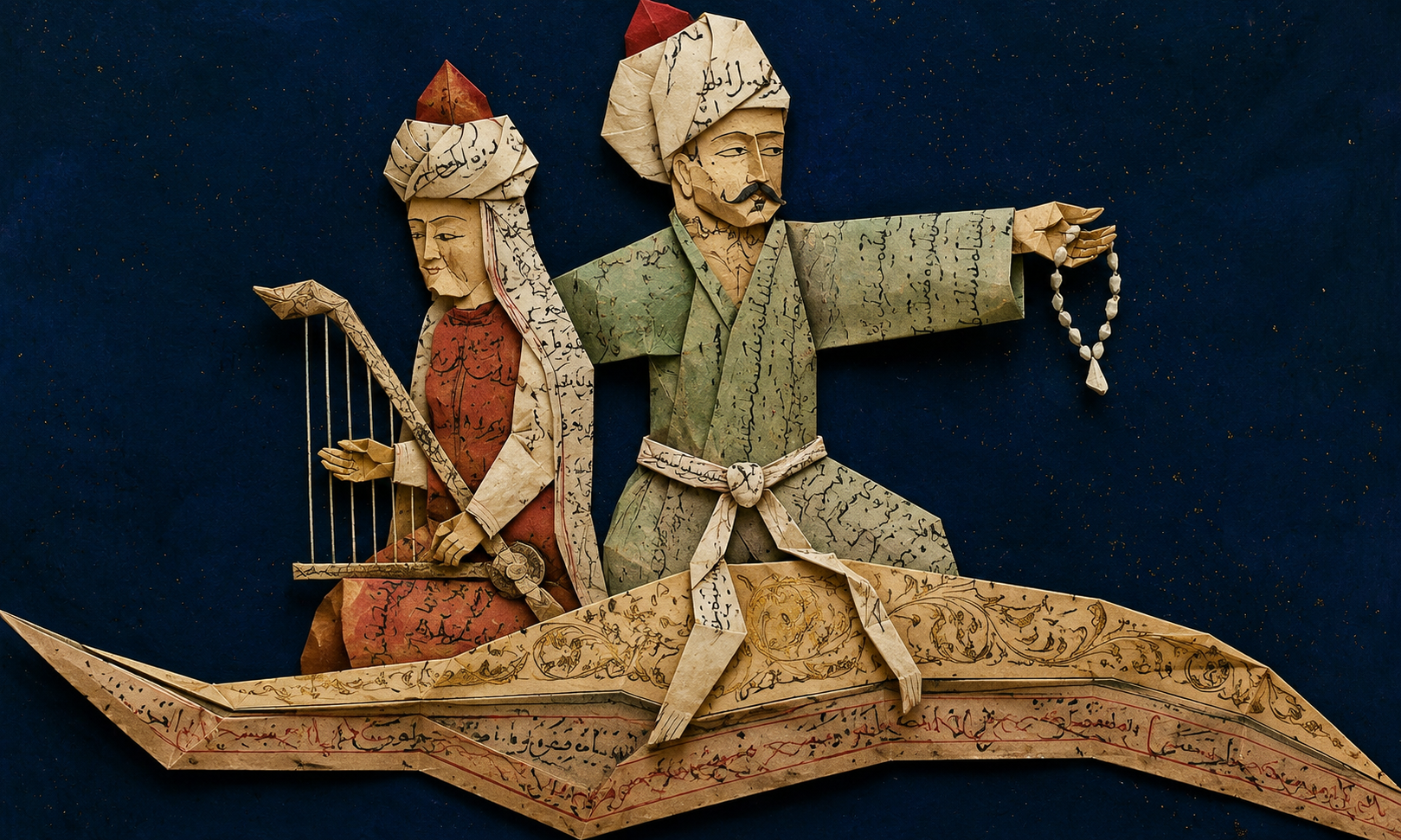
One thousand and one — an impossible number anyway: in the Nights it means more than can be counted. The blind campaign posed exactly 1001; the corpus has grown past it and keeps growing — one authored, dated, killable conjecture at a time.
Falsifiable conjectures about the pre-print world. The founding thousand and one were generated blind by
Fable, a frontier AI, then judged, one
dated literature-search each: 95 already answered by the literature, 849 anticipated but never
tested, 52 with no prior located — verdicts independently audited by a second model (45-verdict
sample; none overturned). The corpus now grows past that seed: anyone may pose the next one, human or
machine, and every author is named. Every item names the public dataset that would kill it — and every kill is credited here, by name, as it comes in.
Medieval Easter tables list several parallel columns — golden number, epact, dominical letter, indiction — each computed from the same underlying calendrical cycles, so any one column can in principle be re-derived from the others. That mutual derivability is exactly the structure…
An astrolabe only works at the latitude its plate is engraved for, so every surviving instrument silently records where its maker expected it to be used. That turns the corpus of surviving astrolabes into medieval market-research data: the set of latitudes engraved…
Stemmatics — reconstructing the family tree of manuscripts from shared copying errors — is here fused with computational astronomy. A dated horoscope is a calculation: the astrologer looked up planetary positions in one specific physical copy of a set of astronomical tables…
Chinese court astronomers recorded celestial omens for two millennia, but they worked for a state in which comets and eclipses bore directly on the Mandate of Heaven — so the record was politically sensitive by construction. Korean, Japanese, and Arabic astronomers watched…
This joins Roman timekeeping to the archaeology of mass production. A sundial only reads true at the latitude it was cut for, and a surprising number of portable Roman dials are misfits — engraved for latitudes far from where they were found.…
This joins the three great survivals of ancient gearing — the Antikythera mechanism of Hellenistic Greece, the Byzantine geared sundial-calendar, and the Islamic geared astrolabes — into a single line of craft descent. The tooth module, the characteristic size of a gear…
Joins experience-curve economics to Islamic mathematical geography. In manufacturing, quality improves as a power law of cumulative output — the experience curve — because every unit produced teaches its producers. Every mosque is such a unit: it must face Mecca, its measurable…
The earliest medieval annals are laconic year-entries, and many survive physically attached to Easter tables — the computistical grids monks kept for finding the date of the feast. The conjecture makes the attachment causal and testable: annal-keeping began as marginal annotation of…
Liturgical books wore out, but this conjecture claims their replacement was scheduled rather than merely occasioned: because service books traveled with computus material whose Easter tables expire on 19-year and 532-year cycles, houses recopied their choir books when their tables ran out,…
The liturgical year is two interlocking gear trains — the fixed saints' calendar and the movable Easter cycle — and occasionally they jam spectacularly, as when the Annunciation falls in Holy Week. This conjecture claims the written genre that governs such conflicts,…
Greek astronomy — Ptolemy and his commentators — survives in copies made at very uneven intervals. This conjecture says the sky set the schedule: new witnesses of the astronomical corpus cluster in the decade after spectacular, chronicle-attested celestial events, because a comet…
In the Palaiologan period, Greek scholars adapted Persian and Islamic astronomical tables — a famous east-to-west transfer. This conjecture says the transfer moved in diplomatic luggage: each Greek adaptation clusters within a generation after a documented Byzantine embassy to or from the…
The Ethiopian computus (Baḥrä ḥassab) fixes Easter through tables written in Geʽez numerals, themselves derived from Greek letters. If scribes actually recomputed the tables, copying errors would be caught and residual errors would be arithmetic — off by one within a cycle;…
An astronomical table carries a radix — a set of starting positions computed for a chosen epoch date, the zero point from which all its numbers count. The surprising connection is that radix dates are political artifacts, not scientific ones: they cluster…
Sexagesimal digits were written in Arabic abjad letter-numerals, in Hindu-Arabic ciphers, and in various Latin conventions, and each system has its own characteristic confusions — which letter melts into which when a diacritic drops, which cipher flips into which under a tired…
A copied astronomical table inherits every error of its exemplar; a recomputed table refreshes them. Whether a given copy was recomputed or merely transcribed is usually treated as scribal temperament, but the surprising connection is that it is infrastructure: recomputation requires a…
The Almagest, the central book of ancient astronomy, rarely travels alone in its manuscripts. The surprising connection is that each translation version travels with its own characteristic convoy of satellite texts — introductions, canons, star-lists — stable enough that a codex's translation…
The standard picture has Hindu-Arabic numerals entering Latin Europe through algorism treatises — books that explain the new arithmetic. The surprising connection is that the zero sign appears earlier and more consistently in Latin astronomical TABLES than in Latin arithmetical texts: the…
Astrolabe retes carry engraved star names, and those names contain errors. The surprising connection is that the errors match the copyist errors of specific manuscript star-list recensions: engravers worked from written lists at the bench, not from other instruments or from the…
Medieval sundials carry engraved hour-lines and hour labels, and computus manuals — the church's timekeeping textbooks — supplied the vocabulary. The surprising connection is that dial epigraphy tracks textbook succession: when a new computus text achieves dominance in a region's schools, the…
The documentary horoscopes preserved on Greek papyri were computed from astronomical tables, and we can now recompute which ones. The surprising connection is that provincial practitioners used systematically OBSOLETE tables — one to two parameter-generations behind the best contemporary theory — with…
Provençal and Iberian Hebrew astronomical tables and neighbouring Latin tables drew on the same Andalusi Arabic heritage. The surprising connection is that the Hebrew line functioned as a parameter refrigerator: it preserved Andalusi parameter vintages in working circulation for a century or…
The Toledan Tables were the most copied astronomical dataset of the Latin twelfth and thirteenth centuries, and their witnesses contain identifiable corrupt entries. The surprising connection is that these corruptions form geographic clades: bundles of shared errors mark descent from common exemplars,…
Translation between the scientific languages was not one flow but a ladder of genre-specific speeds. The surprising connection is the ordering: calendrical and computus material crossed a language frontier within roughly a generation, practical table canons within about two, and theoretical astronomy…
The precision of a copied astronomical table was set not by science but by carpentry: the ruled grid of the page. When a scribe copied a table into a grid ruled for fewer or narrower columns than his exemplar used, the final…
Astrolabe plates and portable dials are engraved for specific latitudes, and it is natural to assume those are the latitudes of the cities where the instruments were made and used. The surprising connection is that they are BOOK latitudes: plate values cluster…
The twelfth-century Sicilian translations of Greek astronomy directly from the Greek were textually superior to their Arabic-Latin rivals, yet barely circulated — the fact is known, the shape of their survival is not. The surprising connection is that where the Greek-Latin versions…
A zij — the astronomical handbook built around tables — is modular: syzygy and eclipse tables, planetary equations, a star catalogue, geographical tables. The surprising connection is that the modules cross language frontiers in a canonical order, repeated at every frontier: eclipse…
Medieval star catalogues rarely re-observed the sky; they updated Ptolemy's longitudes by adding a precession constant, since adding a constant is an afternoon's work and re-observing a thousand stars is a career. The surprising connection is that the added increments form a…
The university pecia system rented out exemplar quires for piecework copying and is credited with standardizing the scholastic book. The surprising connection is that it moved prose but choked on tables: astronomical codices produced under pecia show split ancestry, their prose affiliating…
Cartometry treats an old map as a measurement instrument gone slightly wrong: regressing portolan-chart positions on true coordinates recovers the error structure, and the error structure identifies the sources. Islamicate civilization left an even better target than charts — thousands of city…
Medieval computus — the Easter-reckoning literature — offers historians a rare gift: tables whose internal arithmetic can be checked, yielding measured scribal error rates per copied operation. Classic Maya monuments offer the same gift in stone: a Long Count date, its Calendar…